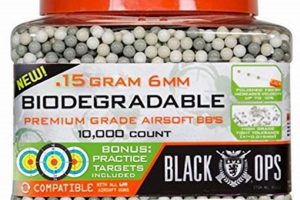
This refers to a replica firearm designed to closely resemble the Smith & Wesson M&P 2.0 pistol, but which fires non-lethal, typically 6mm plastic BBs. These replicas are used in the sport of airsoft, a recreational activity where participants eliminate opponents by hitting them with the aforementioned projectiles.
The significance of this model stems from its realistic feel and appearance, enhancing the immersive experience for airsoft participants. It allows players to simulate real-world scenarios with a training tool that mimics the weight, handling, and aesthetics of a genuine firearm. Its popularity can be attributed to the real steel firearm that has become an essential tool for many law enforcement agencies.
The following content will explore various aspects of this type of airsoft replica, including available models, performance characteristics, maintenance considerations, and considerations for responsible use.
Airsoft M&P 2.0
Adhering to proper usage and maintenance protocols is crucial for optimal performance and longevity of any airsoft replica. These recommendations provide specific guidance for the “airsoft m&p 2.0” to ensure consistent operation and minimize potential issues.
Tip 1: Magazine Maintenance: Regularly inspect magazines for debris accumulation. Disassemble and clean internal components as needed, using silicone oil sparingly to lubricate follower mechanisms. Ensure proper spring tension for reliable BB feeding.
Tip 2: Hop-Up Adjustment: Adjust the hop-up unit incrementally to achieve optimal BB trajectory. Over-adjustment can cause jamming or erratic flight patterns. Experiment with different settings based on BB weight and range requirements.
Tip 3: Gas System Care: For gas blowback (GBB) models, use appropriate gas types recommended by the manufacturer. Avoid overfilling magazines, as this can damage internal seals and valves. Regularly lubricate the gas valve with silicone oil.
Tip 4: Cleaning the Barrel: Clean the inner barrel regularly using a cleaning rod and appropriate cleaning patches. Remove any residue or debris that may accumulate, affecting BB accuracy and consistency.
Tip 5: Storage Considerations: Store this airsoft pistol in a cool, dry place, away from direct sunlight and extreme temperatures. Depressurize gas magazines before long-term storage to prevent seal degradation.
Tip 6: Seal Inspection: Periodically inspect all seals for cracks, wear, or damage. Replace worn or damaged seals promptly to maintain proper gas pressure and prevent leaks. Common areas of concern include magazine seals and nozzle O-rings.
Tip 7: Trigger Mechanism: Avoid rapid or excessive dry-firing, as this can accelerate wear on the trigger mechanism. If experiencing trigger malfunctions, consult a qualified airsoft technician for repair or replacement of worn parts.
Following these recommendations will help ensure the reliable and consistent performance of your airsoft pistol, extending its lifespan and providing an enhanced airsoft experience.
The subsequent sections will delve into potential upgrades, troubleshooting common issues, and best practices for safe handling and responsible ownership.
1. Realism and Aesthetics

The degree to which an airsoft replica mirrors the appearance and tactile qualities of its real-world counterpart directly influences its perceived value and suitability for specific applications. In the context of the airsoft M&P 2.0, a high level of realism enhances its appeal for training simulations, historical reenactments, and players who prioritize an immersive experience. This realism extends beyond mere visual similarity to encompass factors such as weight distribution, grip texture, and the functionality of operational controls, such as the slide, magazine release, and trigger.
Manufacturers employ various techniques to achieve a high degree of realism. These include utilizing detailed molds, employing authentic markings and logos, and replicating the construction materials and finishes of the real firearm. For instance, using polymers and metals with similar properties to those used in the genuine M&P 2.0 contributes to a more convincing and realistic feel. The inclusion of features like a functional slide stop and realistic takedown procedure further enhances the simulation experience. The closer an airsoft pistol gets to the look and function of the real firearm, the higher its quality and value can be attributed.
The pursuit of realism in the airsoft M&P 2.0 is not merely an aesthetic concern. It impacts the training value of the replica, as it allows users to practice weapon handling, manipulation, and target acquisition in a manner that closely simulates real-world scenarios. This level of detail is particularly relevant for law enforcement and military personnel who utilize airsoft for force-on-force training exercises. While challenges exist in replicating every aspect of a real firearm while maintaining safe operation and regulatory compliance, the ongoing pursuit of realism remains a central driving force in the design and development of these airsoft replicas.
2. Gas Efficiency (GBB)
Gas efficiency, particularly in Gas Blowback (GBB) models, directly impacts the operational cost and practical usability of the airsoft M&P 2.0. GBB replicas utilize compressed gas, typically propane or CO2, to propel BBs and cycle the slide, simulating recoil. Lower gas efficiency translates to fewer shots per gas fill, requiring more frequent refills and increasing expenditure on gas. This becomes especially relevant during extended airsoft games or training sessions.
The efficiency of the gas system is influenced by various factors, including the design of the magazine, the tightness of internal seals, and the ambient temperature. Magazines with larger gas reservoirs generally offer more shots per fill. Properly maintained seals minimize gas leakage, ensuring that more energy is directed towards propelling the BB. Lower temperatures can reduce gas pressure, negatively affecting performance and gas efficiency. For example, a magazine achieving 30-40 shots per fill under ideal conditions might only yield 20-30 shots in colder weather. Therefore, the airsoft M&P 2.0 that utilizes a design that prioritizes gas system tightness will have more satisfying game experience.
Understanding gas efficiency is paramount for selecting and maintaining GBB airsoft replicas. Players should consider models known for their efficient gas consumption and implement regular maintenance practices, such as lubricating seals and using appropriate gas types, to optimize performance. In conclusion, gas efficiency is a crucial factor influencing the practical and economic viability of the GBB airsoft M&P 2.0, impacting overall user satisfaction and long-term operational costs.
3. Accuracy Potential

The “airsoft m&p 2.0’s” value is significantly tied to its accuracy potential, defined as the degree to which it can consistently and precisely place projectiles on a target. This characteristic influences its suitability for various applications, including target practice, competitive airsoft games, and training exercises. Factors that contribute to the accuracy potential include the quality of the inner barrel, the design and adjustability of the hop-up unit, the consistency of the gas system (in GBB models), and the overall build quality. A well-designed hop-up unit, for example, imparts backspin on the BB, extending its range and improving its trajectory. Inconsistent gas pressure can cause shot-to-shot variations, negatively impacting accuracy. Thus, a high-quality “airsoft m&p 2.0” should exhibit minimal variation between shots, allowing for predictable and repeatable results.
Several real-world examples illustrate the importance of accuracy potential. In competitive airsoft, a more accurate replica provides a distinct advantage, enabling players to engage opponents from greater distances and with greater precision. Law enforcement and military personnel may utilize these replicas for force-on-force training, where accuracy is paramount for simulating realistic engagement scenarios. However, realizing the accuracy potential requires careful attention to maintenance and adjustment. Regular cleaning of the inner barrel, precise hop-up adjustment, and the use of high-quality BBs are essential for optimal performance. Some users may also opt for aftermarket upgrades, such as precision inner barrels or improved hop-up units, to further enhance accuracy.
In summary, the “airsoft m&p 2.0’s” accuracy potential is a critical determinant of its overall value and utility. While inherent design and manufacturing quality set the baseline, achieving and maintaining optimal accuracy requires ongoing maintenance, careful adjustment, and the use of appropriate accessories. Understanding these factors allows users to maximize the performance of their replica and ensures a more satisfying and effective airsoft experience. Challenges to realizing the full accuracy potential can include manufacturing defects, wear and tear on internal components, and improper maintenance. However, with proper care and attention, the “airsoft m&p 2.0” can deliver a high level of accuracy, making it a valuable tool for both recreational and training purposes.
4. Durability Assessment

The assessment of durability is paramount in evaluating the long-term value and suitability of an “airsoft m&p 2.0.” This assessment encompasses the materials used in construction, the design of critical components, and the replica’s ability to withstand the stresses of regular use. A durable “airsoft m&p 2.0” will resist wear and tear, maintain its functionality under field conditions, and require fewer repairs or replacements over its lifespan. The materials that constitute the “airsoft m&p 2.0” are of extreme importance. For example, if a weaker polymer is used it can crack easily during rigorous play.
Considerations within a durability assessment include the type of plastic or metal used for the frame and slide, the quality of internal gears and springs, and the resistance of seals to gas leakage. For instance, an “airsoft m&p 2.0” with a metal slide and reinforced internals is likely to withstand more use than a model with a plastic slide and standard components. Similarly, the design of the hop-up unit and magazine can affect durability. A poorly designed hop-up may be prone to breakage, while a leaky magazine will require frequent seal replacements. Ultimately, these individual elements influence the overall performance and longevity, directly impacting their value and appeal to end-users.
In conclusion, durability assessment is not merely a theoretical exercise but a practical necessity for both consumers and manufacturers. It informs purchasing decisions, guides design improvements, and ensures that the “airsoft m&p 2.0” meets the demands of its intended use. Prioritizing durability translates to cost savings over time, enhanced user satisfaction, and a more reliable product that can withstand the rigors of airsoft gameplay and training scenarios. A proper durability assessment is a determining factor in whether a particular “airsoft m&p 2.0” replica is worthwhile.
5. Aftermarket Support

Aftermarket support significantly influences the longevity, performance, and customization potential of the “airsoft m&p 2.0.” The availability of replacement parts, upgrade components, and technical expertise directly affects the replica’s lifespan and adaptability to individual user preferences. A robust aftermarket ecosystem ensures that damaged or worn parts can be readily replaced, preventing premature obsolescence. Furthermore, upgrade parts, such as precision inner barrels, enhanced hop-up units, and reinforced internal components, allow users to enhance the replica’s accuracy, range, and overall performance. The absence of adequate aftermarket support limits the potential lifespan and utility of the “airsoft m&p 2.0,” rendering it less attractive to serious airsoft players and collectors.
Consider, for example, a scenario where a user experiences a broken hop-up unit in their “airsoft m&p 2.0.” If replacement hop-up units are readily available from multiple vendors, the user can quickly and affordably restore the replica to full functionality. Conversely, if replacement parts are scarce or non-existent, the user may be forced to discard the replica altogether. Similarly, the availability of aftermarket upgrade parts enables users to tailor the “airsoft m&p 2.0” to their specific needs and playing style. A player seeking improved accuracy might install a precision inner barrel and enhanced hop-up unit, while a player prioritizing durability might opt for reinforced internal components. Without such options, the replica’s performance remains limited to its stock configuration.
In conclusion, aftermarket support is an integral component of the “airsoft m&p 2.0” ecosystem. It extends the replica’s lifespan, enhances its performance, and allows for personalized customization. The presence of a thriving aftermarket support network is a key indicator of a high-quality and desirable “airsoft m&p 2.0” model, while the absence of such support can significantly diminish its value and appeal. Challenges to aftermarket support can include limited production runs, discontinued models, and proprietary designs that restrict compatibility with third-party components. However, manufacturers and retailers who prioritize aftermarket support demonstrate a commitment to customer satisfaction and the long-term viability of their products.
Frequently Asked Questions
The following addresses common inquiries regarding the characteristics, operation, and maintenance of this airsoft replica. The intent is to provide clarity and informed guidance to potential and current users.
Question 1: What distinguishes this airsoft replica from other similar models?
The “airsoft m&p 2.0” is generally distinguished by its attempt to replicate the ergonomics, dimensions, and aesthetics of the real Smith & Wesson M&P 2.0 firearm. Specific models may vary in terms of internal components, gas system design (if applicable), and materials used.
Question 2: What type of gas is recommended for gas blowback (GBB) variants?
The manufacturer’s recommendations should always be followed. Generally, propane (with silicone oil additive) or CO2 are the common gas types. Using the incorrect gas can damage internal components or reduce performance.
Question 3: How often should the inner barrel be cleaned?
Cleaning frequency depends on usage. After each game day or prolonged use, cleaning the inner barrel with a cleaning rod and appropriate patches is advisable to remove accumulated debris and maintain accuracy.
Question 4: What are the common causes of magazine leaks in GBB models?
Magazine leaks typically result from damaged or worn O-rings and seals. Overfilling magazines or using improper gas can accelerate seal degradation. Regular maintenance, including silicone oil lubrication, can help prevent leaks.
Question 5: What is the typical effective range of this airsoft replica?
Effective range depends on factors such as hop-up adjustment, BB weight, and wind conditions. Generally, an effective range of 75-125 feet can be expected with proper tuning.
Question 6: Are there any specific safety precautions to observe when handling this airsoft replica?
Eye protection is mandatory for all individuals in the vicinity of airsoft activities. The “airsoft m&p 2.0” should always be treated as if it were a real firearm. Never point it at anything that is not intended to be shot, and always keep the finger off the trigger until ready to fire.
These answers provide a foundational understanding of critical aspects related to this airsoft replica. Proper adherence to safety guidelines and maintenance protocols will ensure a safe and enjoyable airsoft experience.
The next article will delve into the subject of performance enhancing modifications and upgrades for the “airsoft m&p 2.0”
Concluding Remarks
The preceding analysis has explored various facets of the “airsoft m&p 2.0,” encompassing its realism, operational efficiency, accuracy potential, durability considerations, and the importance of aftermarket support. Understanding these elements is crucial for making informed purchasing decisions and ensuring responsible ownership of this airsoft replica. The meticulous replication of the real firearm, coupled with considerations for gas efficiency and accuracy, makes it a viable option for both recreational and training purposes.
Continued advancements in materials science and manufacturing techniques are expected to further enhance the performance and durability of future iterations of this airsoft replica. Responsible usage, adherence to safety guidelines, and proactive maintenance remain paramount for maximizing the lifespan and utility of any airsoft firearm. Further research into the optimization of gas systems and hop-up mechanisms may lead to even greater accuracy and efficiency in subsequent models, solidifying the role of the “airsoft m&p 2.0” within the broader airsoft community.