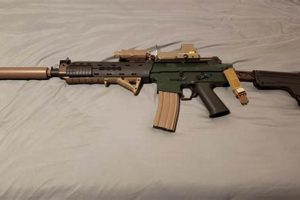
The activity encompasses simulated combat scenarios conducted in open-air environments. These settings typically involve natural terrain such as woodlands, fields, or constructed environments designed to mimic real-world locations. Participants utilize realistic replica firearms that discharge non-lethal plastic projectiles. This simulates military or law enforcement operations for recreational or training purposes.
Its appeal lies in providing a physically and mentally engaging experience that promotes teamwork, strategic thinking, and physical fitness. Participants develop skills in communication, leadership, and problem-solving while adhering to strict safety protocols. Historically, the hobby has evolved from informal backyard games to organized events with complex objectives and realistic simulations, fostering a vibrant community.
This article delves into the gear, strategies, and safety measures essential for engaging effectively. Further exploration examines the variations in game types, optimal field selection criteria, and the evolving trends within the simulated combat sport.
Effective participation demands preparation, strategic thinking, and adherence to safety guidelines. The following outlines essential considerations for success.
Tip 1: Terrain Assessment. Prior to engagement, thoroughly assess the environment. Identify potential cover, flanking routes, and chokepoints. This knowledge provides a tactical advantage.
Tip 2: Appropriate Camouflage. Selecting camouflage patterns suitable for the operational environment is crucial. Consider foliage density, seasonal variations, and prevailing weather conditions to maximize concealment.
Tip 3: Hydration and Nutrition. Extended engagements necessitate maintaining adequate hydration and energy levels. Carry sufficient water and energy-rich snacks to prevent fatigue and maintain optimal performance.
Tip 4: Communication Protocol. Establish clear communication protocols with team members. Utilize concise terminology, pre-arranged signals, and designated communication channels to ensure effective coordination.
Tip 5: Adherence to Safety Regulations. Strict adherence to established safety regulations is paramount. Eye protection, face protection, and adherence to velocity limits are non-negotiable aspects of safe participation.
Tip 6: Gear Maintenance. Regularly inspect and maintain equipment. Ensure proper functioning of replica firearms, communication devices, and protective gear to minimize malfunctions during gameplay.
Tip 7: Physical Conditioning. Stamina and agility are advantageous. Incorporate cardiovascular exercises and strength training into regular routines to enhance endurance and maneuverability on the field.
Mastering these elements improves survivability, enhances tactical effectiveness, and contributes to a positive overall experience.
The subsequent sections will address advanced tactical maneuvers and strategies for dominating the field.
1. Tactical Terrain

Tactical terrain forms the foundational landscape upon which simulated combat operations are conducted, directly influencing strategies, movement, and engagement tactics within the context of outdoor airsoft. The characteristics of the environment fundamentally dictate the flow of gameplay and necessitate adaptive approaches.
- Cover and Concealment
Variations in elevation, vegetation, and man-made structures provide essential elements of cover and concealment. Bunkers, trees, and trenches offer physical protection from projectiles, while undergrowth and shadows facilitate undetected movement. The effectiveness of cover and concealment directly impacts a participant’s survivability and ability to engage opponents effectively. For example, a team utilizing a dense wooded area can establish ambushes and flanking maneuvers while remaining largely unseen, forcing the opposing team to proceed cautiously and risk exposure.
- Lines of Sight and Fields of Fire
Terrain dictates lines of sight, influencing engagement ranges and opportunities for observation. Elevated positions offer extended fields of fire, enabling snipers and designated marksmen to effectively control sectors of the battlefield. Conversely, low-lying areas restrict visibility, creating opportunities for close-quarters engagements and ambushes. A team controlling a hilltop, for instance, can observe enemy movements across a wide area and suppress advances, whereas an opposing team moving through a valley might rely on speed and maneuverability to avoid detection and engage at close range.
- Movement and Maneuverability
The nature of the terrain impacts the speed and ease of movement. Steep inclines, dense vegetation, and water obstacles hinder progress, requiring participants to adapt their tactics and utilize appropriate equipment. Open fields offer greater mobility but expose participants to enemy fire. Navigating complex terrain requires physical conditioning, tactical awareness, and effective teamwork. For example, a team attempting to traverse a river might need to utilize specialized equipment or create a diversion to draw enemy fire, while a team navigating a dense forest must maintain close formation and communicate effectively to avoid getting lost or ambushed.
- Strategic Objectives and Control Points
Terrain often dictates the placement of strategic objectives and control points. Naturally defensible positions, such as hills or fortified structures, become focal points for conflict. Control of these areas provides tactical advantages, such as enhanced observation, secure supply lines, or the ability to launch coordinated attacks. The struggle for control of key terrain features shapes the overall narrative and objectives of the engagement. A team holding a central building, for instance, might use it as a command post and staging area for attacks, while an opposing team might focus on cutting off access routes and isolating the defenders.
The interplay between these factors emphasizes that terrain is not merely a backdrop. It actively shapes the dynamics of simulated combat, demanding adaptability, strategic planning, and a deep understanding of the environment to achieve success in outdoor simulations.
2. Protective Gear

Engagement in simulated combat inherently carries the risk of injury from projectiles. Eye protection stands as the most critical element, as direct impact from a projectile to the eye can cause severe and irreversible damage. Full-seal goggles or a mask meeting ANSI Z87.1 standards provide a necessary barrier. Facial protection, often in the form of a lower face mask, mitigates the potential for dental and soft tissue injuries. Beyond facial regions, torso protection, such as vests or plate carriers, diminishes the impact force of projectiles. While these garments might not prevent all bruising, they significantly reduce the risk of serious injury, particularly in high-energy engagements. Hand protection, through the use of gloves, prevents abrasions and impacts, especially during maneuvers in rugged terrain. The choice of appropriate protective gear directly affects the safety and well-being of participants, enabling more confident and aggressive participation.
Consider a scenario where a player, without adequate facial protection, sustains a direct hit to the teeth from a projectile. The resulting dental damage would necessitate costly and potentially disfiguring restorative procedures. Conversely, a player equipped with a full-face mask could have avoided this injury entirely, continuing to participate in the simulated engagement without interruption. Similarly, imagine a player sliding across rough terrain during a tactical maneuver. Without gloves, the player risks significant abrasions to the hands, impeding the ability to grip equipment and potentially forcing withdrawal from the game. These examples underscore the practical importance of investing in appropriate protective equipment; furthermore, many organized events mandate specific protection, and failure to comply prohibits participation.
In summary, protective gear constitutes a non-negotiable element of responsible engagement in open-air simulations. Its purpose extends beyond mere compliance, as it directly safeguards the well-being of participants and enables more immersive and confident gameplay. The challenge lies in striking a balance between comprehensive protection and comfort, allowing for effective movement and communication on the field. Ignoring protective gear carries substantial risks, undermining the core principles of safety and responsible participation within the wider community.
3. Strategic Maneuvering

Strategic maneuvering constitutes a critical component of engagement within outdoor airsoft environments. The open and varied terrains characteristic of these settings necessitate tactical approaches beyond simple direct confrontation. Successful participation relies on calculated movements, planned positioning, and coordinated team actions to gain advantages and achieve objectives. Terrain exploitation forms a cornerstone of strategic maneuvering; teams that effectively utilize natural cover, elevation changes, and choke points gain a significant edge. For instance, a team might flank an entrenched opponent through a dense wooded area, disrupting their defensive line and forcing a retreat. The ability to anticipate enemy movements and counter their strategies requires constant observation, communication, and adaptability.
The importance of strategic maneuvering extends beyond individual engagements. Coordinated team movements designed to secure strategic locations, such as control points or high ground, can decisively shift the balance of power within a game. Consider a scenario where two teams are vying for control of a central building. One team might initiate a frontal assault to draw the defenders’ attention, while a smaller flanking element circles around to attack from the rear, creating a crossfire and overwhelming the opposition. This exemplifies how coordinated strategic maneuvering can overcome a seemingly superior defensive position. Furthermore, effective communication is integral to successful strategic maneuvering, as team members must relay information about enemy positions, coordinate movements, and adapt to changing battlefield conditions in real-time.
Ultimately, strategic maneuvering elevates engagement from a simple firefight to a complex and intellectually stimulating experience. Mastering the art of movement, positioning, and coordinated team tactics allows participants to achieve objectives, outmaneuver opponents, and experience the satisfaction of executing a well-planned strategy. The challenges associated with strategic maneuvering include maintaining situational awareness, adapting to unpredictable enemy actions, and coordinating effectively within a team, reinforcing the need for continuous learning and tactical refinement. The understanding of strategic maneuvering is essential for an enjoyable and victorious simulated combat experience.
4. Realistic Simulation

The pursuit of verisimilitude serves as a core tenet, influencing equipment, tactics, and overall engagement within the realm of simulated combat. The degree to which implements mimic authentic counterparts directly shapes the immersive quality and tactical depth of the activity.
- Replica Weaponry and Ballistics
Realistic simulation extends to the replication of firearms, magazines, and associated accessories, as well as the trajectory and impact of the projectiles they discharge. The weight, handling, and operation of replica weapons approximate that of real-world firearms, fostering a sense of authenticity and requiring participants to adopt realistic weapon handling techniques. For instance, a replica rifle may necessitate realistic reloading procedures, magazine changes, and sight adjustments, closely mirroring those employed with an actual firearm. The use of heavier projectiles or modified velocity settings can alter ballistic trajectories, requiring participants to account for range, windage, and bullet drop, further enhancing the realism of simulated engagements.
- Tactical Gear and Loadouts
Participants frequently utilize tactical gear and loadouts that mirror those used by military or law enforcement personnel. This may include plate carriers, tactical vests, helmets, communication devices, and other specialized equipment. The use of realistic gear influences movement, endurance, and carrying capacity, necessitating strategic load management and teamwork. For example, a player might carry multiple magazines, a medical kit, and communication equipment, requiring them to distribute weight effectively and prioritize essential items. The choice of specific gear can also reflect the intended role within a team, such as a grenadier carrying specialized grenade pouches or a medic carrying a comprehensive first aid kit.
- Scenario and Objective Replication
Realistic simulation often extends to the replication of military or law enforcement scenarios and objectives. Engagements may involve simulated reconnaissance missions, hostage rescues, building clearances, or convoy ambushes. The complexity and realism of these scenarios demand strategic planning, coordination, and adherence to established tactical procedures. For instance, a simulated building clearance might require participants to utilize breaching techniques, coordinate entry points, and communicate effectively while navigating a confined and potentially hostile environment. The incorporation of realistic objectives adds a layer of strategic depth, motivating participants to employ tactical thinking and teamwork to achieve success.
- Environmental Immersion
Environmental elements contribute significantly to the overall sense of realism. The selection of locations that mimic real-world environments, such as urban ruins, abandoned military bases, or dense forests, enhances immersion and necessitates adaptation to specific terrain challenges. The incorporation of environmental effects, such as smoke grenades, simulated explosives, or pyrotechnics, further intensifies the experience. Weather conditions, such as rain, wind, or fog, can also significantly impact gameplay, requiring participants to adjust their tactics and equipment accordingly. A simulated engagement in a dense forest during heavy rain, for instance, might necessitate the use of waterproof gear, enhanced communication protocols, and close-quarters tactics to compensate for reduced visibility and mobility.
These facets collectively contribute to the immersive quality. By striving for accuracy in equipment, tactics, and scenarios, the hobby offers a challenging and engaging experience that promotes teamwork, strategic thinking, and physical fitness. The degree of emphasis placed on realistic simulation varies, providing diverse levels of engagement ranging from casual skirmishes to highly structured and immersive reenactments.
5. Team Communication
Effective team communication constitutes a foundational pillar of successful participation in simulated combat scenarios. Open-air environments, often characterized by complex terrain and extended engagement distances, amplify the necessity for clear, concise, and timely information exchange. The dynamic nature of outdoor engagements necessitates a communication infrastructure capable of adapting to rapidly evolving tactical situations. The absence of effective communication mechanisms inevitably leads to disorganization, fratricide, and mission failure. As a demonstrable example, consider a scenario wherein a team attempts to secure a fortified position. If the lead element encounters unexpected resistance but fails to relay this information promptly, the trailing elements remain unaware of the elevated threat level, increasing their vulnerability to ambush or concentrated fire.
The practical application of effective team communication extends beyond the simple relay of enemy positions. Coordinated movements, flanking maneuvers, and suppression fire tactics rely on precise timing and synchronization, which are directly dependent on clear communication channels. Teams often employ pre-defined codes, hand signals, or radio protocols to transmit critical information efficiently and discreetly. The utilization of standardized terminology minimizes ambiguity and ensures that all team members understand the intended message. Furthermore, the assignment of specific communication roles, such as a designated radio operator or squad leader, streamlines the flow of information and facilitates rapid decision-making. The ability to adapt communication strategies to specific environmental conditions, such as employing quieter communication methods in dense vegetation or utilizing visual signals across open terrain, reflects a sophisticated understanding of the interplay between team communication and the physical environment.
In summary, team communication serves as an indispensable component of effective open-air engagement, directly influencing mission outcomes and participant safety. While the challenges associated with maintaining clear communication in dynamic environments remain significant, the investment in robust communication infrastructure and standardized protocols yields substantial benefits. Ultimately, the ability to effectively communicate within a team distinguishes successful participants from those who struggle to coordinate and adapt to the complexities of the outdoor combat environment.
Frequently Asked Questions
This section addresses common inquiries regarding engagement in open-air simulated combat, aiming to clarify misconceptions and provide concise, informative answers.
Question 1: What minimum age is typically recommended for participation?
While specific age restrictions vary by field and event organizer, a common minimum age for unrestricted participation is 16 years. Participants younger than 18 often require parental consent and may be subject to additional supervision or restrictions. The rationale behind this age threshold centers on maturity, responsible decision-making, and the ability to adhere to stringent safety protocols.
Question 2: What is the typical range of projectile velocity deemed safe for gameplay?
The maximum permissible projectile velocity generally ranges from 350 to 400 feet per second (FPS) when measured with 0.20g projectiles. Specific velocity limits may vary depending on the field, game type, and engagement distance. Adherence to established velocity limits is paramount to minimize the risk of injury and ensure fair gameplay.
Question 3: Are there specific guidelines regarding appropriate attire for participation?
Durable clothing that provides adequate protection against abrasions, impacts, and environmental hazards is essential. Full-length sleeves, trousers, and sturdy footwear are highly recommended. Camouflage patterns appropriate for the operational environment can enhance concealment and tactical effectiveness. However, adherence to local laws and regulations regarding the wearing of military-style attire is necessary.
Question 4: How significant is the risk of injury during engagements?
While the risk of serious injury is relatively low when proper safety protocols are observed, minor injuries such as welts, bruises, and abrasions are not uncommon. Eye protection is critical to prevent severe ocular damage. Adherence to established safety rules, responsible gameplay, and the use of appropriate protective gear significantly mitigate the potential for injury.
Question 5: Is any formal training or certification required to participate?
Formal training or certification is generally not mandatory for participation. However, many fields and event organizers offer introductory safety briefings or tactical workshops to familiarize new participants with safety rules, equipment operation, and basic tactical maneuvers. Participation in these sessions is highly recommended to enhance safety and enjoyment.
Question 6: What is the typical cost associated with initial equipment acquisition?
The initial cost of equipment can vary significantly depending on the quality and features of the chosen gear. A basic setup, including a replica firearm, eye protection, a battery, and ammunition, may range from $150 to $300. More advanced setups, incorporating upgraded weaponry, tactical gear, and communication devices, can easily exceed $500 or more.
These answers provide a baseline understanding of key considerations. Participants are encouraged to consult with experienced players, field operators, and event organizers for more detailed information and guidance.
The following section will delve into the ethical considerations surrounding the pursuit and its effect on the environment.
Concluding Remarks on Airsoft Outdoor
This exploration has underscored the multifaceted nature of simulated combat in open environments. Key aspects, ranging from tactical considerations and protective measures to strategic maneuvering, realistic simulation, and the imperative of team communication, are demonstrably crucial for engagement. A comprehensive understanding of these factors enables participants to engage responsibly, effectively, and safely within this dynamic activity.
As the simulation sport evolves, participants’ ethical and environmental responsibility necessitates continuous reflection. Further engagement should prioritize safety adherence, environmental stewardship, and the promotion of positive community values. The future depends on dedicated participants who champion the sport’s responsible and sustainable growth.