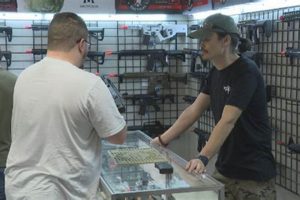
Age restrictions for participating in airsoft vary significantly depending on geographical location, specific airsoft field policies, and the type of equipment used. There is no universally mandated minimum age. For instance, some locations might permit younger participants with parental supervision, while others enforce a minimum age of 16 or 18, regardless of supervision.
The imposition of age limits aims to mitigate potential safety risks associated with handling airsoft guns, which, while not firearms, can cause injury if misused. Regulations are also shaped by insurance requirements and legal interpretations of applicable laws concerning imitation firearms. Understanding the local regulations and field-specific rules is crucial for responsible participation.
This article will delve into the diverse age requirements across different regions, the rationale behind these regulations, and the factors contributing to varying policies at airsoft fields. It will also cover the role of parental consent, safety equipment, and responsible gameplay in the context of age limitations.
Guidance on Airsoft Age Requirements
Navigating the complexities of age restrictions for airsoft participation requires careful consideration of various factors. The following tips offer guidance for ensuring compliance and promoting safe involvement.
Tip 1: Research Local Laws: Conduct thorough research on applicable local and regional laws pertaining to airsoft guns and age restrictions. Laws vary considerably, so understanding the specific legal framework is essential.
Tip 2: Verify Field Policies: Contact the specific airsoft field or arena directly to ascertain their age-related policies. Field regulations may be more stringent than legal requirements, and compliance with these policies is mandatory.
Tip 3: Consider Parental Consent: If the individual is below the age of 18, secure explicit parental or guardian consent. Many fields require written consent for minors to participate.
Tip 4: Emphasize Safety Training: Prioritize comprehensive safety training for all participants, regardless of age. Training should cover safe handling practices, proper use of safety equipment, and awareness of potential hazards.
Tip 5: Ensure Adequate Supervision: For younger participants, ensure adequate adult supervision is provided at all times. Supervision should be active and attentive, ensuring adherence to safety rules and responsible gameplay.
Tip 6: Use Appropriate Equipment: Utilize age-appropriate airsoft guns and safety equipment. Lower-powered airsoft guns may be more suitable for younger players, and full-face masks are essential for all participants.
Tip 7: Understand Insurance Coverage: Inquire about the field’s insurance coverage and any potential liabilities associated with participation. Understand the terms and conditions of any waivers that must be signed.
Adhering to these guidelines promotes responsible participation in airsoft and minimizes the risk of accidents or legal issues related to age restrictions.
The following sections will provide a more detailed exploration of the various factors influencing age regulations and offer practical advice for safe airsoft participation.
1. Local regulations
Local regulations directly influence minimum age requirements for airsoft participation. Jurisdictions establish laws regarding the possession, handling, and use of airsoft guns, often categorizing them as replica firearms or toys. These classifications dictate age restrictions. For example, a municipality classifying airsoft guns as replica firearms might impose an age restriction mirroring regulations for actual firearms, potentially requiring participants to be 18 or older. Conversely, if classified as toys, the age limit might be lower or non-existent, contingent upon parental supervision. The absence of local regulations does not imply unrestricted access; airsoft fields retain the right to enforce their own age policies.
Variations in local regulations generate diverse age landscapes. In some regions, selling airsoft guns to minors is prohibited, directly influencing airsoft field policies, which must align with retail restrictions. Other jurisdictions might require specific markings on airsoft guns to differentiate them from real firearms, indirectly impacting age requirements through increased scrutiny and enforcement. Consider California, where laws regarding imitation firearms are stringent, necessitating clear markings and potentially influencing field operators to adopt higher minimum age standards as a precautionary measure. Conversely, states with less restrictive laws may see fields implementing self-imposed age limits based on insurance or perceived safety concerns.
Comprehending local regulations is essential for safe and legal airsoft engagement. Lack of awareness can lead to legal penalties or denial of access to airsoft fields. Participants bear the responsibility of verifying local ordinances before participating. Furthermore, local regulations can change; therefore, consistent monitoring of applicable laws is imperative. The interplay between local regulations and field policies underscores the decentralized nature of airsoft age requirements, demanding proactive research to ensure compliance.
2. Field policies

Field policies exert a significant influence on determining age restrictions for airsoft participation. While local laws may establish a baseline, individual airsoft field operators often implement more stringent regulations tailored to their specific environment, insurance requirements, and perceived safety risks. These policies directly dictate whether a prospective player, regardless of legal age, can participate at a given facility. The cause-and-effect relationship is clear: the field operator’s risk assessment and insurance stipulations lead to the establishment of specific age-related rules, ultimately determining accessibility. For example, an airsoft field with challenging terrain or a high volume of players may enforce a higher minimum age to mitigate potential injuries. A field’s insurance provider may require a minimum age for coverage, compelling the operator to adopt that age as their policy. The importance of field policies as a component of age determination cannot be overstated; they frequently act as the final gatekeeper.
Real-life examples illustrate the practical significance of understanding field policies. A scenario involves a 15-year-old legally permitted to possess an airsoft gun under local laws, yet denied entry to an airsoft field requiring participants to be 16 or older. Conversely, some fields might allow younger participants with parental supervision, necessitating written consent forms and active parental involvement during gameplay. Such variations highlight the need for proactive communication with field operators. A prudent approach includes directly contacting the field, reviewing their website for posted regulations, and inquiring about any specific waivers or consent forms required for minors. Ignoring field policies can lead to immediate expulsion from the premises, regardless of legal compliance regarding airsoft gun ownership.
In conclusion, field policies are a critical factor in determining access to airsoft activities, often superseding local laws. Understanding the reasoning behind these policies, whether driven by insurance, safety concerns, or operational considerations, allows prospective participants to navigate the complex landscape of age restrictions. The challenge lies in the diversity of field policies, requiring thorough investigation prior to participation. By prioritizing communication and adhering to established regulations, participants can ensure a safe and compliant airsoft experience. Failure to do so introduces the risk of forfeiting the opportunity to play, despite fulfilling broader legal age requirements.
3. Parental consent

Parental consent represents a significant factor in determining airsoft participation eligibility for individuals below a certain age. It often serves as a bridge, enabling minors to engage in the activity even when they don’t meet the standard age requirements stipulated by local laws or field policies. The influence of parental consent stems from the understanding that a responsible adult can provide supervision and assume responsibility for the minor’s safety and adherence to rules.
- Legal Guardianship and Responsibility
Parental consent implies the transfer of responsibility from the airsoft field operator to the parent or legal guardian regarding the minor’s conduct and well-being during gameplay. This consent often requires a signed waiver acknowledging potential risks and releasing the field from certain liabilities. For instance, an airsoft field with a minimum age of 16 might permit 14-year-olds to participate with documented parental consent, provided the parents agree to supervise them directly. The legal underpinning rests on the parent’s authority to make decisions on behalf of their child, within reasonable safety parameters.
- Supervision and Training Oversight
Parental consent frequently necessitates active parental supervision during airsoft activities. This involves ensuring the minor adheres to safety rules, utilizes appropriate protective gear, and demonstrates responsible gameplay. Parents are often expected to actively participate in safety briefings and enforce proper conduct. Consider a scenario where a parent provides consent for their 12-year-old to play; they would typically be required to remain on-site, monitoring the child’s adherence to field rules and intervening if necessary. This highlights the role of parental oversight in ensuring a safe airsoft environment for younger participants.
- Waiver of Liability and Risk Acknowledgment
Parental consent invariably includes signing a waiver of liability, acknowledging the inherent risks associated with airsoft, such as eye injuries, abrasions, or more severe impacts from projectiles. This waiver essentially absolves the airsoft field of responsibility for injuries sustained by the minor, within legally permissible limits, provided the field maintains reasonable safety standards. For example, a waiver might state that the parent understands airsoft pellets can cause welts and eye injuries even with protective gear, and that they assume the risk of such injuries occurring to their child. The significance of this waiver lies in transferring the onus of risk assessment and acceptance to the parent or guardian.
- Impact on Insurance Coverage
Airsoft fields’ insurance policies often dictate the terms under which minors can participate, including the requirements for parental consent. Insurers may demand specific consent forms and supervision ratios to provide coverage for incidents involving younger players. If an airsoft field allows minors based on parental consent, but fails to meet the insurance company’s supervision criteria, they risk losing coverage in the event of an accident. Therefore, parental consent is not merely a formality but a crucial element in aligning field practices with insurance mandates, ensuring financial protection against potential liabilities. The absence of adequate insurance coverage can severely impact a field’s ability to operate legally.
In conclusion, parental consent acts as a conditional allowance, permitting minors to engage in airsoft under specified conditions. Its legal implications, the requirements for active supervision, the waivers of liability, and the impact on insurance coverage all interplay to create a framework that balances the desire for participation with the imperative for safety. While not universally accepted or implemented identically, parental consent significantly alters the landscape of age requirements, enabling younger individuals to experience airsoft under the guidance and responsibility of their parents or legal guardians.
4. Equipment power

The power of airsoft guns, commonly measured in feet per second (FPS) or joules, exerts a direct influence on minimum age requirements at many airsoft fields. A higher FPS value indicates a greater potential for injury, thus prompting stricter age restrictions to mitigate risks. This cause-and-effect relationship is fundamental: increased projectile velocity elevates the possibility of severe bruising, skin penetration, or eye damage, particularly in younger participants with less developed physical resilience. Equipment power is a crucial component of age-related policies, reflecting a field operator’s commitment to participant safety and responsible gameplay. Ignoring this connection exposes younger players to undue harm.
Airsoft fields frequently categorize airsoft guns by FPS and assign corresponding age limits. For instance, a field might permit individuals aged 14 and older to use airsoft guns firing at or below 350 FPS, while requiring participants to be 18 or older to operate guns exceeding this velocity. This tiered approach reflects the escalating injury potential associated with increased power. Moreover, some fields mandate lower FPS limits for indoor environments or close-quarters combat scenarios, regardless of participant age, emphasizing the contextual impact of equipment power on safety protocols. Real-world examples include scenarios where minors using overpowered airsoft guns have caused significant injuries, leading to increased scrutiny and stricter enforcement of FPS limits and age regulations at airsoft facilities.
In conclusion, equipment power significantly shapes age requirements in airsoft due to its direct correlation with injury potential. Understanding these FPS-based restrictions is essential for ensuring safe and compliant participation. Challenges arise from the varying FPS limits enforced at different fields and the potential for players to modify airsoft guns to exceed legal or field-imposed limits. Adherence to established FPS regulations and the consistent use of appropriate safety gear, such as full-face masks, are crucial for promoting responsible airsoft gameplay, particularly among younger participants. Failure to acknowledge the impact of equipment power undermines the integrity of safety measures and increases the likelihood of preventable injuries.
5. Safety training

Safety training serves as a pivotal element in determining the appropriateness of airsoft participation, irrespective of chronological age. Its role extends beyond mere rule recitation, shaping behavior, fostering responsible gameplay, and mitigating potential risks associated with airsoft activities. Comprehensive safety training often influences an airsoft field’s willingness to permit younger individuals to participate, even when minimum age requirements exist.
- Fundamental Knowledge of Equipment Handling
Proper handling of airsoft guns forms the cornerstone of safety training. Participants, regardless of age, must demonstrate proficiency in loading, unloading, aiming, and firing airsoft guns safely. Instruction encompasses the significance of treating every airsoft gun as if it were loaded, maintaining muzzle discipline, and employing safe zones for handling equipment. For instance, training programs emphasize the importance of keeping the airsoft gun pointed in a safe direction at all times and utilizing designated areas for adjustments and repairs. This foundational knowledge minimizes the risk of accidental discharges and negligent use, especially critical for younger participants who may lack experience with similar devices.
- Understanding and Adherence to Field Rules
Airsoft fields operate under specific sets of rules designed to ensure participant safety and fair play. Safety training includes a comprehensive review of these rules, covering aspects such as minimum engagement distances, prohibited areas, acceptable behavior, and emergency procedures. Examples include rules prohibiting blind firing, requiring eye protection at all times, and mandating the use of barrel socks when airsoft guns are not in use. Effective training ensures that participants, including younger players granted conditional access based on parental consent, understand and comply with these rules, fostering a culture of responsible gameplay and minimizing the potential for accidents or disputes.
- Use of Personal Protective Equipment
Safety training emphasizes the mandatory use of appropriate personal protective equipment (PPE), primarily focusing on eye protection. Participants are instructed on the proper selection, fitting, and maintenance of safety goggles or full-face masks. Training highlights the importance of ensuring that PPE meets or exceeds industry safety standards and remains in place at all times during gameplay. Real-world scenarios demonstrate the consequences of inadequate or absent eye protection, underscoring the criticality of consistent PPE use. This emphasis on PPE is paramount in protecting younger participants, whose eyes may be more susceptible to injury.
- Emergency Procedures and First Aid Awareness
Safety training often incorporates basic emergency procedures and first aid awareness, equipping participants with the knowledge to respond effectively in the event of an accident or injury. This includes instruction on recognizing symptoms of common airsoft-related injuries, such as eye injuries, sprains, or heatstroke, and administering basic first aid. Participants learn how to summon assistance, provide accurate information to emergency responders, and maintain a safe environment for the injured individual. For instance, training might cover the proper steps to flush an eye injured by an airsoft pellet or how to stabilize a suspected sprain. This knowledge empowers participants to act responsibly in emergency situations, regardless of their age, contributing to a safer airsoft environment for all.
The effectiveness of safety training directly correlates with a field’s willingness to accommodate younger players. Fields that prioritize comprehensive training programs may be more inclined to permit minors to participate, contingent upon parental consent and demonstrated proficiency in safety protocols. Conversely, fields with minimal safety training may enforce stricter age limits as a means of mitigating risk. Therefore, safety training not only enhances individual preparedness but also influences the accessibility of airsoft activities for younger individuals.
6. Supervision level

Supervision level directly correlates with minimum age requirements for airsoft participation. A higher level of supervision often allows younger individuals to participate in airsoft activities where stricter age restrictions might otherwise preclude their involvement. The cause-and-effect relationship is demonstrable: increased adult oversight mitigates risks associated with younger, less experienced players, thus lowering the perceived liability for airsoft field operators. The importance of supervision level as a component of age determination stems from the assumption that responsible adults can enforce safety rules, prevent reckless behavior, and provide guidance to minors during gameplay. For example, an airsoft field requiring participants to be 16 or older might permit 13- to 15-year-olds to participate if accompanied by a parent or guardian who actively supervises them throughout the event. In such scenarios, the adult assumes responsibility for the minor’s adherence to safety protocols and ensures responsible handling of airsoft equipment.
Further analysis reveals that different types of supervision exist, each impacting age eligibility differently. Direct supervision involves an adult being physically present alongside the minor at all times during gameplay, actively monitoring their actions and providing immediate guidance. Indirect supervision, while still requiring adult presence on-site, may allow the minor more autonomy within defined boundaries and under periodic observation. A practical application involves fields designating specific areas for younger players with direct supervision, separating them from older, more experienced participants. This segregation, combined with adult oversight, reduces the likelihood of accidental injury or rule violations. Conversely, fields offering only minimal or indirect supervision may enforce higher minimum age requirements to compensate for the increased risk associated with less stringent oversight.
In conclusion, supervision level is a crucial determinant in airsoft age restrictions, influencing accessibility for younger participants and reflecting a field’s risk management strategy. The challenge lies in defining and enforcing consistent supervision standards, as the effectiveness of adult oversight varies depending on individual capabilities and commitment. Adherence to established supervision ratios and proactive enforcement of safety rules remain paramount in ensuring a safe and enjoyable airsoft experience for all participants, regardless of age. Addressing the complexities of supervision level is essential for creating inclusive yet secure airsoft environments.
Frequently Asked Questions
This section addresses common inquiries regarding minimum age standards for airsoft participation, providing clear and concise information.
Question 1: Is there a universal minimum age to participate in airsoft?
No, a universally mandated minimum age does not exist. Age requirements are determined by a combination of local regulations and individual airsoft field policies, resulting in significant variations across different locations.
Question 2: Do local laws always dictate the minimum age for airsoft?
While local laws establish a legal framework, individual airsoft fields can implement stricter age requirements. Field policies often consider insurance liability and site-specific safety concerns, potentially superseding local regulations.
Question 3: Is parental consent always sufficient to allow a minor to participate?
Parental consent can enable a minor to participate if field policy permits, but it does not override all age restrictions. Some fields may have absolute minimum age requirements regardless of parental consent.
Question 4: Does the power of an airsoft gun influence age restrictions?
Yes, airsoft fields commonly impose age limits based on the gun’s FPS (feet per second) or joule rating. Higher-powered guns generally require participants to be older due to the increased risk of injury.
Question 5: Does completing a safety training course negate age restrictions?
While safety training enhances preparedness, it does not automatically override age restrictions. However, demonstrating proficiency in safety protocols might influence a field’s decision regarding participation, especially for younger individuals with parental consent.
Question 6: Can supervision level affect the minimum age for airsoft?
Yes, airsoft fields might allow younger participants if they are under direct supervision by a responsible adult. The level of supervision required varies among fields, impacting the minimum permissible age.
These FAQs offer a foundation for understanding the complexities of airsoft age regulations. Thorough research of local laws and field-specific policies remains crucial before engaging in airsoft activities.
The following section provides a guide for safely starting in airsoft.
Conclusion
The exploration of “how old do you have to be to airsoft” reveals a nuanced landscape influenced by interdependent factors. Local regulations, field policies, parental consent, equipment power, safety training, and supervision levels collectively determine participation eligibility. The absence of a universal standard necessitates diligent research and proactive communication with airsoft field operators. These elements combine to create a varied set of requirements that must be met.
Understanding the diverse influences on age restrictions empowers individuals to make informed decisions regarding airsoft participation. Prioritizing safety, adhering to regulations, and respecting field policies are paramount. The onus lies on participants to ensure compliance and promote responsible gameplay within this evolving recreational activity. Airsoft participation requires due diligence and respect for varying age restriction requirements that have been set for various logical reasons.