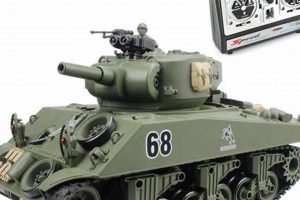
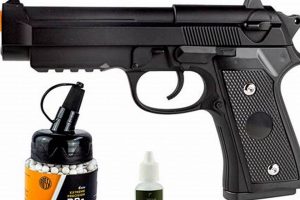
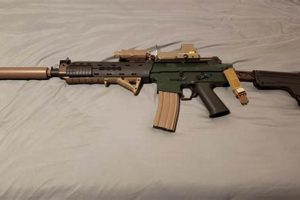
This segment of the airsoft market focuses on replicas that utilize battery-powered motors to drive their internal mechanisms. These devices generally employ an electric motor to compress a spring, which, upon release, propels a small plastic projectile. A common example involves a rifle powered by a rechargeable battery pack, capable of semi-automatic and fully automatic firing modes.
Their significance lies in offering a balance of performance, reliability, and ease of use. They eliminate the need for manual cocking after each shot, leading to higher rates of fire and a more immersive experience. Historically, these designs have evolved from simple, low-powered systems to sophisticated platforms incorporating electronic components for improved accuracy and efficiency, influencing the tactics and strategies employed in the sport.
The following article will delve into the various models available, explore the intricacies of their internal workings, and provide guidance on maintenance and upgrades. Furthermore, it will examine the legal considerations surrounding their ownership and use in different regions.
Essential Guidance
The following provides crucial recommendations to optimize the functionality, longevity, and user experience associated with these devices.
Tip 1: Battery Maintenance: Proper battery care is essential. Always use a charger specifically designed for the battery type. Avoid overcharging and discharging the battery completely, as this can reduce its lifespan and performance.
Tip 2: Gearbox Lubrication: Regular lubrication of the internal gearbox components minimizes friction and wear. Use a high-quality silicone grease formulated for airsoft applications. Insufficient lubrication can lead to premature component failure.
Tip 3: Barrel Cleaning: Consistent cleaning of the inner barrel with a dedicated cleaning rod and silicone spray removes accumulated debris. A clean barrel improves accuracy and range.
Tip 4: Hop-Up Adjustment: The hop-up unit imparts backspin to the projectile, extending its range. Adjust the hop-up carefully to achieve optimal trajectory without over-hopping, which causes the projectile to rise excessively.
Tip 5: Storage Considerations: When not in use, store the device in a cool, dry environment. Remove the battery to prevent corrosion and potential damage to the internal electronics. A dedicated carrying case can protect the device from physical damage during transport and storage.
Tip 6: Motor Maintenance: Periodically inspect the motor brushes for wear. Replace worn brushes promptly to maintain optimal motor performance and prevent damage to the armature.
Adhering to these recommendations promotes consistent performance, reduces the likelihood of malfunctions, and extends the operational lifespan of the equipment.
The subsequent section will address common troubleshooting issues and provide guidance on resolving potential problems.
1. Battery Power

Battery power constitutes a fundamental element dictating the operational efficacy of these electric-powered replicas. It directly influences factors such as rate of fire, trigger response, and overall operational duration. The selection of an appropriate power source is therefore crucial for optimal performance.
- Voltage and Cell Count
Voltage, determined by the number of cells within the battery pack, establishes the potential electrical force driving the motor. Higher voltage often translates to increased motor speed and a quicker trigger response. Conversely, exceeding the recommended voltage can damage the motor and internal components. Lithium Polymer (LiPo) batteries, commonly used due to their high energy density, typically range from 7.4V to 11.1V. Nickel-Metal Hydride (NiMH) batteries offer a more robust and less volatile alternative but generally provide lower voltage options.
- Capacity (mAh) and Discharge Rate (C-Rating)
Capacity, measured in milliampere-hours (mAh), indicates the battery’s ability to deliver current over time, directly influencing operational duration before requiring a recharge. A higher mAh rating signifies a longer runtime. The C-rating reflects the battery’s maximum safe continuous discharge rate, impacting the motor’s ability to draw power under load. Insufficient C-rating can lead to battery overheating and potential damage, while an excessively high C-rating may be unnecessary and add to the battery’s cost and weight.
- Battery Chemistry (LiPo vs. NiMH)
Lithium Polymer (LiPo) batteries are favored for their high energy density, compact size, and ability to deliver high discharge rates. However, they require meticulous handling and charging due to their inherent volatility and susceptibility to damage from overcharging or deep discharging. Nickel-Metal Hydride (NiMH) batteries offer a more stable and forgiving alternative, resistant to overcharging and deep discharging. NiMH batteries generally have a lower energy density and discharge rate than LiPo counterparts but are easier to maintain and handle.
- Connector Types (Tamiya, Deans, XT60)
Connector types facilitate the electrical connection between the battery and the airsoft device. Tamiya connectors are commonly found on older and lower-end models but exhibit higher resistance, potentially limiting current flow. Deans connectors offer lower resistance and improved power delivery, becoming increasingly prevalent in higher-performance configurations. XT60 connectors provide a robust and secure connection with minimal resistance, often employed in high-current applications. Selecting an appropriate connector type ensures efficient power transfer and minimizes the risk of connection-related failures.
In essence, battery selection and maintenance represent critical aspects of owning and operating these airsoft devices. Informed choices concerning voltage, capacity, discharge rate, battery chemistry, and connector type significantly contribute to optimizing performance, extending operational lifespan, and ensuring safe and reliable operation.
2. Motor Torque
Motor torque represents a critical factor in the performance and responsiveness of devices within the airsoft electric category. It directly correlates with the capacity of the motor to overcome resistance during the cycling of the gearbox. Higher torque facilitates the efficient compression of the main spring, enabling consistent projectile velocity and a faster rate of fire. Insufficient torque can lead to sluggish performance, incomplete gearbox cycles, and, ultimately, reduced operational effectiveness. For example, a high-torque motor is often employed in replicas intended for use in scenarios demanding rapid follow-up shots or the lifting of heavier springs to achieve greater muzzle velocity. A low-torque motor, conversely, may be suitable for less demanding applications where energy efficiency is prioritized over raw power.
The influence of motor torque extends beyond simple mechanical actuation. The efficiency with which the motor delivers torque impacts the electrical load placed on the battery. Inefficient operation, stemming from insufficient torque, results in increased current draw and accelerated battery depletion. Conversely, a well-matched motor with ample torque can minimize energy consumption, extending battery life and overall operational endurance. Many serious airsoft players will upgrade to high torque motors to increase trigger response and reliability during intense gameplay scenarios.
In summary, motor torque is a key determinant of both immediate performance and long-term reliability in the realm of airsoft electric systems. Understanding its influence is crucial for selecting and maintaining these devices. Choosing the appropriate motor torque ensures optimal responsiveness, efficient energy usage, and enhanced operational longevity. Balancing motor torque with other key performance indicators is crucial for the end user.
3. Gearbox Ratio

Within airsoft electric replicas, the gearbox ratio plays a pivotal role in determining the balance between rate of fire, trigger response, and overall system efficiency. It defines the relationship between the motor’s rotation and the final rotational speed of the gears driving the piston assembly.
- Definition and Calculation
Gearbox ratio is expressed as a numerical value representing the number of motor rotations required for a single cycle of the piston assembly. A higher ratio implies more motor rotations per cycle, resulting in a slower rate of fire but potentially increased torque. The ratio is calculated by multiplying the number of teeth on each gear within the gearbox, considering the gear train configuration. For example, a 16:1 gear set requires 16 motor rotations for one piston cycle.
- Impact on Rate of Fire (ROF)
Gearbox ratio directly influences the rate of fire achievable by an airsoft electric replica. Lower ratio gear sets (e.g., 13:1) allow for faster cycling of the piston, leading to higher rates of fire. However, this increased ROF may come at the expense of trigger response and place greater stress on the motor and battery. Conversely, higher ratio gear sets (e.g., 20:1) result in slower cycling but can improve trigger response and reduce stress on the system.
- Influence on Trigger Response
Trigger response, the time elapsed between pulling the trigger and the firing of a projectile, is also affected by the gearbox ratio. Higher ratio gear sets generally provide a quicker trigger response due to the increased torque available to initiate the piston cycle. This is particularly beneficial in scenarios requiring rapid engagement and precise shot placement. Lower ratio gear sets, while offering a faster ROF, may exhibit a slightly delayed trigger response due to the lower torque available at the initial stage of the cycle.
- Relationship with Motor Selection
The gearbox ratio must be carefully considered in conjunction with the motor selection. A high-torque motor is often paired with higher ratio gear sets to maximize trigger response and pulling heavier springs. Conversely, a high-speed motor is commonly used with lower ratio gear sets to achieve a very high rate of fire. Mismatched combinations can lead to performance degradation, increased stress on the system, and premature component failure. Optimal performance requires a synergistic relationship between gearbox ratio and motor characteristics.
In conclusion, the gearbox ratio within an airsoft electric replica is a critical determinant of its overall performance characteristics. Careful consideration of the ratio’s impact on rate of fire, trigger response, and motor compatibility is essential for achieving the desired balance between these factors. The optimal gearbox ratio is dependent on the intended use of the replica and the specific performance requirements of the user.
4. Hop-Up System

The hop-up system, an integral component of airsoft electric replicas, imparts backspin to projectiles as they exit the inner barrel. This backspin generates lift, counteracting the effects of gravity and extending the effective range of the replica. Without a functional hop-up system, projectiles would experience a significantly shorter range and a less predictable trajectory, severely limiting the device’s utility in skirmishes. For instance, a correctly adjusted hop-up on a standard airsoft electric rifle can increase its effective range from approximately 30 meters to over 50 meters.
The hop-up system commonly employs a rubber bucking or nub that protrudes slightly into the inner barrel. As the projectile passes this point, it experiences friction, causing it to rotate. The degree of backspin is typically adjustable, allowing the user to fine-tune the trajectory based on projectile weight, environmental conditions, and desired range. This adjustability represents a crucial advantage, enabling players to adapt to diverse field layouts and engagement distances. Improper adjustment can result in either under-hopping, where the projectile falls short, or over-hopping, where the projectile rises excessively and reduces accuracy.
In essence, the hop-up system is not merely an accessory but a fundamental mechanism for optimizing the performance of airsoft electric replicas. Understanding its operation and adjustment is paramount for achieving accuracy, maximizing range, and enhancing the overall effectiveness of the device on the field. The challenges lie in achieving a precise adjustment that balances range and accuracy, often requiring experimentation and a thorough understanding of the system’s mechanics.
5. Firing Rate
Firing rate, often expressed as rounds per minute (RPM), represents a primary performance metric for airsoft electric replicas. It quantifies the speed at which the device can discharge projectiles, directly impacting its suitability for various engagement scenarios and tactical applications.
- Mechanical and Electrical Factors
The achievable firing rate is governed by a confluence of mechanical and electrical factors within the replica. Gearbox ratio, motor speed, battery voltage, and the resistance of internal wiring all contribute to the overall cycling speed of the piston assembly. A higher voltage battery and a faster motor, for instance, can increase the rate of fire but may also place undue stress on the gearbox components, potentially leading to premature wear or failure.
- Gearbox Design and Cycle Time
The design of the gearbox, particularly the efficiency of the gear train and the weight of the piston assembly, critically influences cycle time and, consequently, firing rate. Lightweight pistons and optimized gear ratios can reduce the inertia that the motor must overcome, resulting in a faster and more responsive firing rate. However, excessively light components may sacrifice durability in high-stress operational environments.
- Air Volume and Projectile Feed
The volume of air delivered by the cylinder head and piston assembly must be sufficient to propel each projectile effectively. Insufficient air volume can lead to reduced projectile velocity and inconsistent firing rates. The efficiency of the projectile feeding mechanism, including the magazine and hop-up unit, is also critical. Slow or unreliable feeding can create bottlenecks, limiting the maximum achievable firing rate.
- Controller Systems and Burst Modes
Advanced airsoft electric replicas often incorporate electronic control systems, such as MOSFETs (Metal-Oxide-Semiconductor Field-Effect Transistors), that regulate motor speed and enable programmable burst modes. These systems allow users to customize the firing rate and firing patterns, enhancing tactical flexibility. However, improper programming or malfunctions within the control system can lead to erratic firing rates or complete system failure.
Ultimately, the firing rate of an airsoft electric replica is a carefully balanced attribute, influenced by a complex interplay of mechanical and electrical components. Achieving an optimal firing rate requires a thorough understanding of these factors and a careful consideration of the intended application, balancing performance with reliability and longevity.
Frequently Asked Questions
The following addresses common inquiries and misconceptions regarding airsoft electric replicas, providing factual and objective information.
Question 1: What constitutes the primary power source for airsoft electric devices?
The primary power source consists of rechargeable batteries, typically Nickel-Metal Hydride (NiMH) or Lithium Polymer (LiPo), which provide the electrical energy required to drive the internal motor.
Question 2: How does temperature affect the performance of airsoft electric replicas?
Extreme temperatures can negatively impact battery performance. Low temperatures reduce battery capacity and discharge rate, while high temperatures can accelerate degradation and increase the risk of thermal runaway in LiPo batteries.
Question 3: What distinguishes a MOSFET unit in an airsoft electric system?
A MOSFET (Metal-Oxide-Semiconductor Field-Effect Transistor) is an electronic switch that improves trigger response, reduces electrical wear on trigger contacts, and enables higher firing rates by providing a more efficient electrical pathway for the motor.
Question 4: What are the fundamental maintenance requirements for airsoft electric gearboxes?
Fundamental maintenance involves regular lubrication of internal gears with appropriate silicone grease, inspection for wear and tear on components such as pistons and gears, and proper shimming to ensure optimal gear mesh.
Question 5: How does the voltage rating of a battery impact the performance?
A higher voltage rating generally translates to increased motor speed and a quicker trigger response. However, exceeding the recommended voltage can cause damage to the motor and other internal components.
Question 6: What safety precautions must be observed when handling LiPo batteries used in airsoft electric replicas?
LiPo batteries require meticulous handling due to their inherent volatility. They must be charged with a LiPo-specific charger, protected from physical damage, and stored in a fire-resistant container. Overcharging or deep discharging must be avoided.
Understanding these aspects contributes to safe and effective use. Proper maintenance is key.
The subsequent section will examine legal considerations associated with ownership and usage.
Concluding Remarks
This article has provided an examination of airsoft electric replicas, covering technical specifications, performance metrics, maintenance protocols, and legal considerations. Critical elements such as battery power, motor torque, gearbox ratios, hop-up systems, and firing rates have been dissected, with an emphasis on their individual contributions and interdependencies. A thorough comprehension of these aspects is essential for optimizing performance, ensuring safety, and complying with relevant regulations.
The continued evolution of airsoft electric technology promises further advancements in realism, reliability, and customization. Responsible ownership and diligent adherence to safety guidelines remain paramount. Prospective and current users are encouraged to stay informed about best practices and regulatory updates to ensure the longevity of their equipment and the integrity of the sport.