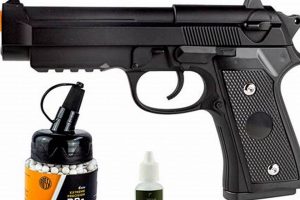
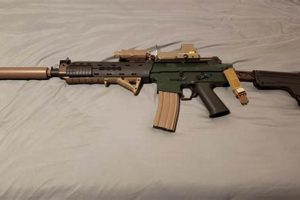
The terminology references a specific configuration within the airsoft hobby, combining the features of a particular firearm cartridge with the recreational activity of airsoft. This setup typically involves airsoft guns modified or designed to mimic the aesthetics and operational characteristics of firearms chambered in the .300 AAC Blackout cartridge. For instance, an airsoft rifle might be configured with magazines and external parts to resemble an AR-15 platform adapted for the .300 AAC Blackout round, despite firing 6mm plastic BBs.
The appeal stems from the desire for realism and tactical simulation among airsoft enthusiasts. Players seeking to replicate real-world firearm platforms often gravitate toward configurations that mirror the appearance and handling of their real-steel counterparts. Furthermore, the association with special operations forces and the perceived effectiveness of the .300 AAC Blackout cartridge in close-quarters combat lends an aspirational quality to this type of airsoft setup. Historically, airsoft has often mirrored trends and preferences in the firearms community, adopting popular calibers and weapon systems for recreational use.
Consequently, the subsequent discussion will delve into the available airsoft guns that accommodate this configuration, the modifications required to achieve the desired aesthetic, and the tactical considerations for utilizing such setups in gameplay scenarios.
Tips for Utilizing a .300 Blackout Airsoft Configuration
Effective implementation of a .300 Blackout-inspired airsoft setup requires careful consideration of both the equipment and its application within the gameplay environment. The following tips offer guidance on optimizing performance and maximizing the advantages of this specific airsoft configuration.
Tip 1: Opt for High-Quality Components. The internal mechanisms of the airsoft gun should be robust and reliable. Investing in reinforced gearboxes, high-torque motors, and precision inner barrels will enhance accuracy and consistency, crucial for effective engagement.
Tip 2: Prioritize Ammunition Weight. Employing heavier weight BBs (0.28g or higher) can improve accuracy and trajectory, particularly at medium ranges. Experimentation is advised to determine the optimal BB weight for the specific airsoft gun and playing conditions.
Tip 3: Master CQB Tactics. The .300 Blackout cartridge is often associated with close-quarters battle. Refine room clearing techniques, practice maneuvering in confined spaces, and develop proficient snap-shooting skills.
Tip 4: Utilize a Red Dot Sight or Holographic Optic. These optics facilitate rapid target acquisition and improved accuracy in dynamic environments. Proper zeroing is essential for consistent point of impact at anticipated engagement distances.
Tip 5: Implement a Sling System. A single-point or two-point sling provides secure weapon retention and allows for seamless transitions between primary and secondary weapons. The sling should be adjusted for optimal comfort and accessibility.
Tip 6: Muzzle Velocity Consistency. Achieving a stable muzzle velocity within allowed field limits is vital for fair play and safety. Regular maintenance and correct air compression parts help in consistent muzzle velocity output.
Tip 7: Train with a Secondary Weapon. A reliable sidearm is crucial for situations where the primary airsoft gun is ineffective or out of ammunition. Practice drawing and engaging targets quickly and accurately with the secondary weapon.
In summary, maximizing the effectiveness of a .300 Blackout-style airsoft configuration requires a commitment to quality components, mastery of CQB tactics, and a focus on accuracy and reliability. These elements contribute to a more immersive and successful airsoft experience.
The subsequent section will address frequently asked questions regarding .300 Blackout airsoft configurations, covering topics such as legality, compatibility, and performance expectations.
1. Aesthetic Realism

Aesthetic realism, in the context of replicating the .300 Blackout within airsoft, refers to the degree to which an airsoft gun visually resembles a firearm chambered in that cartridge. This is achieved through various modifications and component swaps designed to mirror the appearance of real-steel counterparts. The pursuit of aesthetic realism is a significant driver for many airsoft enthusiasts seeking to create authentic tactical simulations. The cause is a desire for a more immersive and visually accurate experience, while the effect is a heightened sense of realism during gameplay. The importance of aesthetic realism lies in its ability to blur the lines between recreational activity and authentic tactical training, contributing to a more compelling and engaging experience.
Consider, for example, the prevalence of airsoft rifles equipped with .300 Blackout-style magazines, handguards, and suppressors. These external components are often carefully selected to match the dimensions, colors, and textures of their real-steel equivalents. Manufacturers cater to this demand by producing specialized airsoft parts that are explicitly designed to replicate the look and feel of .300 Blackout firearms. This level of detail extends to the markings, engravings, and even the weathering patterns applied to the airsoft gun, further enhancing the sense of realism. For instance, a common modification is the replacement of standard airsoft flash hiders with mock suppressors designed to resemble those used with .300 Blackout rifles, contributing significantly to the overall aesthetic.
In summary, aesthetic realism is a fundamental component for many airsoft players aiming to replicate the .300 Blackout platform. While the airsoft gun’s internal mechanics dictate its performance, the external aesthetics contribute significantly to the overall immersion and realism of the experience. This pursuit of visual accuracy presents challenges in sourcing compatible components and accurately replicating the nuances of real-steel firearms. However, the resulting increase in immersion and engagement makes aesthetic realism a crucial consideration for enthusiasts pursuing this particular configuration.
2. Magazine Compatibility

Magazine compatibility represents a critical consideration when configuring airsoft replicas to emulate the .300 Blackout platform. The extent to which airsoft magazines mirror the dimensions, materials, and feeding mechanisms of their real-steel counterparts significantly affects the overall realism and functionality of the airsoft setup.
- External Dimensions and Aesthetics
The external dimensions and aesthetics of the magazine impact the visual accuracy of the .300 Blackout airsoft build. Magazines should ideally replicate the shape, size, and finish of real .300 Blackout magazines to enhance the realistic appearance of the airsoft rifle. For example, dedicated .300 Blackout airsoft magazines often feature a distinct ribbing pattern or a specialized baseplate design to differentiate them from standard 5.56 NATO magazines, mirroring the visual cues found on real-steel .300 Blackout magazines. Discrepancies in size or shape can detract from the overall realism of the setup.
- Feeding Reliability
Magazine compatibility extends beyond mere aesthetics to encompass feeding reliability. Airsoft magazines designed for .300 Blackout replicas must reliably feed 6mm BBs into the hop-up unit to ensure consistent firing. This requires proper alignment of the magazine with the receiver and a robust internal spring mechanism to maintain consistent pressure on the BB stack. Issues such as misfeeds, double feeds, or jams can significantly impair the performance and enjoyment of the airsoft gun. Therefore, magazine compatibility must prioritize reliable feeding to mirror a real steel .300 blackout.
- Capacity Considerations
The capacity of .300 Blackout airsoft magazines influences gameplay dynamics. While high-capacity magazines offer a greater BB count, they may sacrifice realism, as real-steel .300 Blackout magazines typically have lower capacities than standard 5.56 NATO magazines. Mid-capacity magazines, on the other hand, offer a balance between realism and practicality, providing a sufficient BB count while maintaining a more authentic look and feel. The choice between high-capacity and mid-capacity magazines depends on the user’s preference for either maximizing firepower or prioritizing realism.
- Adaptation and Modification
In some cases, achieving magazine compatibility may require adaptation or modification of existing airsoft magazines. This could involve altering the magazine’s external dimensions, adjusting the internal feeding mechanism, or replacing the magazine follower. For example, some users may modify standard M4 magazines to resemble .300 Blackout magazines by adding cosmetic features or altering the magazine’s profile. Such modifications require careful planning and execution to ensure reliable feeding and compatibility with the airsoft gun.
Ultimately, magazine compatibility is a multifaceted aspect of .300 Blackout airsoft configurations. It encompasses both visual realism and functional performance, requiring careful attention to detail and a thorough understanding of airsoft mechanics. Achieving optimal magazine compatibility enhances the overall realism, reliability, and enjoyment of the .300 Blackout airsoft experience.
3. Internal Upgrades

The correlation between internal upgrades and .300 Blackout airsoft centers on optimizing performance to align with the characteristics and deployment scenarios associated with the real-steel .300 Blackout cartridge. The cartridge is frequently used in close-quarters combat (CQB) and suppressed applications; replicating these attributes within airsoft necessitates alterations to stock internal components. The effect of upgraded internals is an increase in airsoft gun reliability, accuracy, and overall effectiveness within the intended gameplay environment. For instance, a standard airsoft gun might exhibit inconsistent performance, whereas one equipped with a high-torque motor, precision inner barrel, and upgraded hop-up unit will offer improved trigger response, range, and accuracy, more closely mimicking the performance profile of a .300 Blackout firearm.
A critical aspect of internal upgrades is ensuring the airsoft gun’s consistency and reliability under sustained use. Airsoft guns replicating .300 Blackout platforms are often employed in dynamic, fast-paced scenarios, demanding high rates of fire and rapid target acquisition. Upgraded gearboxes, reinforced pistons, and high-capacity batteries are crucial to maintaining consistent performance and preventing mechanical failures. Furthermore, the use of heavier-weight BBs is often recommended to enhance accuracy and trajectory, requiring modifications to the hop-up unit to accommodate the increased projectile weight. The implementation of a tightbore inner barrel can increase consistency and therefore accuracy down range.
In summary, internal upgrades are integral to achieving the desired performance and operational characteristics within .300 Blackout airsoft configurations. The benefits of these upgrades extend beyond mere aesthetic replication, improving the airsoft gun’s reliability, accuracy, and suitability for CQB engagements. Selecting the appropriate internal components and ensuring proper installation are crucial for maximizing the effectiveness of a .300 Blackout-inspired airsoft setup and addressing the specific demands of this configuration.
4. CQB Suitability

The discussion of CQB suitability within the framework of airsoft configurations centers on the practicality and effectiveness of a particular setup in close-quarters battle scenarios. The .300 Blackout cartridge, known for its effectiveness in confined spaces, influences the characteristics desired in an airsoft replica intended for similar use. The following outlines key considerations for CQB suitability in a .300 Blackout airsoft context.
- Compact Dimensions and Maneuverability
CQB environments necessitate weapons that are easily maneuverable in tight spaces. Airsoft guns replicating .300 Blackout platforms should ideally feature shorter barrel lengths and compact overall dimensions to facilitate rapid target acquisition and movement through confined areas. The implementation of folding stocks or PDW-style configurations further enhances maneuverability. A bulky or unwieldy airsoft gun can impede movement and compromise effectiveness in CQB scenarios.
- High Rate of Fire and Trigger Response
Rapid engagement of multiple targets is a hallmark of CQB. An airsoft gun’s ability to deliver a high rate of fire and exhibit a crisp trigger response is crucial for suppressing opponents and gaining a tactical advantage. Upgraded motors, MOSFET units, and optimized gear ratios contribute to improved trigger response and increased rates of fire. These modifications enable the airsoft gun to cycle BBs quickly and consistently, enhancing its effectiveness in close-quarters engagements.
- Suppression and Noise Reduction
The .300 Blackout cartridge is often associated with suppressed firearms, which reduce noise and muzzle flash. While true sound suppression is not achievable in airsoft, mock suppressors can be used to alter the airsoft gun’s sound signature and provide a psychological advantage. Furthermore, the use of quieter airsoft gun internals, such as padded piston heads and dampened gearboxes, can further reduce noise levels, enhancing the user’s stealth and situational awareness in CQB environments.
- Optics and Target Acquisition
CQB engagements require rapid target acquisition and accurate aiming. Airsoft guns intended for CQB should be equipped with optics that facilitate quick target acquisition, such as red dot sights or holographic sights. These optics allow users to rapidly acquire and engage targets with both eyes open, enhancing their situational awareness and accuracy. Low-magnification optics or illuminated reticles can also be beneficial in low-light conditions, which are common in CQB environments.
In summary, CQB suitability in a .300 Blackout airsoft context is determined by a combination of factors including compact dimensions, high rate of fire, noise reduction, and effective optics. Replicating the characteristics of the real-steel .300 Blackout cartridge in an airsoft platform requires careful consideration of these factors and the implementation of appropriate modifications to enhance the airsoft gun’s performance in close-quarters battle scenarios.
5. Ammunition Weight
The selection of ammunition weight significantly influences the performance characteristics of a .300 Blackout airsoft replica. Unlike real firearms where bullet weight affects terminal ballistics, in airsoft, BB weight primarily affects range, accuracy, and trajectory. The .300 Blackout cartridge, often used in scenarios favoring subsonic rounds and heavier projectiles, prompts airsoft players to consider heavier BBs to emulate similar flight characteristics. The cause is the desire to mimic the trajectory and stability of the .300 Blackout round, and the effect is enhanced accuracy and range in the airsoft platform, especially at medium to longer distances. A standard 0.20g BB may be significantly affected by wind and lose energy quickly, while heavier BBs like 0.28g or 0.30g offer greater resistance to external factors and retain velocity over a longer distance, yielding a flatter trajectory. Therefore, ammunition weight is a key component in optimizing the performance and realistic feel of the .300 Blackout airsoft experience.
The practical significance of understanding ammunition weight lies in the ability to fine-tune the airsoft gun for specific playing conditions. For instance, in outdoor environments with variable wind conditions, heavier BBs provide a distinct advantage in terms of accuracy and consistency. Similarly, in CQB scenarios, a balance between BB weight and muzzle velocity must be struck to ensure safety while maintaining effective range and impact. Field regulations often impose limits on muzzle velocity, necessitating careful consideration of BB weight to comply with safety protocols. Real-world examples include players using chronographs to measure muzzle velocity with different BB weights to optimize their airsoft gun’s performance and ensure compliance with field regulations. Moreover, the selection of ammunition weight often influences the choice of hop-up unit, as heavier BBs require a more aggressive hop-up setting to achieve optimal flight characteristics. Therefore, the relationship between ammunition weight and hop-up adjustment is critical for achieving consistent accuracy and range.
In summary, the choice of ammunition weight is a fundamental aspect of configuring a .300 Blackout airsoft replica. It directly impacts the airsoft gun’s range, accuracy, and trajectory, and it requires careful consideration of playing conditions, field regulations, and hop-up adjustments. While challenges may arise in selecting the optimal BB weight for a specific airsoft gun and environment, the benefits of a well-tuned setup are significant, contributing to a more realistic and effective airsoft experience. Ultimately, understanding ammunition weight and its effects bridges the gap between replicating the aesthetics of a .300 Blackout firearm and emulating its performance characteristics within the context of airsoft.
6. Effective Range

Effective range, in the context of airsoft replicas of firearms chambered in .300 Blackout, is defined as the distance at which a user can consistently and accurately engage a target with a reasonable expectation of achieving the desired effect, typically target neutralization or suppression. The .300 Blackout cartridge is often selected for its ballistic properties in short-barreled rifles and suppressed configurations, roles airsoft replicas attempt to emulate. The cause is the desire to simulate the tactical advantages associated with the .300 Blackout platform, and the effect is that players must understand the limitations of their airsoft equipment to utilize it effectively at varying distances. The importance of effective range lies in its direct correlation to the user’s ability to successfully participate in airsoft engagements and achieve strategic objectives. An airsoft replica with an accurately determined effective range allows the user to make informed decisions regarding engagement distances, ammunition selection, and tactical positioning.
Real-world examples illustrate the practical significance of understanding effective range. For instance, an airsoft player using a .300 Blackout replica in a woodland setting might accurately engage targets at 150 feet with consistent groupings, while the same replica might only be effective to 100 feet in an urban environment due to tighter spaces and obstructed lines of sight. This understanding informs the player’s tactical approach, dictating when to engage directly and when to maneuver for a more advantageous position. Furthermore, knowledge of effective range informs the selection of appropriate BB weights and hop-up adjustments to optimize accuracy and trajectory. An improperly calibrated airsoft replica, regardless of its aesthetic resemblance to a .300 Blackout firearm, will be ineffective if its effective range is poorly understood or inaccurately assessed.
In summary, effective range is a critical component of the .300 Blackout airsoft experience. It dictates the engagement distances at which an airsoft replica can be reliably employed. While challenges may arise in accurately determining effective range due to variables such as wind, target size, and BB weight, the benefits of a well-understood effective range are significant, contributing to a more successful and realistic airsoft experience. The insights gained from understanding effective range allow players to bridge the gap between replicating the aesthetics of a .300 Blackout firearm and emulating its tactical applications within the limitations of the airsoft platform.
7. Tactical Gear
Tactical gear significantly enhances the operational capabilities and realism of airsoft configurations designed to replicate the .300 Blackout platform. The .300 Blackout cartridge is often associated with specific tactical applications, and the gear complements the airsoft replica by mirroring these scenarios. The cause is the desire to replicate the function and aesthetic of real-world tactical setups, and the effect is a heightened sense of immersion and improved performance in airsoft gameplay. The importance of tactical gear lies in its ability to enhance both the visual accuracy and functional effectiveness of the .300 Blackout airsoft experience. Proper gear selection allows players to emulate the roles and operational requirements associated with the real-steel firearm, thereby increasing the level of realism and strategic options available during gameplay. For example, plate carriers, chest rigs, and magazine pouches designed for .300 Blackout magazines not only enhance the aesthetic authenticity but also provide practical means for carrying and accessing ammunition during engagements.
Practical applications of tactical gear are manifold. The inclusion of tactical slings, for instance, allows for secure weapon retention and facilitates smooth transitions between primary and secondary weapons, mirroring techniques employed by real-world operators. Similarly, the use of communication devices, such as headsets and radios, enables coordinated teamwork and strategic communication during gameplay. Night vision devices and weapon-mounted lights enhance visibility and target acquisition in low-light conditions, further replicating the tactical advantages associated with the .300 Blackout platform. A crucial aspect is the appropriate integration of gear with the airsoft replica. For example, a .300 Blackout airsoft rifle equipped with a mock suppressor and paired with a plate carrier featuring dedicated magazine pouches contributes significantly to the overall realism and functional utility of the setup. However, improper gear selection or configuration can hinder movement, reduce maneuverability, and compromise overall effectiveness. Therefore, careful planning and consideration are essential when selecting tactical gear for a .300 Blackout airsoft setup.
In summary, tactical gear is an integral component of the .300 Blackout airsoft experience, enhancing both the visual authenticity and functional effectiveness of the configuration. The accurate selection and integration of appropriate gear allows players to emulate the roles and tactical applications associated with the real-steel firearm. While challenges may arise in sourcing high-quality, compatible gear and configuring it for optimal performance, the benefits of a well-equipped .300 Blackout airsoft setup are substantial. The combined effect of the airsoft replica and complementary tactical gear elevates the level of realism, strategic options, and overall enjoyment of the airsoft experience, bridging the gap between recreational gameplay and authentic tactical simulation.
Frequently Asked Questions
This section addresses common inquiries and misconceptions regarding the integration of the .300 Blackout cartridge aesthetic into airsoft platforms. The information provided aims to clarify the technical aspects and practical considerations involved in replicating this firearm configuration within the context of airsoft.
Question 1: Is it legal to own a 300 Blackout airsoft gun?
Legality depends on local regulations concerning airsoft guns. While replicating the appearance of a firearm cartridge, airsoft guns are generally classified as toy or sporting equipment. Compliance with local laws governing airsoft gun ownership, transportation, and usage is mandatory. Modification of airsoft guns to resemble real firearms too closely might attract legal scrutiny.
Question 2: What type of airsoft gun is best suited for a 300 Blackout conversion?
Airsoft guns based on the AR-15 platform are the most suitable for replicating the .300 Blackout configuration. Their modular design facilitates the replacement of external components, allowing for visual accuracy. The M4/AR-15 platform is widely supported by aftermarket parts manufacturers, providing a range of options for replicating the .300 Blackout aesthetic.
Question 3: Can standard M4 magazines be used with a 300 Blackout airsoft gun?
Standard M4 magazines can be utilized, but they do not accurately replicate the appearance of .300 Blackout magazines. Dedicated .300 Blackout airsoft magazines, featuring distinct ribbing or specialized baseplates, enhance the visual authenticity of the setup. While M4 magazines will function, they will not offer the correct aesthetic.
Question 4: What internal upgrades are recommended for a 300 Blackout airsoft gun?
Internal upgrades that improve trigger response, accuracy, and reliability are recommended. High-torque motors, precision inner barrels, and upgraded hop-up units enhance the performance of the airsoft gun. These upgrades allow the replica to function more consistently and accurately during gameplay.
Question 5: Is a shorter barrel length necessary for a realistic 300 Blackout airsoft gun?
Shorter barrel lengths contribute to visual accuracy, as .300 Blackout firearms are frequently configured with shorter barrels. However, barrel length also affects the airsoft gun’s accuracy and range. A balance between visual accuracy and performance must be considered. Some users prioritize shorter barrels for aesthetic purposes, while others opt for longer barrels for improved range.
Question 6: Does replicating a 300 Blackout airsoft gun improve its performance?
Simply replicating the aesthetics of a .300 Blackout firearm does not inherently improve an airsoft gun’s performance. Performance enhancements require internal upgrades that improve accuracy, reliability, and consistency. The visual modifications are primarily cosmetic and do not directly impact the airsoft gun’s functional capabilities.
In summary, configuring a .300 Blackout airsoft replica involves a combination of aesthetic modifications and performance-enhancing upgrades. Understanding the legal implications, platform compatibility, and performance considerations is essential for achieving a realistic and effective airsoft setup.
The following section will provide guidance on sourcing components and completing the .300 Blackout airsoft conversion.
Concluding Remarks
The preceding discussion has explored various facets of integrating the .300 Blackout aesthetic into airsoft platforms. Key considerations included achieving visual realism through component selection, optimizing internal mechanisms for enhanced performance, understanding the importance of ammunition weight and effective range, and leveraging tactical gear to mirror real-world operational scenarios. Magazine compatibility and CQB suitability were also emphasized as critical factors in creating a functional and authentic airsoft replica.
The pursuit of a realistic .300 Blackout airsoft configuration necessitates a comprehensive understanding of both airsoft mechanics and the characteristics of the real-steel firearm. Future endeavors should focus on refining manufacturing processes for more accurate and durable components, as well as promoting responsible airsoft practices that prioritize safety and adherence to local regulations. Ultimately, the successful integration of the .300 Blackout aesthetic into airsoft hinges on a commitment to detail, technical proficiency, and a dedication to maintaining the integrity of the airsoft community.