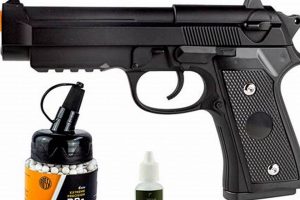
These devices are recreational guns that discharge spherical projectiles with a diameter of six millimeters. Commonly used in simulated combat scenarios, target practice, and collection, they offer a safer alternative to firearms, utilizing compressed gas or spring mechanisms to propel the ammunition.
The popularity of these items stems from their realism, affordability, and the organized sport surrounding their use. Replicas often closely resemble actual firearms, providing a training tool for responsible gun handling, or catering to historical reenactment enthusiasts. Their availability and lower potential for harm compared to conventional weapons make them accessible to a wider audience. Historically, their development reflects a growing interest in accessible and safe recreational shooting activities.
The following sections will delve into the various aspects of these recreational devices, examining their mechanisms, types, usage guidelines, and safety considerations in detail.
Considerations for 6mm Airsoft Pistol Usage
This section presents crucial guidelines for safe and effective use of these devices. Adherence to these tips will enhance both the user’s experience and the safety of those nearby.
Tip 1: Eye Protection is Paramount: Always wear approved eye protection specifically designed for airsoft. Standard eyewear may not withstand the impact of a projectile, leading to serious injury.
Tip 2: Understand Velocity Limitations: Be aware of the accepted velocity limits for play areas and ensure the device complies. Exceeding these limits can cause injury and violate regulations.
Tip 3: Practice Safe Handling Procedures: Treat the device as if it were a real firearm. Keep the muzzle pointed in a safe direction, and never point it at anything one is not prepared to shoot.
Tip 4: Store Responsibly: Store the item unloaded and in a secure location inaccessible to children or unauthorized individuals. This prevents accidental discharge and misuse.
Tip 5: Familiarize Yourself with Local Laws and Regulations: Regulations regarding ownership, transport, and use vary significantly. Ensure compliance with all applicable laws to avoid legal repercussions.
Tip 6: Utilize Appropriate Ammunition: Employ only high-quality, seamless 6mm plastic BBs designed for airsoft usage. Inferior ammunition can damage the internal components and compromise accuracy.
Tip 7: Maintain the Device Properly: Regular cleaning and lubrication are essential for optimal performance and longevity. Follow the manufacturer’s instructions for maintenance procedures.
By prioritizing safety and adhering to responsible practices, users can mitigate risks and maximize enjoyment. Consistent application of these guidelines is critical for a positive experience.
The subsequent sections will explore the various categories and applications of this recreational device, providing a comprehensive overview of its capabilities.
1. Velocity
Velocity is a paramount consideration in the context of 6mm airsoft pistols, directly impacting both the performance and safety profile of these devices. The speed at which the projectile is expelled determines its range, impact force, and adherence to safety regulations.
- Feet Per Second (FPS) and Joule Measurement
Velocity is commonly measured in feet per second (FPS), but a more accurate representation of the energy imparted is the joule measurement. A higher FPS value correlates with a greater potential for injury, necessitating strict adherence to field regulations and safety protocols.
- Impact on Range and Accuracy
Increased velocity generally equates to a longer effective range; however, it can also negatively impact accuracy. A projectile travelling at an excessive velocity may be more susceptible to air resistance and trajectory deviation, particularly at longer distances.
- Field Regulations and Safety Limits
Airsoft fields and organizations typically impose velocity limits to ensure participant safety. Exceeding these limits can result in disqualification, suspension, or even injury to other players. Chronographs are commonly used to measure the velocity of devices before gameplay.
- Upgrades and Modifications
Modifying a device to increase its velocity requires careful consideration. While enhancing range or power may seem advantageous, exceeding established safety limits or compromising the device’s structural integrity presents significant risks. Responsible modification prioritizes safety and adherence to regulations.
Understanding the interplay between velocity, range, accuracy, and safety regulations is crucial for responsible airsoft gameplay. Careful consideration of these factors is paramount for both participant well-being and adherence to established guidelines.
2. Accuracy

Accuracy represents a critical performance parameter for any projectile-based device, including 6mm airsoft pistols. It dictates the consistency with which projectiles impact a designated target. This parameter is influenced by various factors, ranging from inherent device characteristics to external environmental conditions.
- Hop-Up Systems
A hop-up system imparts backspin to the projectile, counteracting the effects of gravity and extending its effective range. The precise adjustment and consistent performance of this system are crucial for achieving optimal accuracy. Irregular hop-up pressure can lead to erratic projectile trajectories. Airsoft guns often use adjustable hop-up units, a good hop up unit will give you a great accuracy.
- Barrel Quality
The internal barrel’s construction directly influences the projectile’s trajectory. Smooth, consistent bore dimensions minimize friction and ensure a stable path. Variations in barrel diameter or imperfections in the bore can introduce deviations. High-quality barrels often use tighter bores to minimize barrel wobble and improve precision.
- Ammunition Consistency
The uniformity of the 6mm projectiles themselves is paramount. Variations in size, weight, or surface finish can introduce inconsistencies in flight characteristics. High-quality, precision-manufactured ammunition minimizes these variables. Using high grade BB also prolongs the life of your gun.
- External Factors
Environmental conditions, such as wind speed and direction, can significantly impact projectile trajectory. Compensating for these factors requires skill and experience. Understanding wind patterns is important for long range shooting.
Optimal accuracy in 6mm airsoft pistols requires a confluence of factors: a well-designed hop-up system, a high-quality barrel, consistent ammunition, and awareness of external conditions. Maximizing precision is an ongoing process. Regular maintenance and careful selection of components contribute to enhanced performance.
3. Mechanism

The mechanism of a 6mm airsoft pistol directly dictates its performance characteristics, reliability, and overall user experience. The operational principles behind these mechanisms determine projectile velocity, accuracy, and the power source required. Understanding these mechanisms is fundamental to selecting an appropriate device and maintaining it effectively. The primary mechanisms encountered in 6mm airsoft pistols are spring-powered, gas-powered (including CO2 and green gas), and electric-powered (AEPs). Each presents distinct advantages and disadvantages. The spring mechanism, for instance, necessitates manual cocking before each shot, offering simplicity and affordability, but limiting rate of fire. Gas-powered mechanisms provide greater realism through blowback action and higher potential velocity, but require a consistent gas supply and are sensitive to temperature variations. Electric mechanisms offer semi-automatic and fully automatic firing modes but depend on battery power and may exhibit lower power output compared to gas variants. Consider, for example, a CO2-powered pistol used for target practice. Its higher velocity translates to improved range and projectile stability, enhancing accuracy. Alternatively, a spring-powered pistol, due to its straightforward design and low maintenance requirements, is often favored for beginners.
The selection of a specific mechanism influences the device’s application. Gas blowback pistols are commonly utilized in simulations requiring realistic recoil and cycling, while spring-powered pistols find use in casual target shooting due to their ease of operation and low cost. AEPs, with their automatic firing capabilities, are sometimes favored in close-quarters combat scenarios. The maintenance requirements also vary significantly across mechanisms. Spring-powered models require minimal upkeep, primarily involving cleaning and lubrication. Gas-powered models necessitate regular seal inspection and gas valve maintenance to prevent leaks and ensure consistent performance. AEPs demand careful battery management and occasional motor maintenance. Ignoring mechanism-specific maintenance protocols can lead to diminished performance, premature wear, and, in some cases, device failure.
In conclusion, the mechanism is a defining characteristic of any 6mm airsoft pistol, dictating its performance envelope, maintenance requirements, and suitability for particular applications. A thorough understanding of these mechanisms empowers users to make informed purchasing decisions, optimize device performance, and ensure safe and responsible usage. Challenges arise when users fail to account for the inherent limitations or maintenance demands of a specific mechanism, leading to dissatisfaction or potential safety hazards. Selecting a device with an appropriate mechanism that aligns with user needs and capabilities is vital.
4. Materials

The selection of materials in the construction of a 6mm airsoft pistol fundamentally dictates its durability, weight, realism, and overall performance. The choice of materials impacts its resistance to wear, its handling characteristics, and the aesthetic qualities.
- Polymer Composites
Polymer composites are prevalent in constructing frames, grips, and external components. These materials offer a balance of durability, affordability, and light weight. For example, reinforced nylon polymers provide impact resistance while maintaining a manageable weight, facilitating ease of handling. However, excessive reliance on low-grade polymers can compromise long-term durability.
- Metal Alloys
Metal alloys, such as aluminum, steel, and zinc, are utilized for internal components, barrels, and slides. Steel offers superior strength and durability, essential for parts subjected to high stress, while aluminum reduces weight without sacrificing structural integrity. Zinc alloys, while cost-effective, exhibit lower strength and may be prone to breakage. The use of steel in the barrel, for instance, contributes to improved accuracy and longevity.
- Internal Component Materials
Materials employed in the internal mechanisms, such as gears, pistons, and springs, critically influence performance and reliability. High-grade steel gears ensure smooth operation and withstand wear, while durable piston materials prevent premature failure. The material composition of these components directly correlates with the device’s lifespan and operational consistency. A stainless steel spring guide, for instance, provides better wear resistance than a plastic counterpart.
- Finishes and Coatings
Surface finishes and coatings not only enhance the aesthetic appeal but also provide protection against corrosion and abrasion. Anodizing aluminum components, for example, creates a durable, corrosion-resistant layer. Similarly, specialized coatings on slides reduce friction and improve cycling. These treatments contribute to the device’s longevity and maintain its aesthetic appearance over time.
The judicious selection and application of materials are integral to the design and manufacturing of the 6mm airsoft pistol. A balance between cost, durability, weight, and performance considerations informs material choices. Material degradation or failure often constitutes the primary cause of malfunction, underscoring the importance of informed material selection.
5. Regulation

Regulation forms a critical framework governing the ownership, use, and transportation of 6mm airsoft pistols. Varied legal landscapes necessitate diligent adherence to local, national, and international statutes.
- Age Restrictions
Many jurisdictions impose age restrictions on the purchase and use of these devices. These laws seek to prevent misuse by minors. Violation of age-related regulations can result in fines or legal action. For instance, some regions require individuals to be 18 or older to purchase an airsoft pistol.
- Velocity Limits
Velocity restrictions define the maximum projectile speed permitted. These regulations aim to mitigate the risk of injury. Exceeding velocity limits can lead to penalties and potential confiscation. Many organized airsoft fields enforce strict chronograph testing to ensure compliance.
- Transportation and Storage
Regulations often mandate specific procedures for transporting and storing these devices. Requirements may include storing them unloaded, in a case, and separate from ammunition. Failure to comply can result in legal consequences. Certain areas classify an uncased, readily accessible airsoft pistol in a vehicle as a violation.
- Appearance and Markings
Some jurisdictions require airsoft pistols to be distinctively marked or colored to differentiate them from actual firearms. These regulations aim to prevent confusion and potential misuse. Lack of required markings can lead to legal issues. Certain regions mandate an orange tip on the barrel to indicate its status as a non-lethal device.
Understanding and adhering to applicable regulations are paramount for responsible ownership and use. The potential ramifications of non-compliance underscore the necessity of verifying local laws prior to purchase, transportation, or utilization.
6. Maintenance
Maintenance is intrinsic to the sustained operation and longevity of a 6mm airsoft pistol. Neglecting routine upkeep results in diminished performance, increased risk of malfunction, and reduced lifespan. The cause-and-effect relationship is direct: inadequate maintenance precipitates a cascade of negative consequences affecting accuracy, velocity, and overall reliability. Proper maintenance acts as a preventative measure, mitigating wear and tear on critical components. As an integral component, consistent maintenance ensures that the device functions within specified parameters, delivering consistent performance and adhering to safety standards. For instance, failure to regularly clean the barrel can lead to projectile deviation and reduced accuracy. Similarly, neglecting lubrication of moving parts increases friction, causing premature wear and potentially leading to mechanical failure. These examples highlight the practical significance of integrating maintenance into the ownership of such devices.
The practical application of maintenance procedures varies depending on the type of device. Spring-powered pistols require periodic cleaning of the internal cylinder and lubrication of the spring. Gas-powered models necessitate attention to seals and valves to prevent leaks, alongside lubrication of moving parts. Electric-powered pistols demand proper battery care, motor maintenance, and gear lubrication. Disregarding these mechanism-specific maintenance protocols accelerates component degradation and impairs functionality. A real-world example includes a gas-powered pistol where neglected seal maintenance led to gas leakage, rendering the device inoperable. Another example is neglecting motor maintenance in an electric airsoft pistol. Due to wear and tear, this can cause the motor to burn out. Proper maintenance protocols minimize downtime and prolong the pistol’s operational life, ensuring readiness for recreational or training scenarios.
In summary, maintenance constitutes a non-negotiable aspect of 6mm airsoft pistol ownership. Overlooking this essential component precipitates performance decline and accelerates component degradation. Consistent application of appropriate maintenance procedures, tailored to the device’s specific mechanism, mitigates these risks and extends its operational lifespan. The challenge lies in educating users about the importance of maintenance and providing accessible resources for performing these tasks effectively, thereby fostering responsible ownership practices. Recognizing maintenance as an integral part of the device’s functionality, rather than an optional addendum, ensures optimal performance and minimizes potential hazards.
Frequently Asked Questions Regarding 6mm Airsoft Pistols
This section addresses common inquiries concerning these recreational devices, providing informative responses to enhance understanding and promote responsible usage.
Question 1: What is the effective range of a typical 6mm airsoft pistol?
The effective range varies depending on the specific device, its mechanism, and environmental conditions. Generally, expect an effective range of 50 to 100 feet. Accuracy diminishes beyond this range.
Question 2: What type of ammunition is appropriate for a 6mm airsoft pistol?
Only seamless, high-quality 6mm plastic BBs designed specifically for airsoft use should be utilized. Inferior ammunition can damage the device and compromise accuracy.
Question 3: What safety precautions should be observed when using a 6mm airsoft pistol?
Approved eye protection must be worn at all times. The device should be handled as if it were a real firearm. Adherence to velocity limits and local regulations is essential.
Question 4: How should a 6mm airsoft pistol be stored?
It should be stored unloaded, in a secure location inaccessible to children or unauthorized individuals. Separating the device from its ammunition is recommended.
Question 5: What is the typical lifespan of a 6mm airsoft pistol?
Lifespan varies depending on the quality of the device, the frequency of use, and the level of maintenance performed. Regular maintenance can significantly extend its operational life.
Question 6: Are there legal restrictions on owning a 6mm airsoft pistol?
Regulations vary significantly depending on the jurisdiction. Ownership may be subject to age restrictions, velocity limits, and marking requirements. Verifying local laws is imperative.
In summary, responsible ownership and usage involve understanding the device’s capabilities, adhering to safety precautions, and complying with applicable regulations.
The following section will provide resources for further information and responsible usage practices.
Conclusion
This exploration of the 6mm airsoft pistol has encompassed its mechanisms, materials, regulations, maintenance, and safe usage guidelines. The device, a recreational tool, demands respect, responsible handling, and unwavering adherence to legal and safety standards. It has been established that it’s characteristics directly impact its accuracy and reliability.
The continued growth and evolution of this recreational activity relies on a commitment to safety, ethical practices, and ongoing education. Further research, responsible community engagement, and diligent compliance will ensure its sustained viability. Users must always maintain a safe and legal environment.