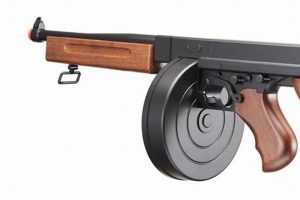
Airsoft replicas designed to closely mimic the appearance, weight, and operation of real firearms are highly sought after. These models prioritize accurate detailing in their external construction and often feature similar controls and blowback actions to their real-world counterparts. Such attention to detail contributes to a more immersive training or recreational experience.
The demand for these detailed replicas stems from various sources, including military and law enforcement training, film and television prop usage, and the airsoft gaming community. The enhanced realism provides a more effective training tool for practicing weapon handling and tactical maneuvers. Furthermore, the historical accuracy appeals to collectors and enthusiasts seeking authentic representations.
Understanding the features that contribute to a heightened sense of authenticity is key to evaluating these airsoft products. Subsequent sections will explore specific design elements, construction materials, and performance characteristics that differentiate high-fidelity replicas from standard airsoft models.
Selecting a High-Fidelity Airsoft Replica
Careful consideration of several key factors is essential when choosing an airsoft replica prioritized for realism. Attention to detail in both aesthetics and functionality is crucial for a satisfying experience.
Tip 1: Prioritize Material Construction: Examine the materials used in construction. Full metal bodies, particularly those employing alloys similar to those used in real firearms, contribute significantly to the overall weight and feel. Polymer components should accurately replicate the texture and appearance of their real-world counterparts.
Tip 2: Assess Blowback Functionality: A robust blowback system that simulates the recoil and slide action of a real firearm enhances the immersive experience. Evaluate the strength and consistency of the blowback mechanism during operation.
Tip 3: Evaluate Dimensional Accuracy: Compare the dimensions of the airsoft replica to the specifications of the real firearm it emulates. Discrepancies in size or proportion can detract from the overall realism.
Tip 4: Examine Trademarks and Markings: Authentic trademarks and markings add to the visual fidelity of the replica. Licensed replicas from reputable manufacturers often feature accurate engravings and details.
Tip 5: Consider Internal Component Quality: While external aesthetics are important, the quality of internal components affects the performance and reliability of the replica. Look for models with durable gearboxes, hop-up units, and inner barrels.
Tip 6: Research Disassembly and Maintenance: Realism extends to the field-stripping process. Airsoft replicas that closely mimic the disassembly procedure of the real firearm provide an added layer of authenticity. Research ease of maintenance and availability of replacement parts.
Adhering to these guidelines will assist in selecting an airsoft replica that offers a high degree of realism, suitable for training, collection, or recreational use.
The final section will address the legal considerations and responsible use of airsoft replicas.
1. Material Composition
The selection of materials directly influences the perceived realism of an airsoft replica. A significant discrepancy exists between replicas constructed primarily of plastic and those incorporating metal alloys analogous to firearm construction. The use of materials such as aluminum, steel, and zinc alloys contributes substantially to the weight, balance, and tactile feel, thereby enhancing the overall authenticity. For example, an airsoft replica with a full metal slide and frame will invariably feel more realistic than one with plastic components, irrespective of other features.
Furthermore, the surface finish and texture of the materials play a critical role. Replicas that accurately mimic the parkerization, bluing, or anodizing found on real firearms contribute to a more convincing visual representation. The presence of realistic mold markings, texture variations, and even simulated wear patterns can further enhance the illusion. An example of this is the use of glass-filled nylon polymers in certain models to accurately replicate the feel and durability of polymer pistol frames.
In conclusion, material composition is a foundational element in achieving a high degree of realism in airsoft replicas. The weight, feel, and appearance imparted by the chosen materials have a profound impact on the user’s experience and perception of authenticity. While internal mechanisms and functional features contribute to realism, the initial impression created by the materials is paramount. The challenges associated with replicating the precise materials and finishes used in real firearms often drive up the cost of high-fidelity airsoft replicas, reflecting the increased complexity and precision required in their manufacture.
2. Functional Blowback

Functional blowback constitutes a critical element in replicating the operation and tactile experience of real firearms within the context of airsoft replicas. The presence and quality of a blowback system significantly impact the perceived realism of an airsoft pistol.
- Simulated Recoil
Functional blowback mechanisms generate a recoil impulse that mimics the sensation of firing a real firearm. The intensity and crispness of this simulated recoil contribute substantially to the user’s immersion. For instance, gas blowback systems in airsoft pistols often utilize a portion of the propellant gas to cycle the slide rearward, creating a distinct recoil effect. The absence of this recoil, or the presence of a weak and unconvincing system, detracts from the overall realism.
- Slide Cycling Realism
The cycling of the slide or bolt during operation is a key characteristic of most real firearms. Functional blowback systems replicate this action, adding to the authenticity of the airsoft replica. The speed, smoothness, and sound of the slide cycling are all important factors. Models that feature a full-travel slide, meaning the slide moves the full distance as in a real firearm, are generally considered more realistic. The slide should lock back on empty, another feature that mimics real firearm operation.
- Gas Efficiency Considerations
While enhancing realism, functional blowback systems also introduce considerations regarding gas efficiency. Replicas with robust blowback mechanisms typically consume more gas per shot compared to non-blowback models. This trade-off between realism and gas consumption is an important factor for users to consider. The type of gas used, such as green gas or CO2, also affects the performance and efficiency of the blowback system.
- Maintenance and Durability
Functional blowback mechanisms involve moving parts and seals, increasing the complexity of the airsoft replica and potentially impacting its long-term durability. Regular maintenance, including lubrication and inspection of seals, is necessary to ensure optimal performance. The quality of the materials used in the blowback system, such as the nozzle, piston, and slide, directly affects its reliability and longevity. Models with reinforced components are generally more resistant to wear and tear.
The incorporation of a well-designed and reliably functioning blowback system is pivotal in achieving a high level of realism in airsoft pistols. It directly affects the user’s experience by simulating the recoil and operational characteristics of a real firearm, thereby enhancing training value and recreational enjoyment.
3. Dimensional Accuracy

Dimensional accuracy is a cornerstone in the pursuit of replicating real firearms with airsoft replicas. Discrepancies in dimensions, even seemingly minor ones, can significantly detract from the overall realism, impacting both aesthetic fidelity and practical applications. A faithful adherence to the original firearm’s measurements is crucial for achieving a high degree of verisimilitude.
The impact of dimensional accuracy extends beyond mere visual appeal. For law enforcement or military personnel utilizing airsoft for training purposes, deviations from the standard dimensions can disrupt familiar handling characteristics. Holsters designed for a specific firearm may not properly fit an inaccurately sized replica, rendering training exercises less effective. For example, a Glock 17 airsoft replica that is even marginally larger or smaller than the actual Glock 17 will not seat correctly in a duty holster, thereby compromising the training scenario. Similarly, the placement of controls and the ergonomics of the grip will be affected, leading to potential discrepancies in muscle memory and weapon manipulation techniques. Manufacturers who prioritize dimensional accuracy often utilize precise measurement tools, such as coordinate measuring machines (CMMs), to ensure that their replicas adhere to the original specifications.
Ultimately, dimensional accuracy represents a commitment to authenticity and a respect for the details that define a firearm’s form and function. While internal mechanisms and operational features contribute to the realism of an airsoft replica, the adherence to accurate dimensions serves as the foundation upon which all other aspects of realism are built. Compromising on dimensional accuracy undermines the entire effort, reducing the replica to a mere approximation rather than a faithful reproduction. The investment in precise dimensional replication results in a product that is both visually convincing and functionally relevant, enhancing its value for collectors, trainers, and recreational users alike.
4. Licensed Trademarks

The presence of licensed trademarks on airsoft replicas significantly contributes to their overall realism, enhancing their visual authenticity and appeal to collectors and enthusiasts. These marks serve as indicators of official authorization, aligning the replica closely with the appearance of the corresponding real firearm.
- Visual Authenticity
Licensed trademarks ensure that the airsoft replica accurately displays the logos, nomenclature, and markings present on the real firearm. This includes manufacturer logos, model designations, and warning labels. The presence of these accurate markings elevates the replica beyond a generic imitation, creating a more convincing visual representation. Without these licenses, manufacturers must often resort to generic markings or omit them entirely, reducing the overall sense of realism. A Glock airsoft pistol, for example, bearing the official Glock logo and model designation, projects a higher degree of authenticity than an unmarked alternative.
- Collectibility and Value
Airsoft replicas bearing licensed trademarks often command a higher market value and are more sought after by collectors. The official endorsement implied by the presence of licensed markings lends credibility to the replica, signaling attention to detail and adherence to the original manufacturer’s specifications. Collectors place a premium on authenticity, making licensed replicas more desirable additions to their collections. Counterfeit or unlicensed markings detract from the collectibility and potentially devalue the airsoft replica.
- Legal Considerations
The unauthorized use of trademarks is a violation of intellectual property law. Airsoft manufacturers must secure licensing agreements with firearm manufacturers to legally reproduce their trademarks on replicas. This process ensures that the trademarks are used responsibly and that the replica accurately reflects the original firearm’s design. The presence of licensed trademarks indicates that the manufacturer has complied with legal requirements, providing assurance to consumers that the product is legitimate and not a counterfeit.
- Perception of Quality
Licensed trademarks can indirectly contribute to the perception of quality associated with an airsoft replica. The willingness of a firearm manufacturer to grant a license suggests that the airsoft manufacturer has met certain standards of quality and accuracy. This implies that the replica is not only visually accurate but also well-constructed and reliable. While the presence of a licensed trademark does not guarantee superior performance, it serves as a positive indicator of the manufacturer’s commitment to quality and authenticity.
In conclusion, licensed trademarks play a vital role in achieving a high degree of realism in airsoft replicas. They enhance visual authenticity, increase collectibility, ensure legal compliance, and contribute to the perception of quality. Replicas bearing licensed trademarks offer a more faithful representation of the real firearm, appealing to enthusiasts and collectors who value accuracy and detail.
5. Field-Stripping
The capacity to field-strip an airsoft replica mirrors the disassembly process of its real-world counterpart and significantly contributes to its realism. This feature provides a deeper level of interaction and understanding, aligning the replica more closely with the actual firearm experience.
- Authenticity of Procedure
Replicating the steps and tools required for field-stripping enhances the authenticity of the airsoft model. When the disassembly process precisely mirrors that of the real firearm, users gain a more immersive understanding of the weapon’s internal mechanisms and operation. For example, if an airsoft replica of a 1911 pistol requires the same steps for disassembly as the actual 1911, including slide removal and bushing rotation, it significantly increases the realism.
- Training Value Enhancement
Field-stripping capabilities elevate the training value of an airsoft replica. Practicing disassembly and reassembly allows users to develop familiarity with the internal components and their relationships, a valuable skill for firearm maintenance and troubleshooting. The ability to identify and address potential issues within the airsoft replica mirrors the diagnostic process for real firearms, providing a practical training tool.
- Component Access and Maintenance
The ease of accessing internal components through field-stripping simplifies maintenance and repair. Regular cleaning and lubrication of internal parts, such as the hop-up unit or gearbox, are essential for optimal performance. A field-strippable replica allows users to perform these tasks without requiring specialized tools or expertise, extending the lifespan and reliability of the airsoft gun. Difficult or impossible field-stripping hinders routine maintenance, potentially diminishing performance over time.
- Educational Opportunities
Field-stripping provides an educational opportunity to learn about firearm mechanics and design. By disassembling and reassembling the replica, users can gain a better understanding of how the various components interact to achieve firing. This hands-on experience offers a more engaging and informative learning process than simply reading about firearm mechanics. Observing the replica’s internal structure allows for appreciation of the engineering that went into the original design.
The ability to field-strip an airsoft replica is more than just a superficial feature; it deepens the user’s engagement with the product, enhancing its realism and providing practical benefits. The level of complexity and accuracy in replicating the field-stripping process is a key differentiator for replicas seeking to emulate the experience of owning and maintaining a real firearm.
Frequently Asked Questions
The following questions address common inquiries concerning airsoft replicas designed to emulate real firearms with a high degree of accuracy. These answers aim to clarify aspects related to realism, functionality, and legal considerations.
Question 1: What defines a “most realistic airsoft pistol”?
A replica categorized as “most realistic” exhibits fidelity in several areas: accurate dimensions, use of materials mirroring those in real firearms, functional blowback, licensed trademarks, and field-stripping capability that closely replicates the real firearm. The convergence of these factors contributes to the perceived realism.
Question 2: Are high-fidelity airsoft replicas suitable for law enforcement training?
High-fidelity replicas can serve as valuable training tools, particularly for practicing weapon handling, manipulation drills, and tactical scenarios. Dimensional accuracy is critical for compatibility with standard duty gear and holster systems. However, reliance solely on airsoft training is insufficient; live-fire exercises remain essential for comprehensive preparedness.
Question 3: Does a functional blowback system enhance realism in all scenarios?
A functional blowback system simulates recoil and slide cycling, adding to the realism. However, it also increases gas consumption and may require more frequent maintenance. The benefit of enhanced realism should be weighed against potential drawbacks for specific applications.
Question 4: Are airsoft replicas with licensed trademarks inherently superior in quality?
Licensed trademarks primarily contribute to visual authenticity, ensuring accurate markings and branding. While the presence of a license suggests adherence to certain standards, it does not automatically guarantee superior internal components or overall performance. Evaluate the replica’s construction, materials, and internal mechanisms independently.
Question 5: Is field-stripping an essential feature for a realistic airsoft replica?
The ability to field-strip a replica, mirroring the disassembly process of the real firearm, enhances the sense of realism and facilitates maintenance. It also provides an opportunity to learn about the replica’s internal mechanisms. While not strictly essential, this feature significantly contributes to the overall experience for enthusiasts and collectors.
Question 6: What are the legal considerations regarding the possession and use of realistic airsoft replicas?
Airsoft replicas, regardless of their realism, are subject to specific legal regulations, which vary by jurisdiction. These regulations may pertain to orange tips, transportation, permissible use locations, and minimum age requirements. It is imperative to be thoroughly familiar with and compliant with all applicable laws and regulations in the relevant locality.
In summary, selecting an airsoft replica with a focus on realism requires careful consideration of multiple factors, balancing aesthetic fidelity, functional accuracy, and legal compliance.
The subsequent article segment addresses responsible airsoft practices and safety protocols.
The Pursuit of Verisimilitude in Airsoft Replicas
The preceding discussion elucidated the critical elements that define a “most realistic airsoft pistol.” Factors such as material composition, functional blowback, dimensional accuracy, licensed trademarks, and field-stripping capabilities contribute significantly to the overall authenticity and immersive experience provided by these replicas. The strategic integration of these features allows manufacturers to create products that appeal to a diverse audience, including training professionals, collectors, and recreational users.
While the pursuit of realism enhances the value and enjoyment derived from airsoft, responsible ownership and adherence to safety protocols remain paramount. Continued innovation in manufacturing processes and design techniques promises further refinements in the fidelity of airsoft replicas. The future of this segment hinges on balancing technological advancements with a steadfast commitment to safety and legal compliance.
![Top Rated: Best Airsoft Vest [Guide & Reviews] | Ultimate Airsoft Guide for Beginners, Tactics & Gear Reviews](https://airsoftica.com/wp-content/uploads/2026/05/th-90-300x200.jpg "Top Rated: Best Airsoft Vest [Guide & Reviews] Ultimate Airsoft Guide for Beginners, Tactics & Gear Reviews")