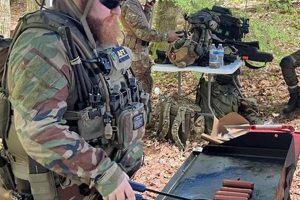
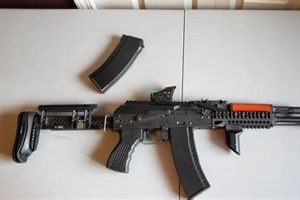
An outdoor recreational activity centered around simulated combat scenarios, involves participants using realistic imitation firearms that discharge non-lethal projectiles. These engagements typically occur in expansive, varied terrains designed to mimic real-world environments.
This form of simulated combat offers several advantages, including promoting physical activity, strategic thinking, and teamwork. Participants develop communication skills, learn to adapt to dynamic situations, and experience the adrenaline rush of tactical maneuvering. Historically, such simulations have been used for military training and team-building exercises, highlighting the value of coordinated action and strategic planning.
The following sections will detail specific aspects of this activity, including equipment selection, safety protocols, field characteristics, and common game types played at dedicated venues.
Essential Guidance for Simulated Combat Engagements
The following recommendations provide valuable insight into optimizing performance and ensuring safety during outdoor simulated combat scenarios.
Tip 1: Prioritize Eye Protection. Full-seal goggles meeting ANSI Z87.1 standards are non-negotiable. Impacts from projectiles can cause serious eye injuries. Verify goggles fit securely and do not fog easily. Replace scratched or damaged lenses immediately.
Tip 2: Understand Field Regulations. Before engaging in any activity, thoroughly review and adhere to the established rules of engagement, boundaries, and prohibited zones. Non-compliance can result in expulsion from the premises and potential injury.
Tip 3: Maintain Equipment Integrity. Regularly inspect equipment for wear and tear. Ensure imitation firearms are properly maintained and operating within velocity limits. Malfunctioning equipment can compromise safety and performance.
Tip 4: Communicate Effectively. Clear and concise communication is critical for coordinated movement and tactical success. Utilize pre-established hand signals and radio protocols to relay information efficiently and avoid misinterpretations.
Tip 5: Practice Situational Awareness. Maintain a constant awareness of surroundings, including terrain features, teammate positions, and potential enemy locations. Anticipate threats and react accordingly.
Tip 6: Emphasize Fair Play. Adhere to the honor system and call oneself out when hit. Dishonest behavior undermines the integrity of the game and creates a negative experience for all participants.
The implementation of these guidelines fosters a safer, more enjoyable, and ultimately more rewarding experience. Adherence to best practices enhances both individual performance and overall gameplay.
The subsequent section will delve into advanced tactical considerations and strategic planning.
1. Terrain Variety

Terrain variety plays a crucial role in simulated combat engagements, significantly impacting tactical approaches, engagement distances, and overall gameplay experience. The diversity of terrain features necessitates adaptable strategies and specialized skills from participants.
- Impact on Engagement Distances
Differing terrain types dictate optimal engagement distances. Open fields favor longer-range engagements requiring precision and marksman skills, while dense woodland environments necessitate close-quarters combat tactics and specialized equipment such as shorter-barreled imitation firearms.
- Influence on Movement and Cover
The availability of cover varies significantly with terrain. Urban environments provide ample cover in the form of buildings and vehicles, while wooded areas offer concealment through trees and foliage. Effective use of cover is paramount for survival and tactical advantage.
- Strategic Planning Considerations
Terrain dictates strategic planning and tactical decision-making. Elevated positions offer superior vantage points, while choke points can be exploited for defensive advantages. Successful teams adapt their strategies to exploit the terrain’s inherent advantages.
- Environmental Realism and Immersion
Diverse terrain enhances the realism and immersive quality of the simulation. The presence of varied landscapes, from rocky outcrops to water features, contributes to a more authentic and engaging experience for participants.
These facets of terrain variety collectively enhance the strategic depth, tactical complexity, and overall enjoyment of the simulated combat experience. A well-designed field incorporates a diverse range of terrain features, challenging participants to adapt their strategies and skills to overcome environmental obstacles.
2. Scenario Diversity

The breadth of available scenarios significantly enhances the engagement, strategic depth, and replayability of simulated combat activities. A diverse array of scenarios challenges participants to adapt their tactics, refine their skills, and engage in varied forms of teamwork.
- Adaptability and Tactical Flexibility
Varied scenarios, such as capture-the-flag, team deathmatch, and objective-based missions, demand distinct tactical approaches. Participants must adapt their strategies based on the scenario’s specific rules, objectives, and terrain configurations. This adaptability fosters tactical flexibility and problem-solving skills.
- Skill Diversification
Different scenarios emphasize different skill sets. Capture-the-flag requires swift movement and coordination, while objective-based missions necessitate strategic planning and communication. This skill diversification broadens the range of competencies developed through participation.
- Replayability and Long-Term Engagement
A diverse scenario pool significantly enhances replayability. Repeated play of the same scenario can become monotonous; however, a wide selection of game types ensures continuous engagement and sustained interest over time.
- Real-World Simulation
Well-designed scenarios often mimic real-world military and law enforcement operations. These simulations provide participants with a glimpse into the complexities of tactical decision-making and the importance of teamwork in high-pressure environments.
The incorporation of scenario diversity enhances the overall experience. A balanced selection of scenario types provides participants with a comprehensive and engaging activity, fostering adaptability, skill diversification, and sustained interest.
3. Safety Protocols

Stringent safety protocols are fundamental to responsible participation in simulated combat activities. The adherence to these guidelines minimizes risk of injury and ensures a positive experience for all participants. These protocols encompass equipment standards, field regulations, and participant conduct.
- Mandatory Eye Protection
Full-seal goggles meeting ANSI Z87.1 impact rating standards are non-negotiable. Projectiles, regardless of velocity, pose a significant risk to ocular health. Consistent use of approved eye protection mitigates this risk.
- Velocity Limits and Equipment Inspection
Designated velocity limits for imitation firearms are strictly enforced. Chronographs are used to verify compliance. Regular equipment inspections identify and address potential malfunctions, preventing accidental injuries.
- Field Rules and Designated Safe Zones
Established field rules govern engagement distances, permissible firing zones, and prohibited areas. Designated safe zones provide areas for rest, equipment adjustments, and communication, free from projectile discharge.
- Participant Conduct and Sportsmanship
Emphasis is placed on honest gameplay and respectful interaction. The “honor system” requires participants to acknowledge being hit by a projectile. Unsportsmanlike conduct, including intentional rule violations, is strictly prohibited.
The consistent implementation and enforcement of comprehensive safety protocols are essential. Prioritizing participant well-being fosters a positive environment, promoting responsible engagement. Compliance with these guidelines is paramount for the sustained enjoyment and safety of simulated combat activities.
4. Equipment Standards
The establishment and enforcement of equipment standards are critical elements within the operational framework of outdoor simulated combat venues. These standards are designed to mitigate risk, ensure fair play, and maintain a consistent level of performance across all participants.
- Velocity Limitations
Imitation firearms must adhere to specific velocity limits, typically measured in feet per second (FPS) using .20g BBs. These limits vary based on field regulations and intended engagement distances. Exceeding prescribed velocity limits poses a significant safety hazard and is strictly prohibited. Chronograph testing is employed to verify compliance before and during gameplay.
- Protective Gear Requirements
Minimum protective gear standards typically include full-seal eye protection meeting ANSI Z87.1 impact ratings. Additional protective gear, such as face masks, gloves, and body armor, may be required or recommended, depending on the field and game type. Ensuring adequate protection minimizes the risk of injury from projectile impacts.
- Imitation Firearm Authenticity and Functionality
While realism is often a desirable attribute, imitation firearms must function safely and reliably. Modifications that compromise safety, such as increasing velocity beyond regulated limits, are prohibited. Fields often require specific safety features, such as trigger locks or barrel covers, when imitation firearms are not in active use.
- Ammunition Specifications
Only approved types of ammunition, typically biodegradable plastic BBs, are permitted. The use of metal or other non-approved projectiles is strictly forbidden due to the increased risk of injury. Restrictions may also be placed on BB weight, as heavier BBs can achieve higher kinetic energy, even within velocity limits.
These facets of equipment standards collectively contribute to a safer and more equitable simulated combat environment. Enforcement of these standards is essential for preserving the integrity of the activity and ensuring a positive experience for all participants. Deviations from these standards compromise safety and undermine the principles of fair play, highlighting their importance for structured and regulated venues.
5. Team Coordination

Effective team coordination represents a pivotal element influencing success and safety within simulated combat activities. Unlike individual pursuits, these engagements frequently demand synchronized movements, shared strategic insights, and clear communication channels to achieve defined objectives. Deficiencies in team coordination typically result in tactical disadvantages, increased vulnerability, and compromised mission outcomes. Real-world military and law enforcement operations underscore the criticality of coordinated action. A squad’s ability to execute maneuvers, suppress enemy positions, and adapt to evolving circumstances depends heavily on seamless communication and a shared understanding of the operational plan. Similarly, in simulated combat, teams that effectively communicate their intentions, relay enemy positions, and support each other’s movements demonstrate a distinct advantage.
Consider a scenario where a team intends to capture a designated objective. Without coordinated action, individual members might advance without supporting fire, exposing themselves to concentrated opposition. Alternatively, a lack of communication might lead to team members unknowingly flanking the same position, leaving other avenues unguarded. In contrast, a well-coordinated team executes a synchronized assault, with some members providing suppressive fire while others advance under cover, minimizing risk and maximizing the chances of objective capture. Similarly, a defensive strategy benefits significantly from coordinated positioning and communication. Team members can establish interlocking fields of fire, providing mutual support and preventing opponents from exploiting gaps in the defensive line. Effective coordination also allows for rapid response to flanking maneuvers or breaches in the perimeter.
In summary, team coordination is not merely a desirable attribute but an essential component of successful engagement in simulated combat activities. Its absence can lead to tactical disadvantages and increased risk, while its presence enhances mission effectiveness and participant safety. Recognizing and prioritizing the development of team coordination skills is paramount for participants seeking to maximize their performance and enjoyment of the activity.
6. Objective-Based Gameplay
The connection between objective-based gameplay and simulated combat engagements is intrinsic. The inclusion of clearly defined objectives transforms what might otherwise be unorganized skirmishes into structured, strategic conflicts. These objectives provide participants with a framework for decision-making, tactical planning, and coordinated action, ultimately enhancing the immersive quality and strategic depth of the experience. Examples of common objectives include capture-the-flag, bomb defusal, hostage rescue, and territorial control, each demanding distinct tactical approaches and team compositions.
The practical significance of understanding objective-based gameplay lies in its direct correlation with tactical success and participant satisfaction. Teams that effectively prioritize objective completion, rather than simply focusing on eliminating opposing players, are more likely to achieve victory. Furthermore, the pursuit of defined objectives encourages teamwork, communication, and strategic thinking, fostering a more engaging and rewarding experience for all participants. The focus on objectives also promotes a sense of purpose and direction, transforming the simulated combat environment from a chaotic free-for-all into a structured, goal-oriented activity. For example, a team tasked with defending a specific location must coordinate defensive positions, establish communication lines, and anticipate potential enemy attack vectors. The successful defense of the objective requires a shared understanding of the mission and a coordinated effort from all team members.
In conclusion, objective-based gameplay serves as a cornerstone of the simulated combat experience. By providing clear goals, objectives enhance strategic depth, promote teamwork, and elevate participant engagement. This connection underscores the importance of incorporating well-defined objectives into all simulated combat scenarios, maximizing the potential for a challenging, rewarding, and immersive experience. The challenge lies in designing objectives that are both engaging and strategically meaningful, requiring careful consideration of terrain, team dynamics, and gameplay balance.
7. Community Engagement

Community engagement represents a critical, yet often overlooked, component of the simulated combat activity centered around dedicated venues. This engagement fosters a sense of shared purpose, promotes responsible conduct, and sustains the long-term viability of these activities. Its absence can lead to fragmented participation, a decline in ethical standards, and ultimately, the erosion of the community itself. The simulated combat activity relies on a delicate balance between competitive gameplay and cooperative community building. Consider, for example, organized events that incorporate charitable fundraising. Such events not only provide participants with opportunities for engagement but also contribute positively to the broader community, fostering goodwill and promoting a positive image of the activity.
The practical significance of understanding community engagement is evident in its ability to address several key challenges. A strong community can self-regulate behavior, ensuring adherence to safety protocols and promoting fair play. Experienced players often mentor newer participants, imparting knowledge and instilling ethical values. Furthermore, community-driven initiatives, such as field maintenance and improvement projects, enhance the overall experience for all participants. A contrasting scenario involves a venue where community engagement is lacking. In such environments, rule violations may go unchecked, leading to a decline in safety and fair play. Newcomers may feel isolated and discouraged, and the overall sense of camaraderie is diminished. This can ultimately result in a decline in participation and the closure of the venue.
In conclusion, community engagement is inextricably linked to the success and sustainability of venues dedicated to outdoor simulated combat engagements. By fostering a sense of shared purpose, promoting responsible conduct, and providing opportunities for mentorship and collaboration, community engagement creates a positive and supportive environment for all participants. Recognizing and actively cultivating community engagement is essential for ensuring the long-term viability and ethical integrity of this activity. Failure to prioritize community engagement can result in fragmentation, declining standards, and ultimately, the erosion of the activity’s inherent value.
Frequently Asked Questions
The subsequent section addresses common inquiries pertaining to the simulated combat activity at a specific venue. Responses are provided to clarify procedures and expectations.
Question 1: What constitutes acceptable eye protection?
Full-seal goggles meeting ANSI Z87.1 impact standards are the sole acceptable form of eye protection. Mesh goggles are explicitly prohibited due to inadequate protection against projectile fragmentation.
Question 2: Are there age restrictions for participation?
Participants under the age of 18 typically require parental consent. The minimum age for unsupervised participation is generally 16, but specific requirements vary. Verification is mandatory.
Question 3: What is the velocity limit for imitation firearms?
The established velocity limit is 400 feet per second (FPS) when using .20g BBs. Chronograph testing is mandatory to ensure compliance. Firearms exceeding this limit are prohibited.
Question 4: Is rental equipment available?
Rental packages, including imitation firearms, eye protection, and tactical vests, are generally available for a fee. Availability and pricing are subject to change. Advance reservations are recommended.
Question 5: What clothing is recommended?
Durable clothing that provides adequate protection against abrasions and impacts is recommended. Long sleeves, long pants, and sturdy footwear are advisable. Camouflage attire is permitted but not required.
Question 6: Are there restrictions on ammunition type?
Biodegradable plastic BBs are the only permissible ammunition type. BBs of .20g to .28g are generally recommended for optimal performance and accuracy. The use of metal or other non-approved projectiles is strictly prohibited.
Adherence to these guidelines promotes a safe and enjoyable experience. It is incumbent upon all participants to familiarize themselves with and abide by these regulations.
The subsequent section will delve into advanced tactical considerations and strategic planning.
Concluding Assessment
The exploration of simulated combat activities, often associated with venues like harris farm airsoft, reveals a complex landscape encompassing safety protocols, equipment standards, team coordination, and community engagement. Adherence to established guidelines is paramount for mitigating risk and fostering a positive environment.
Continued emphasis on responsible conduct, ethical gameplay, and community building is essential for the sustained viability of these activities. A commitment to safety, fairness, and collaboration will ensure that simulated combat engagements remain a valuable and enriching experience for all participants.

![KSC Airsoft: Realistic GBB Airsoft - [Shop Now!] | Ultimate Airsoft Guide for Beginners, Tactics & Gear Reviews](https://airsoftica.com/wp-content/uploads/2026/04/th-414-300x200.jpg "KSC Airsoft: Realistic GBB Airsoft - [Shop Now!] Ultimate Airsoft Guide for Beginners, Tactics & Gear Reviews")