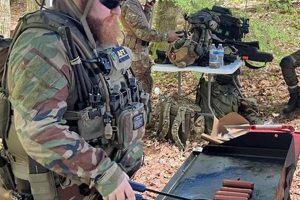
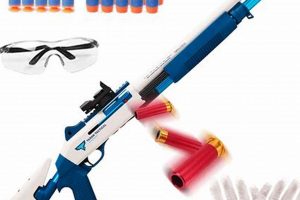
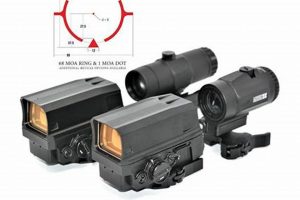
This recreational activity involves simulated combat using realistic replica firearms that fire non-lethal, biodegradable projectiles. Participants engage in organized games and scenarios, often in outdoor or purpose-built indoor arenas, fostering teamwork and strategic thinking. Safety protocols are rigorously enforced, requiring protective gear and adherence to established rules of engagement.
Participation offers various advantages, including physical exercise, mental stimulation through tactical planning, and social interaction within a community. Historically, such activities have evolved from military training simulations to become popular forms of entertainment and recreation, providing a safe and controlled environment for individuals to experience aspects of combat strategy without real-world consequences. The emphasis on fair play and responsible firearm handling contributes to a positive and ethical sporting environment.
The following sections will delve into specific aspects of this activity, including equipment considerations, gameplay strategies, safety regulations, and the broader impact on the community. These topics will provide a deeper understanding of the elements that contribute to this engaging and increasingly popular pastime.
Strategic Guidance for the Airsoft Participant
The following guidance aims to enhance the participant’s experience and effectiveness in the airsoft environment. Emphasis is placed on strategic planning, equipment maintenance, and adherence to safety protocols.
Tip 1: Prioritize Eye Protection: Full-seal goggles or a full face mask are non-negotiable. Ensure the chosen eye protection meets or exceeds ANSI Z87.1 impact standards. Failure to do so risks serious injury.
Tip 2: Understand Site Rules: Each venue establishes specific rules regarding FPS limits, engagement distances, and allowed equipment. Familiarization with, and adherence to, these regulations is paramount for safety and fair play.
Tip 3: Communicate Effectively: Clear and concise communication within a team is crucial for coordinated movement and tactical advantage. Establish pre-determined signals and terminology.
Tip 4: Maintain Equipment: Regular cleaning and maintenance of airsoft replicas will ensure reliable performance. Lubrication of internal components and proper battery storage are essential.
Tip 5: Utilize Cover Effectively: Movement between points of cover should be deliberate and planned. Avoid prolonged exposure in open areas.
Tip 6: Manage Ammunition: Conserve ammunition by utilizing short, controlled bursts of fire. Avoid indiscriminate firing, which can quickly deplete available rounds.
Tip 7: Adapt to the Environment: The playing fields terrain and layout dictate optimal strategies. Adjust tactics based on the specific features of the environment.
Mastery of these tips will contribute to a more successful and enjoyable experience. Strategic thinking, equipment preparedness, and adherence to established rules are fundamental to responsible and effective participation.
The concluding section will summarize the key aspects discussed, highlighting the overall importance of safety, teamwork, and responsible engagement in this recreational activity.
1. Safety Regulations

Safety Regulations are a foundational component, mitigating the inherent risks associated with simulated combat. These regulations, encompassing mandatory protective gear and site-specific guidelines, are designed to minimize potential injuries and promote a controlled environment. For instance, adherence to specific eye protection standards, such as ANSI Z87.1, is crucial in preventing eye injuries from projectile impact. Similarly, velocity limits on airsoft replicas are enforced to reduce the force of impact and minimize the risk of bruising or skin penetration. Ignoring these safety regulations can lead to severe consequences, including permanent vision impairment or other physical harm.
Furthermore, site-specific rules address unique environmental hazards and operational procedures. A woodland site, for example, may have restrictions on pyrotechnics to prevent wildfires, while an indoor arena might mandate specific engagement distances to avoid close-quarters injuries. Marshal oversight and pre-game safety briefings ensure that participants are fully aware of these regulations and their enforcement. Regular equipment checks verify compliance with velocity limits, further contributing to a secure environment. A failure to uphold these standards not only jeopardizes individual well-being but also undermines the integrity and reputation of this recreational activity.
In conclusion, Safety Regulations form the bedrock of responsible and enjoyable participation. Their consistent and rigorous enforcement is not merely a formality but a critical element that distinguishes it from uncontrolled environments. The emphasis on safety protocols fosters a secure setting, enabling participants to engage in this strategic and physical activity with reduced risk, while upholding a standard of fair play and responsible conduct.
2. Tactical Gameplay
Tactical Gameplay, a core element, significantly impacts the participant’s experience and success within this recreational activity. It involves strategic planning, coordinated movements, and adaptability to dynamic field conditions. The cause-and-effect relationship is evident: effective tactical decisions lead to advantageous positioning, successful objective completion, and ultimately, enhanced team performance. Conversely, poor tactical choices result in vulnerability, missed opportunities, and potential defeat. The importance of Tactical Gameplay cannot be overstated; it transforms the activity from a simple shooting exercise into a complex, mentally stimulating exercise that demands critical thinking and teamwork.
Consider a scenario involving the capture of a fortified position. A team employing sound Tactical Gameplay principles would first conduct reconnaissance to identify potential entry points and defensive weaknesses. They would then coordinate a multi-pronged assault, utilizing suppressing fire to cover advancing teammates, flanking maneuvers to bypass entrenched defenders, and clear communication to maintain situational awareness. In contrast, a team relying solely on individual initiative and lacking a cohesive tactical plan would likely suffer heavy casualties and fail to achieve the objective. Practical applications extend beyond specific scenarios; the ability to assess risks, prioritize objectives, and adapt to changing circumstances translates to improved decision-making skills applicable in various real-world contexts.
In summation, Tactical Gameplay is intrinsically linked to successful participation. Its emphasis on strategic thinking, coordinated action, and adaptability fosters a more engaging and rewarding experience. Challenges such as limited resources, unpredictable opponent behavior, and complex terrain necessitate continuous refinement of tactical skills. By understanding and applying these principles, participants enhance their individual capabilities and contribute to a more dynamic and strategic environment. The broader theme highlights the value of this recreational activity as a platform for developing critical thinking, problem-solving, and teamwork skills.
3. Equipment Standards
Equipment Standards within this activity are crucial for ensuring safety, fair play, and consistent performance. These standards govern the specifications, maintenance, and usage of replicas, protective gear, and other accessories. Adherence to these regulations is not merely a suggestion but a requirement for participation.
- Velocity Limits
Velocity limits are a primary component, restricting the muzzle velocity of airsoft replicas to specific thresholds, typically measured in feet per second (FPS) with 0.20g BBs. These limits vary depending on the type of replica and the intended gameplay environment, with indoor arenas often having lower FPS limits than outdoor fields. Enforcement through chronograph testing before gameplay ensures compliance and mitigates the risk of injuries caused by excessively powerful replicas.
- Protective Gear Requirements
Mandatory protective gear forms another critical aspect, safeguarding participants from potential injuries. Full-seal eye protection that meets or exceeds ANSI Z87.1 impact standards is universally required, protecting against BB impacts. Many venues also mandate or strongly recommend face protection, such as lower face masks or full face masks, to prevent dental and facial injuries. Additional protective gear, including gloves, vests, and knee pads, provides further protection and enhances comfort.
- Replica Modifications
Restrictions on replica modifications are implemented to maintain fair play and prevent unsafe alterations. Modifications that increase the replica’s firing rate beyond specified limits or alter its external appearance to resemble real firearms too closely may be prohibited. Internal modifications that compromise the replica’s safety or reliability are also generally restricted. These regulations aim to prevent participants from gaining an unfair advantage and maintain a consistent standard of replica performance.
- BB Weight and Type
Specifications for BB weight and type dictate the projectiles used in gameplay. Biodegradable BBs are often mandated for outdoor fields to minimize environmental impact. BB weight influences the replica’s range, accuracy, and energy delivery, with heavier BBs generally providing greater stability and resistance to wind. Regulations may specify allowable BB weights for different replica types to maintain performance balance and safety.
These facets of Equipment Standards are interconnected and collectively contribute to a safe and equitable environment. The uniform application of these standards ensures that all participants operate within defined parameters, fostering a level playing field and minimizing the potential for accidents. For example, failure to adhere to velocity limits not only increases the risk of injury but also disrupts the performance balance, allowing participants with excessively powerful replicas to gain an unfair advantage. Strict enforcement of Equipment Standards is therefore essential for maintaining integrity and fostering a positive experience.
4. Team Communication

Team Communication constitutes a foundational element contributing directly to success. This encompasses clear, concise exchange of information regarding enemy positions, planned maneuvers, and strategic adjustments. The cause-and-effect relationship is discernible: effective communication facilitates coordinated movements, leading to tactical advantages and ultimately, enhanced team performance. Conversely, lapses in communication result in disorganization, confusion, and increased vulnerability. Within a dynamic combat simulation environment, reliance on individual action without integrated communication often leads to predictable outcomes, such as flanking maneuvers succeeding against isolated units or ambushes succeeding due to lack of shared intelligence.
Consider a scenario involving a multi-objective game mode. One team, leveraging consistent and clear radio communication, can swiftly relay information about enemy movements between dispersed squads. This enables rapid response to developing threats and allows for efficient allocation of resources. Contrast this with a team that relies solely on visual sightings or infrequent communication. Their response time is inherently slower, leaving them susceptible to exploitation by a well-coordinated adversary. Further illustrating this, simulated urban combat scenarios highlight the criticality of concise communication through pre-established codes and signals, enabling effective room clearing and navigation within complex environments while minimizing the risk of friendly fire incidents.
In summary, Team Communication plays an indispensable role in determining team effectiveness. Its strategic value extends beyond mere information exchange, fostering cohesion, facilitating adaptability, and promoting synergistic action. Challenges inherent in maintaining clear communication under simulated combat stress underscore the importance of consistent training and refinement of communication protocols. The broader implications highlight the activity’s capacity to cultivate leadership skills, instill teamwork values, and promote effective interpersonal interaction in high-pressure environments. These aspects synergize to enhance both individual and collective performance.
5. Field Dynamics

Field Dynamics, a crucial aspect, significantly influences the tactical approaches employed within this simulated combat activity. It encompasses the study and utilization of terrain features, environmental conditions, and spatial relationships to gain strategic advantages. A cause-and-effect relationship exists: thorough comprehension of field dynamics leads to optimized movement, improved concealment, and effective engagement strategies. Its importance as a component is evident in its direct impact on mission success, dictating weapon selection, team positioning, and overall tactical flow. For example, utilizing dense woodland for ambush tactics contrasts sharply with open field engagements requiring longer-range weaponry and dispersed formations.
Practical significance is demonstrated through real-world examples. In an urban environment, the utilization of building corners, doorways, and elevated positions provides cover and vantage points for controlling key sectors. Conversely, a sprawling woodland field necessitates camouflage, silent movement techniques, and an understanding of natural cover. Variations in weather conditions, such as fog or rain, further influence visibility and communication, demanding adaptability in tactical plans. Analyzing opponent movement patterns and exploiting predictable routes through terrain features represent critical applications of understanding field dynamics. Success relies on recognizing how terrain characteristics impact sightlines, movement speed, and overall engagement effectiveness.
Understanding field dynamics presents inherent challenges, including unpredictable weather conditions, evolving terrain configurations, and the need for rapid adaptation to changing circumstances. Overcoming these challenges requires constant observation, effective communication, and a willingness to adjust pre-planned strategies based on real-time assessments of the environment. Integrating a deep understanding of field dynamics into tactical protocols enhances survivability, increases mission effectiveness, and underscores the importance of this component within the broader context of a simulated combat environment.
Frequently Asked Questions
The following addresses common inquiries regarding participation and operational protocols. The intent is to clarify potential uncertainties and provide comprehensive information.
Question 1: What constitutes acceptable eye protection?
Acceptable eye protection is defined as full-seal goggles or a full-face mask meeting or exceeding ANSI Z87.1 impact standards. Mesh goggles are generally prohibited due to the potential for projectile fragments to penetrate the weave.
Question 2: What are the established FPS limits?
FPS limits vary depending on the replica type and intended gameplay area. Indoor arenas typically enforce lower FPS limits, generally between 300 and 350 FPS with 0.20g BBs. Outdoor fields often permit higher FPS limits, potentially up to 400 FPS for AEGs and higher for sniper rifles, subject to minimum engagement distances.
Question 3: What are the restrictions on replica modifications?
Modifications that increase the replica’s firing rate beyond specified limits or alter its external appearance to resemble real firearms too closely are prohibited. Internal modifications that compromise the replica’s safety or reliability are also restricted. Marshal discretion prevails in determining the acceptability of specific modifications.
Question 4: Are biodegradable BBs required?
Biodegradable BBs are generally mandated for outdoor fields to minimize environmental impact. The use of non-biodegradable BBs may result in expulsion from the premises.
Question 5: What is the procedure for reporting safety violations?
Observed safety violations should be reported immediately to a marshal. Marshals possess the authority to issue warnings, suspend gameplay privileges, or expel participants for egregious violations.
Question 6: What is the policy regarding minimum engagement distances?
Minimum engagement distances are enforced to prevent close-range injuries. Sniper rifles and high-powered replicas typically require longer engagement distances, often 50 feet or more. Failure to adhere to minimum engagement distances may result in disciplinary action.
The aforementioned information represents a synopsis of prevalent concerns. Participants are encouraged to consult the comprehensive rulebook for detailed guidelines.
The subsequent section will delve into participant testimonials and community perspectives, providing anecdotal insights into the experience.
Conclusion
This exploration has dissected key elements, including safety regulations, tactical gameplay, equipment standards, team communication, and field dynamics. It has emphasized their interconnectivity in shaping the experience. The importance of these aspects for participant safety, fair play, and strategic depth has been detailed, underlining the activity’s complex interplay of physical exertion, mental acuity, and social interaction.
Ongoing diligence in safety protocol enforcement, coupled with continuous refinement of tactical strategies and equipment standards, is vital. This commitment safeguards participants and ensures the activity’s continued growth as a responsible and engaging recreational pursuit.
![KSC Airsoft: Realistic GBB Airsoft - [Shop Now!] | Ultimate Airsoft Guide for Beginners, Tactics & Gear Reviews](https://airsoftica.com/wp-content/uploads/2026/04/th-414-300x200.jpg "KSC Airsoft: Realistic GBB Airsoft - [Shop Now!] Ultimate Airsoft Guide for Beginners, Tactics & Gear Reviews")