



The functionality of airsoft revolves around the use of low-power air guns designed to shoot non-metallic spherical projectiles, commonly referred to as BBs. These projectiles are typically 6mm or 8mm in diameter. A compressed gas, spring, or electric motor powers the mechanism that propels the BB out of the airsoft gun’s barrel.
Understanding this mechanism is fundamental to appreciating the strategic and recreational aspects of the game. The relatively low projectile velocity ensures player safety while still allowing for realistic tactical simulations. The sports origins lie in Japan, where firearm ownership is restricted, and it has since grown into a global activity enjoyed by individuals seeking team-based competitive play.
Examining the inner workings of the guns, the various power sources used, and the safety equipment involved provides a thorough understanding of this popular activity. Key considerations include the types of guns, the power sources they utilize, and the necessary protective gear required for safe participation.
Airsoft Operation
To ensure effective participation and maintain equipment longevity, several operational tips are crucial. These guidelines encompass equipment maintenance, tactical awareness, and adherence to safety protocols.
Tip 1: Regularly Maintain Airsoft Guns: Consistent cleaning and lubrication are essential for proper functionality. Disassembling the gun to clean the barrel and lubricate moving parts prevents jams and ensures consistent projectile velocity. This practice extends the lifespan of the equipment.
Tip 2: Understand Power Source Limitations: Whether utilizing gas, spring, or electric power, each type has distinct operational parameters. Gas-powered guns may experience pressure fluctuations due to temperature changes, while electric guns require properly charged batteries. Recognizing these limitations optimizes performance.
Tip 3: Prioritize Eye Protection: Full-seal goggles or a mask that meets ANSI Z87.1 standards is non-negotiable. Airsoft projectiles can cause serious eye injury; therefore, quality eye protection is the foremost safety consideration.
Tip 4: Adhere to Field Velocity Limits: Chronograph airsoft guns before each game to ensure they meet the field’s stipulated velocity limits (typically measured in feet per second or FPS). Exceeding these limits poses a safety risk to other players and can result in ejection from the game.
Tip 5: Practice Safe Muzzle Control: Treat every airsoft gun as if it were loaded. Keep the muzzle pointed in a safe direction at all times, even when not actively engaged in gameplay. This habit minimizes the risk of accidental discharge and potential injury.
Tip 6: Utilize Appropriate BB Weight: The weight of the BB influences its trajectory and range. Lighter BBs are suitable for close-quarters combat, while heavier BBs offer greater accuracy and range in outdoor environments. Experimentation will determine the optimal BB weight for a given airsoft gun and playing style.
Tip 7: Communicate Effectively with Teammates: Airsoft is a team-based activity. Clear communication regarding enemy positions, flanking maneuvers, and strategic objectives enhances overall effectiveness and contributes to a more organized and successful gameplay experience.
Implementing these measures maximizes the operational effectiveness of airsoft equipment and fosters a safe and enjoyable playing environment. Attention to detail and a commitment to safety are paramount.
Following these operational guidelines sets the stage for a more in-depth discussion of advanced airsoft tactics and strategies.
1. Compressed gas propulsion
Compressed gas propulsion represents a core operating principle for certain types of airsoft devices. The term specifically refers to the process by which a pressurized gas is used to generate the force necessary to expel a projectile from the airsoft gun. This mechanism is central to the operation of many airsoft pistols and some rifles, distinguishing them from spring-powered or electrically-powered counterparts. The efficacy of compressed gas propulsion directly impacts the range, velocity, and overall performance of the airsoft gun.
The practical application of compressed gas propulsion in airsoft typically involves the use of either carbon dioxide (CO2) or green gas, a form of propane mixed with silicone oil. These gases are stored in magazines or internal reservoirs within the airsoft gun. Upon activation of the trigger mechanism, a valve releases a controlled amount of gas, which then expands rapidly. This expansion generates the pressure that propels the BB projectile through the barrel. The consistency of gas pressure is critical; fluctuations can lead to variations in shot velocity, reducing accuracy and consistency.
In summation, compressed gas propulsion is a fundamental element in the operation of numerous airsoft guns. Its effectiveness is contingent upon maintaining consistent gas pressure and utilizing appropriate gas types. Comprehending this principle enables users to better understand the characteristics of their equipment and optimize their gameplay strategies. The specific gas used, and the design of the gas delivery system, all influence the performance of the airsoft device, making this a critical area of understanding for both recreational players and those engaged in competitive airsoft.
2. BB projectile mechanics
The successful operation of airsoft hinges significantly on the principles governing BB projectile mechanics. The launch of a spherical projectile, commonly referred to as a BB, is the culminating event within a chain of mechanical processes that define the functionality of an airsoft device. Understanding the factors that influence a BB’s flight path, velocity, and accuracy is crucial for both equipment design and effective gameplay. The interaction between the propelling force (gas, spring, or electric) and the BB, along with external factors like air resistance, directly affects the user’s ability to accurately engage targets.
The hop-up system is a prime example of how manipulating BB projectile mechanics enhances performance. By imparting backspin to the BB, this system creates a Magnus force, which counteracts gravity and extends the projectile’s range. Different BB weights and quality also play a critical role. Heavier BBs are less susceptible to wind drift, while higher-quality BBs exhibit more consistent dimensions and surface finishes, leading to more predictable trajectories. Variations in BB weight or quality can result in significant deviations from expected results. The physical properties of the projectile, therefore, are intrinsically linked to overall performance.
In conclusion, BB projectile mechanics is an indispensable aspect of the overall functionality. The characteristics of the BB, coupled with the design of the launching mechanism and the influence of external forces, dictate the efficacy of the airsoft system. A comprehensive understanding of these factors allows for informed equipment selection, optimized tactical decisions, and ultimately, improved performance in airsoft activities. Proper consideration of BB projectile mechanics is necessary to achieve the desired outcome of accurately and consistently hitting the intended target.
3. Gun power source

The power source of an airsoft gun directly dictates its operational characteristics, performance capabilities, and maintenance requirements. Its selection is a critical decision, impacting the player’s style of play and the overall experience. The different power sources available each possess distinct advantages and disadvantages that must be carefully considered.
- Spring-Powered Mechanisms
Spring-powered airsoft guns rely on a manual mechanism, where the user compresses a spring, storing potential energy that is then released to propel the BB. These guns are generally the most affordable and require no batteries or gas. However, their single-shot nature and lower rate of fire make them less suitable for sustained engagements. Examples include basic airsoft pistols and sniper rifles. Their simplicity also means lower maintenance requirements.
- Gas-Powered Systems
Gas-powered airsoft guns utilize compressed gas, typically green gas (propane mixed with silicone oil) or CO2, to propel the BB. These guns offer a higher degree of realism, often featuring blowback actions that simulate recoil. They generally have a higher rate of fire than spring guns but are subject to performance variations due to temperature fluctuations. Gas guns require careful maintenance to prevent leaks and ensure consistent performance. Pistols and some rifles utilize this method.
- Electric-Powered Airsoft Guns (AEGs)
Electric-powered airsoft guns, or AEGs, employ an electric motor to power a gearbox that compresses a spring and propels the BB. AEGs offer a high rate of fire and consistent performance, making them popular for both recreational and competitive play. They require rechargeable batteries and occasional gearbox maintenance. Most airsoft rifles are AEGs.
- High-Pressure Air (HPA) Systems
HPA systems use an external compressed air tank connected to the airsoft gun via a hose. These systems offer consistent pressure, adjustable velocity, and a near-silent operation. However, they are more complex and require specialized equipment, making them a more expensive option. They offer unparalleled control over performance characteristics.
The power source fundamentally determines how the equipment functions. Each system’s unique characteristics contribute to different playstyles and are important in selecting an appropriate weapon for the intended gameplay. The impact on velocity, rate of fire, maintenance needs, and operational cost links the power source directly to the core functionality of airsoft. Understanding these interrelations is vital for informed equipment choices and successful participation in activities.
4. Hop-up system

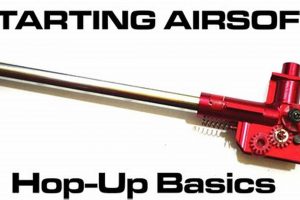
The hop-up system constitutes a critical element in the operation of an airsoft gun, influencing projectile trajectory and range. It works by imparting backspin to the BB as it exits the barrel. This backspin generates a Magnus force, an upward force perpendicular to both the direction of motion and the axis of rotation. This force counteracts the effects of gravity, allowing the BB to travel a greater distance than it would otherwise. Without a hop-up system, airsoft guns would exhibit a significantly reduced effective range, rendering them less practical for many gameplay scenarios. Adjusting the hop-up setting allows players to optimize the trajectory for varying BB weights and distances.
The practical significance of understanding the hop-up system is substantial. Field adjustments allow a user to account for atmospheric conditions such as wind. If the hop-up is set incorrectlyeither with too much or too little backspinthe BB’s trajectory will be negatively impacted. For example, a hop-up set too high will cause the BB to curve upwards excessively, reducing accuracy at longer ranges. Conversely, insufficient hop-up will result in the BB dropping rapidly. Proper adjustment requires a combination of observation and experimentation. Furthermore, the condition of the hop-up bucking (the rubber component that applies the backspin) is crucial. Wear and tear can diminish its effectiveness, necessitating replacement.
In summary, the hop-up system is an integral component that directly influences the performance of an airsoft gun. It is not merely an accessory but a fundamental element that allows for extended range and improved accuracy. Proper understanding, adjustment, and maintenance of the hop-up are essential for maximizing the effectiveness of airsoft weaponry and enhancing the overall gameplay experience. Neglecting the hop-up system significantly impairs the capacity to accurately engage targets at medium to long ranges, highlighting its importance in the broader context of airsoft functionality.
5. Gearbox mechanism

The gearbox mechanism is central to the operation of electric airsoft guns (AEGs), functioning as the power conversion and delivery system. Understanding the gearbox is essential to comprehending AEG functionality and overall how the system operates. It dictates rate of fire, power output, and reliability.
- Motor-Driven Operation
An electric motor, powered by a battery, initiates the gearbox operation. The motor’s rotation drives a series of gears, which ultimately compress a spring-loaded piston. This compression stores potential energy that is released upon trigger activation. The motor’s efficiency and torque directly affect the gearbox’s performance. Weak motors can lead to reduced rate of fire or failure to fully cycle the piston. High-torque motors, conversely, improve trigger response and allow for heavier springs.
- Piston and Cylinder Assembly
The piston and cylinder assembly is where the air compression necessary for propelling the BB occurs. The piston, driven by the gears, moves within the cylinder, compressing air. The cylinder’s volume and the piston’s seal affect the amount of air compressed and the pressure generated. Insufficient air volume can result in reduced range, while a leaky piston seal diminishes power output. Aftermarket piston heads and cylinders are often used to optimize air compression and seal.
- Gear Ratio and Rate of Fire
The gear ratio within the gearbox determines the rate of fire and torque output. Higher gear ratios (e.g., 13:1) prioritize a faster rate of fire but may reduce torque, potentially causing the motor to strain under heavier spring loads. Lower gear ratios (e.g., 18:1) provide increased torque, allowing for the use of stronger springs and heavier BBs, but at the cost of a reduced rate of fire. The selection of gears influences AEG’s performance characteristics, depending on the gameplay style.
- Trigger Mechanism and Cut-off Lever
The trigger mechanism initiates the cycling of the gearbox, while the cut-off lever ensures that only a single cycle occurs in semi-automatic mode. The trigger switch completes the electrical circuit, activating the motor. The cut-off lever disengages the motor after one cycle, preventing continuous fire. Wear and tear on these components can lead to malfunctions such as full-auto firing in semi-auto mode or trigger unresponsiveness.
The gearbox mechanism, as an integrated system, demonstrates how multiple components interact to produce the BB propulsion. Its efficiency and reliability are central to an AEG’s functionality. Optimization or modification of any single component necessitates careful consideration of its impact on the gearbox as a whole, directly connecting to “how does airsoft work”. This directly influences the playstyle and application of the equipment.
6. Battery type/voltage

The selection of battery type and voltage represents a critical factor in the operational dynamics of electric airsoft guns (AEGs). Battery specifications directly influence the AEG’s rate of fire, trigger response, and overall power output. Inadequate or inappropriate battery choice results in diminished performance or potential damage to the AEG’s internal components. For instance, utilizing a battery with insufficient discharge rate can cause the motor to stall, while employing a battery with excessive voltage can lead to premature wear or catastrophic failure of the electronic components, including the motor and the MOSFET (Metal-Oxide-Semiconductor Field-Effect Transistor), if present. The connection between battery attributes and AEG performance is therefore both direct and significant.
Common battery types used in AEGs include Nickel-Metal Hydride (NiMH) and Lithium Polymer (LiPo). NiMH batteries are generally considered more durable and less prone to damage but offer lower energy density and discharge rates compared to LiPo batteries. LiPo batteries, conversely, provide superior power output and lighter weight but require careful handling and charging to prevent damage or fire. Voltage determines the motor’s rotational speed; higher voltages typically result in increased rates of fire and improved trigger response. For example, upgrading from an 8.4V NiMH to a 9.6V NiMH will often noticeably increase the rate of fire. A similar upgrade from a 7.4V LiPo to an 11.1V LiPo provides a significant performance boost but requires careful assessment of the AEG’s compatibility to avoid damage. The MOSFET’s role in regulating current flow becomes increasingly important at higher voltages to protect the trigger contacts.
In summation, the correct selection of battery type and voltage is paramount to the efficient and safe operation of an AEG. A mismatch can lead to suboptimal performance or equipment damage. Understanding the specifications of both the battery and the AEG, combined with adherence to proper charging and handling procedures, ensures that the AEG operates within its design parameters and achieves its potential. The selection of the wrong battery may not allow the AEG to operate effectively. This relationship underscores the importance of battery selection as a key operational aspect.
7. Trajectory control

Trajectory control represents a critical element determining the efficacy of an airsoft device. Projectile trajectory is influenced by several factors, including initial velocity, air resistance, gravity, and the Magnus effect imparted by the hop-up system. Effective trajectory management directly translates to enhanced accuracy and the ability to engage targets at varying distances. Without precise trajectory control, the intended impact point becomes unpredictable, rendering the equipment functionally limited. An example of this limitation is observed when an airsoft gun is fired outdoors. Without the hop-up, the BB projectile will experience the full effect of gravity, causing it to drop quickly, and making it difficult to accurately engage long-range targets.
Practical application of trajectory control involves several considerations. Selection of appropriate BB weight is paramount; heavier BBs exhibit increased resistance to wind drift, while lighter BBs may offer higher initial velocities but are more susceptible to trajectory deviations. The hop-up system must be precisely adjusted to impart the optimal amount of backspin for the chosen BB weight and engagement range. Environmental conditions, such as wind and temperature, also exert influence on the BB’s flight path and necessitate real-time adjustments to aiming. Skillful trajectory management allows for accurate shot placement under dynamic and variable conditions, a critical advantage in competitive airsoft engagements. A real-world example: an experienced airsoft player encountering crosswinds will compensate by adjusting their point of aim slightly upwind, mitigating the effect of the wind on the BB’s trajectory and thus increasing the likelihood of hitting the target.
In summary, trajectory control is an intrinsic component of airsoft operations, fundamentally affecting weapon effectiveness. Mastery requires understanding of the physical forces acting on the projectile, adaptation to environmental factors, and precise adjustment of equipment settings. Challenges exist in consistently achieving accurate shot placement, particularly at longer ranges and under adverse weather conditions. Trajectory control knowledge links to the comprehensive understanding of “how does airsoft work” by emphasizing that accuracy and range are not solely dependent on power, but also on manipulating the BB’s flight path after it leaves the barrel. The skill in adjusting these variables represents a key differentiator between novice and experienced airsoft participants.
Frequently Asked Questions
The following section addresses common inquiries regarding the operational mechanisms and underlying principles of airsoft activities.
Question 1: How does an airsoft gun propel a BB?
Airsoft guns employ one of three primary mechanisms to launch a BB projectile: compressed gas, spring power, or electric motor. Gas-powered guns utilize compressed gas to propel the BB, while spring-powered guns rely on the release of a compressed spring. Electric-powered guns (AEGs) use an electric motor to drive a piston that compresses air and launches the BB.
Question 2: What role does the hop-up system play in airsoft?
The hop-up system imparts backspin to the BB as it exits the barrel. This backspin generates lift (Magnus effect), counteracting gravity and extending the BB’s range. Adjustment of the hop-up allows optimization of trajectory for varying BB weights and distances.
Question 3: What are the power source options for an airsoft gun?
Airsoft guns are powered by spring, gas, or electricity. Spring-powered guns are manually operated. Gas-powered guns typically use green gas or CO2. Electric-powered guns use rechargeable batteries to operate an internal motor.
Question 4: What types of BBs are used in airsoft, and do their weights matter?
Airsoft guns typically use 6mm or 8mm plastic BBs. BB weight significantly influences trajectory and range. Heavier BBs are generally less affected by wind and offer greater accuracy at longer distances.
Question 5: How does the gearbox in an electric airsoft gun (AEG) operate?
The gearbox in an AEG houses a series of gears driven by an electric motor. These gears compress a spring attached to a piston. Upon trigger activation, the piston is released, forcing air through a cylinder and propelling the BB.
Question 6: What safety precautions are essential when engaging in airsoft activities?
Mandatory safety equipment includes full-seal eye protection meeting ANSI Z87.1 standards. Adherence to field velocity limits (FPS) is critical. Safe muzzle control and responsible gun handling practices are also paramount to prevent injury.
Understanding these fundamental aspects contributes significantly to a comprehensive understanding of airsoft. This knowledge enables participants to make informed decisions regarding equipment selection, tactical approaches, and safe gameplay practices.
The next section explores advanced considerations in optimizing airsoft equipment and gameplay.
Concluding Remarks
The exploration of “how does airsoft work” reveals a multifaceted activity reliant on a combination of mechanical principles, projectile dynamics, and responsible operational practices. An effective engagement necessitates an understanding of compressed gas propulsion, BB projectile mechanics, power source variations, hop-up system adjustments, gearbox functions, battery specifications, and, critically, trajectory management. Each element influences overall performance.
Further, consistent adherence to safety regulations and an ongoing commitment to equipment maintenance are integral to a positive participation experience. A comprehensive knowledge base, complemented by disciplined application, ensures that airsoft activities can be engaged safely and proficiently. Continuing to refine this understanding fosters a more informed and conscientious airsoft community.




![Redwolf Airsoft: Find Discount Codes & Save [Year] | Ultimate Airsoft Guide for Beginners, Tactics & Gear Reviews](https://airsoftica.com/wp-content/uploads/2026/04/th-288-300x200.jpg "Redwolf Airsoft: Find Discount Codes & Save [Year] Ultimate Airsoft Guide for Beginners, Tactics & Gear Reviews")