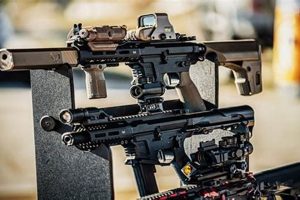
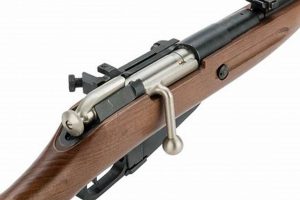
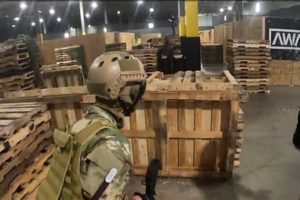
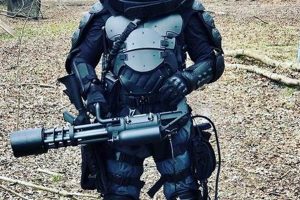
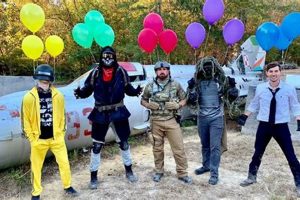
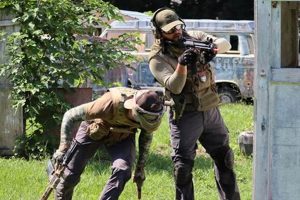
Activities involving simulated combat scenarios using realistic replica firearms, typically firing plastic projectiles, are a growing recreational pursuit. These activities often involve teams engaging in tactical missions within designated arenas or outdoor environments. Participants use protective gear and adhere to strict safety protocols to ensure a safe and controlled experience.
This form of recreational engagement provides opportunities for strategic thinking, teamwork, and physical activity. The organized events frequently foster camaraderie and sportsmanship among participants. The growth of this hobby reflects an increasing interest in immersive and engaging outdoor activities. Its origins can be traced to military simulation and training exercises adapted for civilian recreational use.
The following sections will further explore the practical aspects, equipment standards, safety regulations, and community impact associated with this popular recreational activity. Subsequent discussions will cover gear maintenance, field selection, and the ethical considerations that govern participation.
Essential Guidance for the Hobbyist
The following guidance provides crucial information for those involved in simulated combat activities utilizing realistic replica firearms. Adherence to these points will enhance performance and ensure a safe and enjoyable experience.
Tip 1: Prioritize Eye Protection: Full-seal goggles or a mask meeting ANSI Z87.1 standards are non-negotiable. Damage to eyesight is a permanent risk if adequate protection is not used.
Tip 2: Weapon Maintenance is Paramount: Regular cleaning and lubrication of the replica firearm will prevent malfunctions and ensure consistent performance. Neglect can lead to breakdowns during critical moments.
Tip 3: Know the Field Rules: Each field has specific regulations regarding velocity limits, engagement distances, and allowed equipment. Violating these rules can result in expulsion and potential injury.
Tip 4: Practice Responsible Firearm Handling: Treat the replica firearm as a real firearm. Keep the muzzle pointed in a safe direction, even when not in use, and avoid negligent discharges.
Tip 5: Communication is Key: Effective communication with teammates is vital for tactical success. Clear and concise information sharing about enemy positions and intentions can significantly improve performance.
Tip 6: Hydration and Physical Conditioning: Sustained physical activity requires adequate hydration and a reasonable level of fitness. Fatigue can lead to poor decision-making and increased risk of injury.
Tip 7: Understand Hop-Up Adjustment: Proper adjustment of the hop-up system is essential for achieving accurate shots at longer ranges. Experiment with different settings to find the optimal configuration for various ammunition weights.
Following these essential guidelines will contribute significantly to a safer, more effective, and more enjoyable experience. Safety and preparedness are foundational to responsible participation.
The subsequent sections will delve into specific equipment considerations and advanced tactical maneuvers, further enhancing the participant’s understanding of the intricacies of this hobby.
1. Safety protocols

Safety protocols are the bedrock upon which the integrity and viability of recreational simulated firearm activities rest. These protocols are not merely suggestions, but rather mandatory guidelines designed to mitigate inherent risks and ensure participant well-being.
- Mandatory Eye Protection
This is the first and most crucial line of defense against projectile-related injuries. Approved full-seal goggles or masks meeting ANSI Z87.1 standards are required at all times on the playing field. Failure to comply can result in immediate expulsion due to the severe consequences of eye injuries.
- Velocity Limits and Chronographing
Each replica firearm must adhere to strict velocity limits, typically measured in feet per second (FPS) with specific projectile weights. Fields commonly employ chronographing stations to verify compliance. Exceeding these limits can cause severe injury and is strictly prohibited.
- Minimum Engagement Distances (MED)
MEDs dictate the closest distance at which a replica firearm can be safely discharged at another participant. These distances vary depending on the replica firearm’s velocity and are enforced to prevent close-range injuries. Utilizing a sidearm or “bang-out” rule is often employed when MEDs cannot be maintained.
- Prohibited Areas and Actions
Designated safe zones, such as staging areas or parking lots, are strictly off-limits for firing replica firearms. Reckless behavior, such as blind firing around corners or engaging in physical altercations, is also prohibited and can result in severe penalties, including permanent bans.
The rigorous enforcement of these safety protocols is not merely a matter of policy, but a fundamental necessity. Their consistent application ensures a safer playing environment, fosters responsible participation, and preserves the long-term viability of simulated firearm activities as a recreational pursuit. Adherence demonstrates respect for fellow participants and a commitment to maintaining a positive and safe environment.
2. Equipment standards

Equipment standards are a critical component governing the operation and safety of simulated firearm activities. These standards dictate permissible replica firearm velocities, protective gear requirements, and projectile specifications, impacting the functionality and integrity of these engagements. The absence of defined equipment standards would introduce unacceptable risks to participants, compromising the overall integrity of the recreational activity.
As an example, velocity limits for replica firearms, typically measured in feet per second (FPS), directly influence the potential for injury. Exceeding established FPS thresholds can result in severe bruising, lacerations, or even eye damage. Therefore, adherence to these standards, coupled with mandatory chronograph testing, is imperative. Protective gear standards, encompassing eye protection (ANSI Z87.1 rated goggles) and facial protection, are similarly vital. Failure to employ appropriate protective equipment elevates the risk of significant injury, rendering the activity inherently unsafe. The quality and weight of the BB projectiles also play a vital role.
In summary, meticulously designed and consistently enforced equipment standards are indispensable to the safe and responsible practice of simulated firearm activities. They establish clear boundaries that minimize risk, promote fair play, and safeguard the well-being of all participants. Strict adherence demonstrates a commitment to safety and ensures the longevity and positive reputation of the recreational activity.
3. Field regulations

Field regulations are the formalized guidelines that govern conduct and activity within a designated play area for simulated firearm engagements. These regulations are crucial for ensuring a safe, fair, and enjoyable experience for all participants.
- Velocity Limits and Chronograph Procedures
Each field establishes maximum velocity limits for replica firearms, typically measured in feet per second (FPS) using a specific projectile weight. Chronographing, the process of measuring a replica firearm’s FPS, is conducted to ensure compliance. Failure to adhere to these limits results in immediate disqualification and potential expulsion due to the risk of injury.
- Minimum Engagement Distances (MED)
MEDs dictate the closest distance at which a replica firearm can be discharged at another participant. These distances vary depending on the replica firearm’s velocity and are enforced to prevent close-range injuries. Fields often implement specific rules or procedures, such as the use of sidearms or “bang-out” calls, when MEDs cannot be maintained.
- Designated Safe Zones and No-Fire Areas
Designated safe zones, such as staging areas or parking lots, are strictly off-limits for firing replica firearms. No-fire areas, such as buildings or specific landmarks, may also be established to protect the environment or prevent unintended consequences. Violations of these regulations result in penalties ranging from warnings to expulsion.
- Rules of Engagement and Gameplay Scenarios
Fields establish specific rules of engagement, outlining permissible actions and prohibited conduct during gameplay. These rules may include restrictions on types of ammunition, limitations on firing modes, or prohibitions against certain tactical maneuvers. Fields also design and implement various gameplay scenarios with specific objectives and rulesets, enhancing the strategic and tactical dimensions of the activity.
The strict enforcement and comprehensive understanding of field regulations are fundamental to responsible participation in simulated firearm activities. Adherence to these rules demonstrates respect for fellow participants, promotes a safer playing environment, and preserves the integrity of the overall experience.
4. Team coordination

Effective team coordination is a critical determinant of success in activities involving simulated firearm engagements. These activities often involve complex scenarios requiring synchronized movements, strategic communication, and a shared understanding of objectives. The degree to which a team can seamlessly coordinate its actions directly impacts its ability to achieve its goals, whether that involves capturing an objective, defending a position, or eliminating opposing forces. Lacking coordinated efforts, a team, regardless of individual skill levels, becomes fragmented and vulnerable. Real-world examples consistently demonstrate that well-coordinated teams outperform those lacking such cohesion, leading to tactical advantages and improved outcomes.
Further illustrating this point, consider the execution of a coordinated breach and clear operation. This maneuver requires precise timing, clear communication protocols, and a designated division of labor amongst team members. Each member must execute their assigned role with precision and in synchronization with the others to minimize risk and maximize effectiveness. If communication breaks down or individual roles are not performed correctly, the entire operation can be compromised, potentially leading to mission failure and increased risk of injury. The use of pre-established communication codes, standardized tactical maneuvers, and regular practice sessions reinforces team cohesion and coordination.
In summary, team coordination is not merely a beneficial aspect, but a fundamental requirement for effective engagement. Developing and maintaining high levels of team coordination requires focused training, clear communication, and a shared understanding of team objectives. Ignoring the importance of team coordination severely reduces a team’s effectiveness, highlighting its vital role in achieving success within this domain. Challenges related to team coordination highlight the need for robust communication protocols and comprehensive training programs.
5. Strategic Planning
Strategic planning is a fundamental component for success in simulated firearm activities. Effective planning provides a framework for coordinated action, maximizes resource utilization, and enhances the likelihood of achieving desired objectives within a dynamic and often unpredictable environment. The application of strategic principles distinguishes organized teams from those that rely solely on individual skill.
- Objective Definition and Prioritization
Strategic planning begins with a clear articulation of objectives. Are the goals focused on territory control, elimination of opposing forces, or completion of specific mission parameters? Prioritizing these objectives allows for the allocation of resources and the development of tactical approaches tailored to achieving the most critical goals first. For example, a team might prioritize securing a central high ground position before attempting to eliminate scattered opposing forces. This is the basis of the plan.
- Terrain Analysis and Resource Assessment
A comprehensive assessment of the playing field’s terrain is crucial. Identifying advantageous positions, chokepoints, and areas of concealment informs tactical decision-making. Simultaneously, assessing available resources, including team member skills, equipment limitations, and ammunition reserves, allows for a realistic appraisal of capabilities and constraints. For instance, understanding that a team has limited long-range weaponry might lead to a strategy focused on close-quarters engagements and flanking maneuvers. Plan also incorporates resources available and their impact to the plan.
- Contingency Planning and Adaptation
No plan survives first contact. Effective strategic planning includes the development of contingency plans to address unforeseen circumstances, such as unexpected enemy movements, equipment failures, or changes in environmental conditions. Teams must be prepared to adapt their strategies in real-time based on evolving battlefield dynamics. For example, a planned assault might need to be aborted due to heavy resistance, requiring a shift to a defensive posture or a flanking maneuver. The plans always have back-ups.
- Communication and Coordination Protocols
Strategic planning is ineffective without clear communication and well-defined coordination protocols. Establishing communication channels, pre-determined signals, and assigned roles ensures that team members can effectively share information, execute coordinated maneuvers, and respond to changing circumstances. The better the information, the better plan and coordination.
Integrating these strategic planning elements transforms participation in simulated firearm activities from a purely reactive engagement to a proactive and goal-oriented endeavor. The implementation of strategic planning enhances team effectiveness, minimizes risk, and fosters a more engaging and rewarding experience. The better is the plan, the better is outcome.
6. Skill Development
Participation in simulated firearm activities fosters the development of a diverse range of practical skills extending beyond the immediate context of gameplay. These skills, honed through repeated exposure to simulated tactical scenarios, can translate into enhanced performance in various real-world situations requiring problem-solving, teamwork, and situational awareness. The correlation between engagement in simulated firearm activities and the acquisition of these transferable skills underscores the practical significance of this recreational pursuit.
Skill development within this domain occurs across several key areas. Tactical decision-making is sharpened by the need to rapidly assess threats, anticipate enemy movements, and adapt strategies in real-time. Communication skills are enhanced through the necessity of clear and concise information exchange with teammates under pressure. Physical fitness improves as participants navigate dynamic environments, requiring endurance, agility, and spatial awareness. Consider a scenario where a team must secure a fortified position: participants must coordinate their movements, communicate effectively to identify and neutralize threats, and adapt their tactics based on changing circumstances. Successful execution requires proficiency in tactical planning, communication, and physical coordination, each contributing to demonstrable skill development.
The practical significance of skill development through simulated firearm activities lies in its potential to improve performance in diverse fields such as leadership roles, emergency response situations, and collaborative projects. While simulated, the high-stakes environment compels participants to develop and refine critical thinking skills that can be applied to real-world challenges. The challenges lie in recognizing and leveraging the transferability of these skills beyond the gaming context, and in promoting responsible participation that emphasizes ethical conduct and safety. The long-term benefits can extend beyond recreation to contribute to personal and professional growth.
Frequently Asked Questions
This section addresses commonly encountered inquiries regarding activities employing simulated firearms. The information provided aims to clarify misunderstandings and offer guidance based on established practices.
Question 1: What constitutes acceptable eye protection?
Acceptable eye protection consists of full-seal goggles or a full-face mask meeting ANSI Z87.1 impact resistance standards. Mesh goggles are generally discouraged due to potential projectile fragmentation.
Question 2: What replica firearm velocity is considered safe?
Safe replica firearm velocity varies depending on the field. However, velocities generally range from 350 to 400 feet per second (FPS) using 0.20g projectiles. Fields typically conduct chronographing to verify compliance.
Question 3: What is the purpose of minimum engagement distances (MED)?
MEDs are established to prevent injuries from close-range projectile impacts. MEDs vary depending on replica firearm velocity and are strictly enforced to ensure player safety.
Question 4: What behavior is considered unacceptable on the field?
Unacceptable behavior includes, but is not limited to, reckless firing, physical altercations, unsportsmanlike conduct, and disregard for established safety regulations. Such behavior may result in warnings, suspensions, or permanent expulsion.
Question 5: What responsibility do participants have regarding equipment maintenance?
Participants are responsible for maintaining their replica firearms in proper working order and ensuring compliance with velocity limits. Regular cleaning, lubrication, and inspection are recommended.
Question 6: What is the significance of team communication in tactical scenarios?
Effective team communication is crucial for tactical success. Clear and concise information sharing, coordinated movements, and pre-established communication protocols enhance team effectiveness and situational awareness.
This FAQ section provides essential information for participants. Understanding and adhering to these guidelines fosters a safer and more enjoyable experience.
The following section will explore the ethical considerations within simulated firearm activities, further emphasizing responsible participation.
Conclusion
The preceding discussion has presented a comprehensive overview of simulated firearm activities, emphasizing key elements such as safety protocols, equipment standards, field regulations, team coordination, strategic planning, and skill development. The importance of responsible participation, adherence to established guidelines, and ethical conduct has been consistently underscored throughout the exploration.
Continued engagement in this recreational pursuit necessitates a commitment to safety, integrity, and respect for fellow participants. The long-term viability and positive perception of “ky airsoft” are contingent upon the collective efforts of individuals to uphold the highest standards of conduct. Responsible participation safeguards the well-being of all involved and ensures the continued accessibility of this engaging activity.