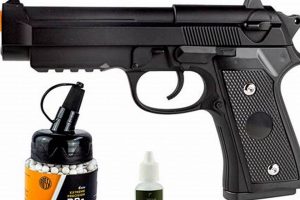
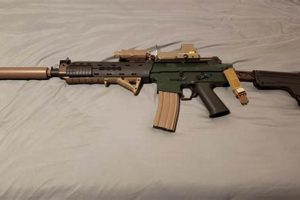
A compact, scaled-down replica firearm designed to discharge small, non-lethal projectiles through compressed gas or a spring-loaded mechanism. These devices are frequently employed in recreational target shooting or simulated combat scenarios. An example would be a scaled-down model of a popular service weapon, designed for indoor use due to its lower power output.
Their reduced size and typically lower power output makes these devices suitable for training in confined spaces or for younger participants under supervision. Historically, interest in these items has paralleled the increased popularity of simulated military games and tactical training exercises, offering a more accessible entry point to the hobby.
The following sections will delve into the mechanics, safety considerations, legal implications, and popular models of these compact recreational devices, providing a comprehensive overview for both novice users and seasoned enthusiasts.
Considerations for Operating Compact Airsoft Replicas
Proper handling and maintenance are crucial for the safe and efficient operation of these devices. The following recommendations aim to enhance user experience and minimize potential risks.
Tip 1: Eye Protection is Paramount: Always wear ANSI-rated Z87.1 safety glasses or a full face mask designed for airsoft. The impact of projectiles, even at lower velocities, can cause serious eye injury.
Tip 2: Understand Power Output Limitations: Ensure the device’s muzzle velocity complies with local regulations and the rules of the playing field. Exceeding these limits can result in injury and legal repercussions.
Tip 3: Maintain the Device Regularly: Clean the barrel and lubricate moving parts periodically to prevent jams, ensure consistent performance, and extend the lifespan of the device. Consult the manufacturer’s guidelines for recommended maintenance procedures.
Tip 4: Use Appropriate Ammunition: Employ only high-quality, seamless BBs of the correct weight and diameter recommended by the manufacturer. Inferior ammunition can damage the internal mechanisms and compromise accuracy.
Tip 5: Store the Device Securely: When not in use, store the replica unloaded, with the magazine removed, in a locked case or out of reach of children and unauthorized individuals.
Tip 6: Be Aware of Surroundings: Before discharging the device, ensure the area is clear of bystanders, pets, and any fragile objects that could be damaged.
Tip 7: Transport Responsibly: When transporting the device, keep it concealed in a bag or case to avoid alarming the public and potential legal issues. Treat it as a real firearm to avoid misinterpretation.
Adhering to these guidelines will promote safe usage, optimize performance, and ensure responsible participation in the airsoft hobby.
The subsequent sections will explore the diverse range of these devices available on the market and provide guidance on selecting the most appropriate model for individual needs and skill levels.
1. Size

The physical dimensions are a defining characteristic of these compact airsoft devices. The diminished scale directly influences usability, handling, and intended application within the broader spectrum of airsoft weaponry.
- Concealability and Portability
Reduced dimensions facilitate easier concealment and transportation. This characteristic is particularly relevant in scenarios where discretion is paramount, or where carrying a larger replica firearm would be impractical. An example is carrying the replica in a smaller bag when participating in outdoor games. This enables easier movement through environments with limited space.
- Maneuverability in Confined Spaces
The smaller size contributes to enhanced maneuverability in tight quarters, such as indoor arenas or CQB (Close Quarters Battle) environments. Operators can navigate obstacles and engage targets more effectively compared to using larger, more cumbersome airsoft guns. This is key in indoor arenas.
- Ergonomics and Handling
The reduced grip size and overall dimensions may present challenges for individuals with larger hands. Conversely, they can be advantageous for users with smaller hands or those seeking a lighter, more easily manageable platform. This can affect the user experience, depending on the size and design of the user’s hands.
- Impact on Power and Range
The compact form factor often necessitates compromises in internal components, potentially resulting in reduced power output and effective range compared to larger airsoft replicas. This is primarily due to the constraints placed on the gas reservoir or spring mechanism within the smaller frame. Because of these limitations, usage is limited to Close Quarter Battle scenarios.
In summary, the physical size of these devices introduces a trade-off between concealability and maneuverability on one hand, and ergonomic considerations and potential performance limitations on the other. The optimal size selection will depend on individual preferences, intended use case, and the specific operational environment.
2. Power Source

The power source is a critical determinant of a compact airsoft replica’s performance characteristics. Its selection fundamentally impacts the device’s velocity, range, and operational reliability. The compact design of such replicas often necessitates compromises in power source capacity, leading to variations in performance compared to larger counterparts.
Common power sources include compressed gas (typically CO2 or green gas) and spring mechanisms. Compressed gas offers consistent power output until depleted, but requires a gas reservoir. Smaller gas reservoirs in compact models limit shot capacity and may necessitate frequent refills. Spring-powered mechanisms, while simpler and eliminating the need for external gas, often produce lower and less consistent velocities. An example of a gas-powered type may be modeled on a smaller handgun; a spring-powered model may be a miniature submachine gun variant. Each exhibits performance compromises related directly to power source constraints.
Understanding the limitations imposed by the power source is crucial for selecting a compact airsoft device suited to intended purposes. Balancing power, range, and operational convenience necessitates a careful evaluation of available options and their inherent compromises. The integration of advanced power delivery systems remains a key challenge in optimizing the performance of these diminutive replicas.
3. Material

The constituent materials of a compact airsoft replica directly impact its durability, weight, performance, and overall realism. These materials typically range from polymers and plastics to various metals, each offering distinct advantages and disadvantages that must be considered in relation to the intended application of the device. Polymer frames, for instance, reduce weight and manufacturing costs, making the device more accessible and maneuverable, but may sacrifice the realistic heft and tactile feel associated with metal construction. Internal components, such as gears and pistons, are frequently constructed of metal alloys to withstand the stresses of repeated use and maintain consistent performance under pressure. A failure in these internal parts renders the airsoft replica unusable. An external example might be a plastic slide cracking after repeated usage.
The selection of material also influences the replica’s resistance to environmental factors. Polymer bodies are generally more resistant to moisture and corrosion than metal counterparts, making them suitable for use in adverse weather conditions. However, metal construction provides superior resistance to impacts and abrasion, enhancing the replica’s longevity in more demanding operational environments. The choice between polymer and metal often represents a compromise between cost, weight, durability, and aesthetic fidelity. One example is a lower grade plastic failing on impact, rendering it unusable.
In summary, the careful consideration of material properties is paramount in optimizing the performance and longevity of a compact airsoft replica. While polymer offers advantages in terms of weight and cost, metal provides enhanced durability and realism. The optimal material selection depends on the specific requirements of the user and the anticipated operational conditions, reflecting a trade-off between practicality and authenticity. Further advancement in material science may lead to future integration of both within a singular device.
4. Accuracy

In the realm of compact airsoft replicas, accuracy denotes the degree to which projectiles consistently strike the intended target. Several factors inherent in the design and operation of these devices influence this critical performance metric, shaping their suitability for various applications.
- Barrel Length and Stability
Reduced barrel length in compact airsoft pistols inherently diminishes projectile stabilization, contributing to increased dispersion at longer ranges. The shorter inner barrel provides less guidance for the BB, resulting in greater deviation from the intended trajectory. This effect is amplified if the barrel is not rigidly mounted within the frame, allowing for movement that introduces inconsistencies.
- Hop-Up System Effectiveness
The hop-up system, responsible for imparting backspin to the BB for increased range and stability, must be meticulously calibrated in compact models. The limited space available for the hop-up unit may constrain its design and effectiveness, potentially leading to inconsistent backspin and erratic projectile flight. Quality and precise adjustment of this component is crucial for maximizing accuracy.
- Gas Consistency (for Gas-Powered Models)
Gas-powered compact airsoft pistols are sensitive to variations in gas pressure, which directly impact projectile velocity and trajectory. Fluctuations in temperature or remaining gas volume can lead to inconsistent shots and decreased accuracy. Regular maintenance and the use of high-quality gas are essential for minimizing these variations.
- Trigger Mechanism and User Input
A poorly designed or manufactured trigger mechanism can introduce inconsistencies in the firing process, affecting accuracy. Trigger pull weight, travel distance, and reset characteristics can all influence the user’s ability to consistently deliver accurate shots. Smooth and predictable trigger operation is vital for precise targeting.
The accuracy of compact airsoft pistols is a complex interplay of design parameters, material quality, and operational factors. While inherent limitations exist due to their reduced size, careful attention to these aspects can optimize performance and ensure a more satisfying user experience. Even high-end replicas may suffer inaccuracies if these parameters are ignored, demonstrating the importance of a holistic approach to accuracy enhancement.
5. Safety Mechanisms
Compact airsoft replicas, while designed for recreational purposes, necessitate robust safety mechanisms due to their realistic appearance and potential for misuse. The presence and proper functioning of these features are paramount in preventing accidental discharge, unauthorized operation, and potential injuries. A manual safety, typically a switch or button that mechanically prevents the trigger from engaging the firing mechanism, is a common safeguard. An example includes a cross-bolt safety positioned near the trigger guard, readily accessible for deactivation before intended use. Another common feature is a trigger safety, which is a small lever integrated into the trigger itself, requiring deliberate pressure for the trigger to function.
The effectiveness of safety mechanisms in a compact airsoft replica is directly correlated with the quality of materials and the precision of manufacturing. A poorly designed or implemented safety can fail, leading to unintended discharge. For example, a safety lever made from brittle plastic may break under pressure, rendering it ineffective. Furthermore, the design of the safety should be intuitive and easily operable, especially under stressful conditions. The absence of clear visual indicators for the safety’s “on” or “off” position can lead to confusion and increase the risk of accidental firing. The presence of multiple safety features is ideal, such as a trigger safety in conjunction with a grip safety that disengages the firing mechanism only when the replica is properly held.
Ultimately, the integration of reliable and user-friendly safety mechanisms is a fundamental aspect of responsible design and manufacturing of compact airsoft replicas. While such features cannot eliminate all risks associated with their use, they serve as a critical line of defense against accidents and contribute significantly to ensuring user safety. Routine inspection and maintenance of these mechanisms are crucial to ensure their continued functionality, complemented by comprehensive user education on their proper operation. The absence or malfunction of such safeties in even the smallest of the replicas can have disastrous results.
6. BB Capacity

BB capacity, representing the number of projectiles a compact airsoft replica can hold within its magazine or internal reservoir, exerts a direct influence on the device’s practical application and tactical utility. A limited BB capacity necessitates frequent reloading, disrupting the flow of simulated combat and potentially placing the user at a disadvantage. Conversely, a larger capacity allows for sustained firing, enhancing the user’s ability to suppress opponents or engage multiple targets without interruption. For example, a magazine holding only 10 BBs would require more frequent reloading compared to one holding 25, thereby affecting the engagement timeframe.
The BB capacity is often constrained by the miniature scale of these replicas. The compact dimensions limit the size of the magazine or internal reservoir, directly impacting the number of projectiles it can accommodate. This design limitation necessitates a compromise between size and ammunition capacity, forcing manufacturers to prioritize either concealability and maneuverability or sustained firepower. A real-world example is the choice between a highly compact pistol replica with a small magazine and a slightly larger version that offers a significantly increased BB capacity. This choice influences the practical utility of the replica in different scenarios, favoring concealment or sustained engagement.
Understanding the interplay between BB capacity and the overall design of compact airsoft replicas is essential for informed decision-making. The user must carefully consider the intended application of the device and weigh the relative importance of sustained firepower versus concealability and maneuverability. While a higher BB capacity enhances operational effectiveness in certain scenarios, it may compromise the replica’s compact form factor, potentially hindering its use in others. Furthermore, the quality and reliability of the magazine design significantly impact the feeding of BBs into the firing mechanism, directly affecting the replica’s overall performance. A low-capacity magazine that consistently malfunctions is of far less value than a higher-capacity magazine that feeds BBs reliably and consistently. Therefore, the BB capacity must be evaluated alongside other design and performance characteristics to determine the replica’s suitability for the intended purpose.
7. Legality

The legal status of compact airsoft replicas varies considerably across jurisdictions, necessitating thorough due diligence prior to purchase, possession, or use. The classification of these devices can range from toys to regulated items akin to firearms, each category incurring distinct legal responsibilities.
- Federal vs. State/Local Laws
Federal regulations may establish broad definitions and requirements, while state and local ordinances frequently impose additional restrictions, such as age limits, permissible usage locations, and transportation protocols. The absence of a uniform legal framework creates a complex regulatory landscape. Example: a state may mandate orange muzzle markings to distinguish airsoft replicas from real firearms, whereas no such federal requirement exists. Enforcement is usually at the state or local level.
- Definition as “Toy” vs. “Replica Firearm”
Legal interpretation hinges on factors like muzzle velocity, construction materials, and realistic resemblance to actual firearms. If deemed a “replica firearm,” stricter regulations, including storage requirements, transportation limitations, and potential licensing obligations, may apply. For example, some jurisdictions may consider any airsoft replica exceeding a specific muzzle velocity threshold as a regulated item, regardless of its size. This distinction impacts transportation and storage requirements.
- Age Restrictions and Parental Responsibility
Many jurisdictions impose minimum age requirements for purchasing or possessing airsoft replicas. Parental or guardian supervision may be mandated for younger users. Furthermore, parents can be held liable for damages or injuries resulting from their child’s negligent or illegal use of these devices. Example: A minor purchasing an airsoft replica illegally can lead to charges to both the store and the individual who purchased the airsoft gun. Parental guidance is key to ensuring this does not happen.
- Public Display and Brandishing
Openly displaying or brandishing a compact airsoft replica in public can be construed as a threat, potentially resulting in criminal charges, even if the device is incapable of causing serious harm. Law enforcement officers may struggle to differentiate between a real firearm and a realistic airsoft replica, triggering a potentially dangerous response. Example: Carrying an unconcealed airsoft replica in a public park could result in police intervention and potential legal consequences, despite the device being non-lethal.
These legal considerations highlight the importance of responsible ownership and handling. Ignorance of applicable laws does not constitute a valid defense. Therefore, individuals must familiarize themselves with all relevant federal, state, and local regulations before acquiring or using a compact airsoft replica to mitigate the risk of legal repercussions and promote safe practices.
Frequently Asked Questions
The following questions address common concerns and misconceptions surrounding the use, safety, and legality of miniature airsoft devices. The answers provide concise, factual information intended to promote responsible ownership and operation.
Question 1: What constitutes a “mini airsoft pistol” from a legal perspective?
The legal classification depends on local laws. Generally, factors considered include muzzle velocity, the presence of an orange tip, and overall resemblance to real firearms. It is essential to check state and local regulations.
Question 2: Are compact airsoft replicas safe for children?
These devices are not toys and pose potential risks. Supervised use by responsible adults and adherence to safety precautions, including eye protection, are mandatory.
Question 3: How should a compact airsoft device be stored when not in use?
The replica should be unloaded, with the magazine removed, and stored in a secure location inaccessible to children or unauthorized individuals. Preferably, it should be stored in a locked container.
Question 4: What type of ammunition is appropriate for these devices?
Only high-quality, seamless BBs of the size and weight recommended by the manufacturer should be used. Inferior ammunition can damage the device and compromise accuracy.
Question 5: Can a compact airsoft device be modified to increase its power?
Modifying the device may violate local laws and can create a safety hazard. Additionally, it may void any existing warranty. Modification is strongly discouraged.
Question 6: Is it permissible to carry a compact airsoft device in public?
Openly carrying an airsoft replica in public may be illegal and can be perceived as a threat, potentially leading to police intervention. The device should always be transported discreetly in a closed container.
Adherence to these guidelines promotes safe usage, respects legal boundaries, and contributes to responsible participation in the airsoft hobby. Further exploration of specific models and advanced techniques will be detailed in subsequent sections.
The next section will focus on selecting the appropriate model based on individual needs and intended use.
Conclusion
This exploration of the compact airsoft replica addressed critical aspects ranging from operational mechanics and safety considerations to legal implications and performance parameters. The analysis underscored the significance of responsible handling, adherence to safety protocols, and informed decision-making when acquiring and utilizing these devices. Factors such as power source, material composition, BB capacity, and accuracy were examined to provide a comprehensive understanding of their impact on the overall performance and utility of scaled-down airsoft weaponry.
The responsible use of a `mini airsoft pistol` necessitates not only a commitment to safety practices but also a thorough understanding of applicable laws and regulations. Continued advancements in design and technology are anticipated to enhance both the performance and safety features of these devices. Individuals are encouraged to prioritize responsible ownership and operation to ensure the continued viability and positive perception of the airsoft hobby.