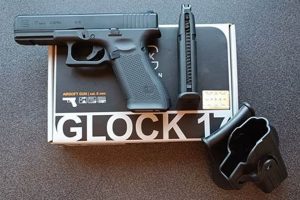
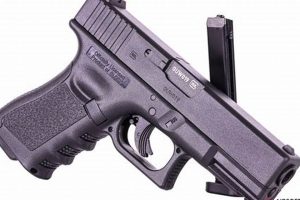
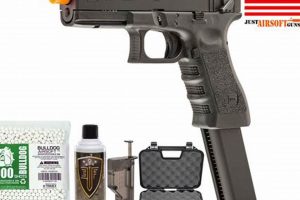
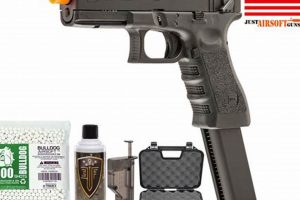
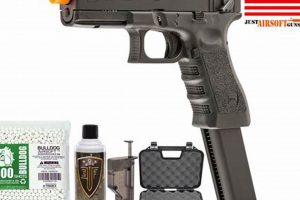
This type of airsoft replica emulates a select-fire handgun known for its rapid rate of fire. The original firearm, developed as a potential personal defense weapon, features a switch allowing the operator to choose between semi-automatic and fully automatic modes. Consequently, the corresponding airsoft version provides a similar operational experience for training or recreational purposes, utilizing either gas or electric power to propel plastic projectiles.
The appeal of this design lies in its ability to simulate realistic weapon handling and tactical scenarios. Its popularity stems from its close resemblance to the real firearm, offering a heightened sense of realism for players and collectors. Its historical significance within the airsoft community relates to the development of more advanced and versatile gameplay options, particularly in close-quarters combat environments.
The subsequent discussion will delve into the specific features, performance characteristics, legal considerations, and appropriate usage for such replicas within the broader airsoft hobby and sport.
Operational and Maintenance Considerations
The following points offer guidance for responsible ownership and effective utilization of select-fire airsoft replicas.
Tip 1: Adhere to Field Regulations: Ensure strict compliance with the specific rules and projectile velocity limits mandated by the airsoft field or arena. Overly powerful replicas can cause injury and are often prohibited.
Tip 2: Prioritize Eye Protection: ANSI Z87.1 rated full-seal eye protection is mandatory for all users and bystanders during operation. The potential for ricochet and fragmentation necessitates robust protection.
Tip 3: Understand Hop-Up Adjustment: Proper hop-up calibration is crucial for achieving optimal range and accuracy. Experiment with small adjustments to find the setting that best suits the weight of the projectile being used.
Tip 4: Utilize Appropriate Ammunition: High-quality, seamless, and polished BBs of the correct weight (typically 0.20g to 0.25g) are recommended. Inferior ammunition can cause jams and damage internal components.
Tip 5: Practice Responsible Fire Control: Controlled bursts, rather than prolonged full-auto fire, conserves ammunition, increases accuracy, and minimizes the risk of overheating in gas-powered models.
Tip 6: Maintain Gas Pressure (Gas Blowback Models): Using the correct type and pressure of gas is vital for consistent performance and preventing damage to seals and valves. Refer to the manufacturer’s recommendations.
Tip 7: Regular Cleaning and Lubrication: Periodic disassembly, cleaning, and lubrication of internal components are essential for maintaining reliability and extending the lifespan of the replica. Use lubricants specifically designed for airsoft guns.
Implementing these procedures will help to ensure safety, optimal performance, and longevity of the equipment.
The next section will discuss legal implications and ethical considerations surrounding the ownership and use of realistic airsoft replicas.
1. Realism

Realism, in the context of airsoft replicas, refers to the degree to which the airsoft gun mirrors the appearance, weight, and operational characteristics of its real firearm counterpart. For the “glock 18c full auto airsoft gun,” realism is a key selling point, attracting enthusiasts who seek an authentic training or simulation experience.
- External Appearance and Markings
The fidelity of the airsoft replica’s external features, including dimensions, material composition, and manufacturer markings, significantly contributes to realism. High-quality replicas feature accurate engravings, textured grips, and replicated slide mechanisms, closely mirroring the aesthetic of the original Glock 18C firearm. Deviations from these details diminish the overall sense of realism.
- Weight and Balance
The weight distribution and overall heft of the airsoft replica should closely approximate that of the real firearm. Variations in weight can affect handling, aiming, and the perceived recoil, influencing the shooter’s experience. Manufacturers often utilize similar materials or internal weighting systems to achieve a comparable balance.
- Functional Similarity
The degree to which the airsoft gun replicates the operational functions of the real firearm is a critical aspect of realism. This includes features such as a functional slide lock, magazine release, and, most notably, the select-fire switch that enables full-automatic operation. Replicating these functionalities enhances the user’s ability to practice weapon manipulation drills and tactical maneuvers.
- Recoil Simulation (Blowback)
In gas blowback (GBB) models, the simulated recoil action adds to the sense of realism. The rearward movement of the slide after each shot mimics the recoil of the real firearm, providing tactile feedback to the shooter. The strength and consistency of the blowback mechanism significantly influence the overall immersive experience.
The level of realism in an airsoft replica directly impacts its value for training, simulation, and collection purposes. While aesthetic accuracy is important, the functional and operational similarities play a critical role in providing a truly authentic experience. The closer the airsoft gun adheres to the characteristics of the real firearm, the more valuable it becomes to enthusiasts seeking a realistic training tool or a collector’s item.
2. Full-Auto Functionality
The defining characteristic of the “glock 18c full auto airsoft gun” is its selective-fire capability, allowing operation in both semi-automatic and fully automatic modes. This functionality directly replicates the operational versatility of the real Glock 18C firearm, initially designed for specialized military and law enforcement applications. The full-auto mode enables the rapid discharge of projectiles, significantly altering the tactical dynamics in airsoft engagements. This feature distinguishes it from standard airsoft pistols, which are typically limited to semi-automatic fire. The inclusion of full-auto is not merely an aesthetic choice; it represents a fundamental shift in the weapon’s role, demanding a higher degree of user proficiency and a more stringent adherence to safety protocols.
The presence of full-auto functionality has profound implications for gameplay. It allows for suppressive fire tactics, area denial, and rapid engagement of multiple targets scenarios less effectively addressed with semi-automatic replicas. However, this advantage comes with trade-offs. Ammunition consumption increases dramatically, requiring careful resource management. Accuracy often suffers due to recoil and muzzle climb during sustained fire, necessitating the development of specific techniques for controlling the weapon. Furthermore, the faster rate of fire intensifies concerns about projectile velocity and the potential for causing injury, leading to stricter regulations on fields where such replicas are permitted.
In summary, full-auto functionality is not simply an added feature, but an integral element defining the “glock 18c full auto airsoft gun.” It impacts gameplay, requires advanced user skills, and is subject to heightened scrutiny regarding safety and compliance. Its inclusion alters the risk profile and necessitates careful consideration of its ethical and practical implications within the airsoft community.
3. Gas/Electric Operation

The method of propulsion gas or electric represents a fundamental divergence in the design and performance characteristics of “glock 18c full auto airsoft gun” replicas. The choice between these two power systems significantly impacts factors such as realism, rate of fire, maintenance requirements, and overall cost of ownership.
- Gas Blowback (GBB) Systems
GBB systems utilize compressed gas (typically green gas, propane, or CO2) to propel the projectile and cycle the slide, simulating the recoil action of a real firearm. This contributes to a higher degree of realism in terms of handling and operation. GBB replicas often feature a more robust construction and a louder report. However, they are also more sensitive to temperature fluctuations, require regular maintenance of gas seals, and may exhibit inconsistent performance in cold weather.
- Electric (AEG/AEP) Systems
Automatic Electric Guns (AEGs) and Automatic Electric Pistols (AEPs) employ an electric motor, gearbox, and battery to drive a piston that compresses air and propels the projectile. Electric systems offer a more consistent rate of fire, are less affected by temperature, and typically require less frequent maintenance than GBB systems. While AEGs are more common for rifles, AEPs represent the electric alternative for pistol-sized replicas. Electric systems generally produce less recoil and a quieter report compared to GBB models.
- Rate of Fire Implications
Both gas and electric systems are capable of achieving high rates of fire in full-auto mode, although the specific rate may vary depending on the design and components of the replica. GBB systems are often limited by gas flow and cooldown effects, while electric systems are constrained by motor speed and battery capacity. The user’s trigger discipline becomes critical in managing ammunition consumption and preventing overheating in either system.
- Maintenance and Reliability
GBB systems require meticulous maintenance of gas seals and valves to prevent leaks and ensure consistent performance. Electric systems require less frequent maintenance but may eventually necessitate gearbox servicing and motor replacement. The overall reliability of both systems depends on the quality of the components and the adherence to proper maintenance procedures.
The choice between gas and electric operation depends on the user’s priorities. GBB systems offer enhanced realism and a more engaging shooting experience, while electric systems provide greater consistency, lower maintenance, and improved cold-weather performance. Both systems are capable of delivering full-auto functionality, but their inherent characteristics necessitate different operational techniques and maintenance considerations.
4. Velocity (FPS)
Velocity, measured in feet per second (FPS), is a critical performance metric for any airsoft replica, including the “glock 18c full auto airsoft gun.” It directly influences the projectile’s range, impact force, and adherence to safety regulations. Understanding the velocity output is essential for responsible use and legal compliance.
- FPS as a Measure of Power
FPS directly correlates to the kinetic energy of the projectile. A higher FPS value indicates greater power, resulting in a longer effective range and a potentially more significant impact force. This necessitates careful consideration to avoid causing injury during gameplay. For example, a replica firing at 400 FPS will have a greater potential for causing welts or bruising than one firing at 300 FPS, even with the same weight projectile.
- Field Regulations and FPS Limits
Airsoft fields universally impose FPS limits to ensure player safety. These limits vary depending on the type of replica (pistol, rifle, sniper) and the engagement distance. For pistols, the FPS limit typically ranges from 300 to 350 FPS. Exceeding these limits can result in expulsion from the field. A “glock 18c full auto airsoft gun,” due to its close-quarters combat role, is generally subject to pistol FPS limits. Chronograph testing is typically conducted before gameplay to verify compliance.
- Impact of Full-Auto Functionality on FPS Considerations
The full-auto capability of the “glock 18c full auto airsoft gun” amplifies the importance of adhering to FPS limits. The rapid discharge of projectiles increases the risk of accidental overshooting and potential injury. Responsible users exercise extreme caution and adjust their engagement distances accordingly. Some fields may impose stricter FPS limits on replicas with full-auto capabilities.
- Factors Affecting FPS
Several factors influence the FPS of an airsoft replica, including the type and pressure of gas used (for GBB models), the battery voltage and motor strength (for AEP models), the tightness of the air seal within the internal mechanisms, and the weight of the projectile. Maintenance, such as cleaning and lubrication, can also affect FPS consistency. Temperature can also be a factor, with gas-powered guns often showing reduced FPS in colder conditions.
In conclusion, velocity, as measured by FPS, is a critical parameter for the “glock 18c full auto airsoft gun.” It dictates range, impact force, and compliance with safety regulations. The full-auto functionality emphasizes the importance of responsible usage and adherence to field limits. Understanding the factors affecting FPS allows users to optimize performance while minimizing the risk of injury and ensuring a safe and enjoyable gameplay experience.
5. Legal Restrictions
Legal restrictions concerning airsoft replicas, and specifically the “glock 18c full auto airsoft gun,” vary significantly across jurisdictions. These regulations govern ownership, transportation, modification, and usage, often reflecting concerns about public safety and the potential for misuse. Therefore, comprehensive understanding of applicable laws is paramount for responsible ownership.
- Federal vs. State/Local Laws
Many countries and regions have laws differentiating airsoft from real firearms, air guns or other regulated objects. In some jurisdictions airsoft replicas are completely unrestricted, while others have extensive restrictions. These laws often specify permitted velocity limits, color requirements (e.g., orange tip), and minimum age for possession. State and local ordinances may further restrict the public display or discharge of these replicas, regardless of federal laws.
- Imitation Firearm Laws
Many jurisdictions have laws addressing imitation firearms, often intended to prevent the brandishing or misuse of replicas to commit crimes. These laws may require prominent markings (e.g., blaze orange tip) to distinguish airsoft guns from real firearms. Removing or altering these markings can result in severe penalties, including fines and imprisonment. A “glock 18c full auto airsoft gun,” due to its realistic appearance, is particularly susceptible to scrutiny under these laws.
- Full-Auto Restrictions
The full-automatic firing capability of the “glock 18c full auto airsoft gun” may trigger more stringent regulations in certain areas. Some jurisdictions classify airsoft guns with full-auto functionality as more dangerous or regulate them similarly to real automatic weapons. Restrictions may include permit requirements, background checks, or outright prohibition of ownership. Users must verify the legality of owning and operating a full-auto airsoft replica in their specific location.
- Transportation and Public Display
Laws often govern the transportation of airsoft guns, requiring them to be stored in cases or bags and kept out of plain sight. Public display or brandishing of an airsoft gun, even if unloaded, can be interpreted as threatening behavior and may result in arrest or confiscation of the replica. The realistic appearance of the “glock 18c full auto airsoft gun” increases the risk of misinterpretation and necessitates cautious handling in public spaces.
The legal landscape surrounding airsoft replicas is complex and subject to change. Owners and users of the “glock 18c full auto airsoft gun” bear the responsibility of staying informed about current laws and regulations in their area. Failure to comply with these laws can have serious consequences, ranging from fines and confiscation to criminal charges. Consulting with legal counsel or local law enforcement agencies is advisable to ensure full compliance.
6. Field Regulations

Field regulations constitute the operational framework for organized airsoft gameplay, dictating acceptable equipment parameters, engagement protocols, and safety guidelines. These regulations are particularly relevant to the “glock 18c full auto airsoft gun” due to its capabilities and the potential risks associated with its usage. Compliance with field regulations is essential for ensuring player safety and maintaining a positive environment within the airsoft community.
- Velocity Limits and Joules Measurement
Most airsoft fields enforce strict velocity limits, typically measured in feet per second (FPS) using 0.20g BBs. These limits aim to minimize the risk of injury. Some fields may also measure energy output in joules. The “glock 18c full auto airsoft gun,” especially when gas-powered, must be chronographed to ensure compliance. Exceeding the velocity limit typically results in the replica being deemed unusable on that field. Some fields may have lower FPS limits for pistols to encourage the use of other airsoft weapons such as Airsoft Rifle.
- Full-Auto Restrictions and Minimum Engagement Distances (MED)
Recognizing the increased potential for injury with rapid-fire weapons, many fields impose restrictions on full-automatic fire. These restrictions may include limitations on burst length (e.g., three-round bursts only) or outright prohibition of full-auto within certain distances. Minimum Engagement Distances (MEDs) are often enforced, requiring players to engage targets at a specified distance to prevent close-range injuries. A “glock 18c full auto airsoft gun” is often subject to more stringent MED requirements when used in full-auto mode.
- Approved Ammunition and Equipment Guidelines
Field regulations frequently specify the permissible types of ammunition and equipment. Some fields may prohibit the use of heavyweight BBs or require the use of biodegradable BBs for environmental reasons. Regulations also extend to protective gear, mandating ANSI Z87.1 rated eye protection and potentially other forms of protection such as face masks or helmets. Players using a “glock 18c full auto airsoft gun” must ensure their equipment meets all field-specific requirements.
- Gameplay Rules and Conduct
Field regulations encompass a wide range of gameplay rules, including rules of engagement, respawn procedures, and prohibited behaviors. Rules of engagement may specify restrictions on blind firing, overshooting, or engaging from unsafe positions. These rules are designed to promote fair play and prevent intentional or accidental injury. All players, including those using a “glock 18c full auto airsoft gun,” are expected to adhere to these rules and conduct themselves responsibly.
In essence, field regulations create a structured environment for safe and enjoyable airsoft gameplay. The unique characteristics of the “glock 18c full auto airsoft gun,” particularly its full-automatic capability and potential for high velocity, necessitate a thorough understanding and strict adherence to these regulations. Responsible usage and compliance with field rules are paramount for maintaining a positive reputation within the airsoft community and ensuring the continued availability of fields for organized play.
7. Maintenance Needs
Maintaining the “glock 18c full auto airsoft gun” is crucial for optimal performance, longevity, and safety. Regular maintenance prevents malfunctions, ensures consistent velocity, and preserves the replica’s realistic operation. Neglecting upkeep can lead to diminished accuracy, decreased rate of fire, and potential damage to internal components, ultimately shortening the lifespan of the device.
- Gas System Servicing (GBB Models)
Gas Blowback (GBB) versions require meticulous attention to the gas system. Seals, valves, and magazines are prone to leaks and wear. Regular cleaning and lubrication with silicone oil are essential to prevent gas leakage and maintain consistent pressure. Disassembly and inspection of the magazine valve are necessary to identify and replace worn or damaged components. Neglecting these maintenance steps will result in reduced gas efficiency and inconsistent shot power, impacting performance and realism.
- Gearbox Maintenance (AEP Models)
Automatic Electric Pistol (AEP) versions depend on a functional gearbox. Gears, pistons, and electrical components require periodic inspection and lubrication. Over time, gears may wear, pistons may crack, and electrical contacts may corrode. Disassembly, cleaning, relubrication, and replacement of worn parts are necessary to maintain optimal performance. Failure to maintain the gearbox will lead to reduced rate of fire, decreased power, and eventual gearbox failure.
- Barrel Cleaning and Hop-Up Adjustment
Regardless of the propulsion system, the barrel requires regular cleaning to remove accumulated debris and residue. A dirty barrel compromises accuracy and range. A cleaning rod and silicone oil are used to swab the barrel. Simultaneously, the hop-up unit requires adjustment to optimize projectile trajectory. Over time, the hop-up bucking may wear or become contaminated, requiring replacement. Consistent barrel cleaning and hop-up adjustment are essential for maintaining accuracy and maximizing effective range.
- External Cleaning and Lubrication
The external surfaces of the “glock 18c full auto airsoft gun” require regular cleaning to remove dirt, dust, and fingerprints. A clean, dry cloth is typically sufficient for routine cleaning. Lubrication of moving parts, such as the slide rails and magazine release, with silicone oil helps to ensure smooth operation and prevent wear. Neglecting external cleaning and lubrication can lead to sluggish operation and increased wear on critical components.
Proper maintenance is not merely a recommendation but a necessity for the “glock 18c full auto airsoft gun.” The complexities of its gas or electric operation, combined with the demands of full-automatic fire, necessitate a consistent maintenance schedule. Neglecting these needs results in diminished performance, reduced lifespan, and potential safety hazards. A well-maintained replica provides a more realistic, enjoyable, and reliable airsoft experience.
Frequently Asked Questions
The following questions address common inquiries and concerns regarding the operation, legality, and maintenance of this specific type of airsoft replica.
Question 1: Is ownership of a “glock 18c full auto airsoft gun” legal?
Legality varies significantly by jurisdiction. Many regions have laws governing imitation firearms, requiring specific markings (e.g., orange tip) and regulating public display. The full-automatic capability may trigger stricter regulations in some areas, potentially requiring permits or outright prohibiting ownership. Consultation with local law enforcement or legal counsel is advised.
Question 2: What type of power source is most suitable for a “glock 18c full auto airsoft gun?”
Both gas and electric power sources have advantages and disadvantages. Gas blowback (GBB) systems offer enhanced realism but require more maintenance and are sensitive to temperature. Automatic electric pistols (AEPs) provide consistent performance and lower maintenance but typically offer less realistic recoil simulation. The optimal choice depends on individual preferences and priorities.
Question 3: What is the typical velocity (FPS) of a “glock 18c full auto airsoft gun?”
Velocity varies depending on the model and power source but typically falls within the range of 200-350 FPS. Field regulations usually dictate maximum allowable FPS, and replicas must be chronographed before gameplay to ensure compliance. Exceeding these limits is unsafe and can result in expulsion from the field.
Question 4: How does full-auto functionality impact gameplay?
Full-auto capability allows for suppressive fire tactics and rapid engagement of multiple targets. However, it also increases ammunition consumption, reduces accuracy, and intensifies concerns about safety. Many fields impose restrictions on full-auto fire, such as limiting burst length or requiring minimum engagement distances.
Question 5: What type of maintenance is required for a “glock 18c full auto airsoft gun?”
Maintenance depends on the power source. GBB models require regular cleaning and lubrication of gas seals and valves. AEP models require gearbox servicing and motor maintenance. Both types require barrel cleaning and hop-up adjustment to maintain accuracy and range. Neglecting maintenance can lead to malfunctions and reduced performance.
Question 6: Are there specific safety precautions to consider when using a “glock 18c full auto airsoft gun?”
Yes. ANSI Z87.1 rated eye protection is mandatory for all users and bystanders. Responsible fire control is essential to avoid overshooting and causing injury. Adherence to field regulations, including FPS limits and minimum engagement distances, is crucial. Treat the replica with respect and always assume it is loaded.
These FAQs provide a foundational understanding of the “glock 18c full auto airsoft gun.” Additional research and consultation with experienced airsoft players are recommended for responsible ownership and usage.
The subsequent section will explore potential modifications and upgrades for enhancing performance and customization.
Conclusion
This exploration of the “glock 18c full auto airsoft gun” has illuminated critical aspects of its operation, legality, maintenance, and usage within the airsoft community. The analysis encompassed the replica’s realism, distinguishing full-auto functionality, gas versus electric power systems, performance metrics like FPS, and the complex interplay of legal restrictions and field regulations. The thorough examination of maintenance needs and common inquiries underscores the responsibilities associated with ownership.
Ultimately, the “glock 18c full auto airsoft gun” presents a unique convergence of recreational simulation and tactical considerations. Responsible ownership requires not only an appreciation for its realistic design and performance capabilities but also a firm commitment to safety, legal compliance, and ethical conduct. The continuing evolution of airsoft regulations and technology warrants ongoing awareness and diligent adherence to best practices within the sport.