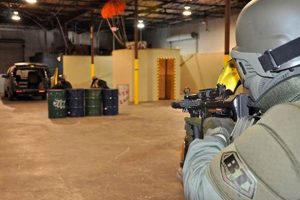
A designated and fortified location, serving as a temporary operational hub during simulated military exercises, allows players a strategic point for planning, resupply, and defense. These installations often incorporate natural terrain features and man-made barriers to enhance their tactical value, offering participants a realistic and immersive environment.
The utilization of such forward operating sites significantly enhances the realism and strategic depth of the game. It provides a focal point for team coordination, resource management, and tactical decision-making. Historically, the concept mirrors real-world military practices, providing a tangible link to the operational procedures employed in armed conflicts and tactical training scenarios.
The following sections will elaborate on constructing effective emplacements, detailing tactical considerations for their defense, and exploring the impact on overall game strategies. Discussions will include equipment selection, communication protocols, and scenario design best practices to maximize the benefits of utilizing these positions during gameplay.
Deployment Strategies for a Forward Operating Site
Effective utilization of a forward operating site is critical for success in extended simulated combat scenarios. Careful planning and execution are paramount to maximizing its tactical advantages.
Tip 1: Site Selection: The choice of location is fundamental. Prioritize areas offering natural cover, defensible terrain, and strategic oversight of key avenues of approach. Consider factors such as elevation, concealment opportunities, and ease of access for resupply.
Tip 2: Fortification and Perimeter Security: Construct robust defenses using available resources. Employ barriers, obstacles, and warning systems to detect and delay enemy advances. Establish clear fields of fire and interlocking defensive positions.
Tip 3: Communication Network: Implement a reliable communication system to maintain situational awareness and coordinate movements. Utilize radios, visual signals, and pre-determined communication protocols to relay information effectively.
Tip 4: Resource Management: Efficiently manage ammunition, medical supplies, and other essential resources. Establish a designated supply point within the installation and implement a system for tracking and distributing resources as needed.
Tip 5: Rotation and Rest: Implement a rotation schedule to ensure that personnel receive adequate rest and remain alert. Fatigue can significantly impair performance and decision-making. Rotate personnel through observation posts, defensive positions, and rest areas.
Tip 6: Contingency Planning: Develop contingency plans to address potential threats and emergencies. Prepare for scenarios such as enemy assaults, breaches of the perimeter, and medical emergencies. Clearly define roles and responsibilities for each contingency.
Tip 7: Camouflage and Concealment: Minimize the visual signature of the installation by utilizing camouflage techniques and natural concealment. Blend the position with the surrounding environment to reduce the likelihood of detection.
Adherence to these guidelines enhances the operational effectiveness of the position, providing a strategic advantage during simulated engagements. A well-planned and executed position serves as a force multiplier, enabling a smaller team to effectively defend a critical area and project power.
The subsequent sections will delve into specific tactical maneuvers and advanced strategies for employing this position in diverse scenarios.
1. Defensible Terrain
Defensible terrain constitutes a cornerstone of effective emplacement strategy. Selection of a position is intrinsically linked to the available natural or man-made features that enhance its resilience against simulated enemy assault. Understanding cause and effect is paramount; choosing a location with pre-existing cover, such as dense woodland, rocky outcrops, or elevated ground, directly impacts the ease with which the position can be fortified and defended. The absence of defensible terrain necessitates extensive construction of barriers and fortifications, increasing resource expenditure and potentially compromising concealment. Historical military engagements illustrate this point; the strategic advantage conferred by naturally defensible positions has consistently influenced the outcome of battles, highlighting the critical importance of terrain selection.
The practical significance of this understanding translates directly to operational effectiveness. Teams that prioritize terrain analysis before establishing their position gain a significant advantage. For instance, occupying a ridgeline allows for superior observation and fields of fire, enabling early detection of approaching adversaries and maximizing the effectiveness of defensive fire. Conversely, selecting a low-lying area lacking natural cover exposes personnel to increased risk and necessitates a more reactive, rather than proactive, defensive posture. Effective integration of the environment into the defensive plan minimizes exposure and maximizes tactical advantage, thereby increasing survivability and mission success.
In summary, the identification and utilization of defensible terrain are essential elements in the successful implementation. Challenges include accurately assessing terrain limitations and adapting defensive strategies accordingly. Understanding and exploiting terrain features represents a fundamental principle of tactical positioning, directly impacting the security and operational effectiveness of the installation.
2. Communication Network

A reliable communication network is critical for the effective operation of any tactical installation. Within the context of simulated combat scenarios, this infrastructure facilitates coordination, enhances situational awareness, and enables rapid response to evolving threats.
- Real-time Information Dissemination
The ability to transmit and receive information instantaneously is crucial for maintaining situational awareness. Examples include relaying enemy positions, reporting casualties, and coordinating movements. In a tactical scenario, this might involve radio communication to alert nearby fireteams of an imminent breach of the perimeter, enabling a coordinated defensive response.
- Command and Control
A robust network allows leadership to effectively direct and control operations. This includes issuing orders, assigning tasks, and adjusting strategies based on real-time feedback. For instance, a commander can remotely redirect a squad to reinforce a vulnerable sector based on radio reports received from forward observers.
- Emergency Response Coordination
In the event of an emergency, such as a simulated injury or unexpected enemy assault, the communication network facilitates rapid coordination of resources. This includes dispatching medical personnel, requesting reinforcements, and coordinating evacuation efforts. A clear and concise communication protocol ensures efficient and effective emergency response.
- Interoperability and Collaboration
A well-designed network enables seamless communication between different units and elements, fostering interoperability and collaboration. This is particularly important in complex scenarios involving multiple teams or factions. Standardized communication protocols and equipment ensure that all participants can effectively communicate and coordinate their actions.
These facets collectively underscore the significance of establishing and maintaining a resilient network. Its effectiveness directly impacts a team’s ability to respond to dynamic situations, coordinate tactical maneuvers, and achieve mission objectives. The integration of appropriate communication technologies and protocols is, therefore, a critical consideration in any simulated military exercise.
3. Resource Management

Resource management is an indispensable element for the effective sustainment of a forward operating site. It encompasses the strategic allocation, control, and conservation of essential supplies, including ammunition, medical provisions, water, and equipment. The correlation between efficient resource management and operational longevity is direct; insufficient planning and execution result in depleted stockpiles, compromised mission capabilities, and increased vulnerability to simulated enemy action.
Consider the scenario of a prolonged engagement. A team neglecting ammunition management faces the consequence of running out of essential firepower, rendering their defensive position untenable. Similarly, inadequate medical provisions lead to prolonged casualty care, potentially resulting in simulated fatalities and a degraded fighting force. Real-world military logistics serve as a historical analog, where the success or failure of campaigns frequently hinges on the effective distribution and maintenance of resources. The practical significance lies in the ability of the unit to maintain operational effectiveness under sustained pressure, enabling them to achieve their objectives and defend their position effectively.
Effective resource management necessitates meticulous planning, strict inventory control, and disciplined consumption. Challenges include accurately forecasting demand, securing reliable supply lines, and mitigating the impact of simulated enemy interference. Ultimately, adept resource management extends the operational lifespan, bolsters the overall resilience, and enhances the likelihood of success within a structured tactical simulation. The core principle remains the ability to sustain the operation over a defined period, maximizing defensive capabilities and minimizing vulnerabilities.
4. Perimeter Security

Perimeter security is a critical component in establishing and maintaining the integrity of a forward operating site. It directly impacts the ability of personnel to defend the position, gather intelligence, and sustain operations, and is vital for a stable operation.
- Early Warning Systems
Early warning systems are designed to provide advance notice of approaching threats. These systems can include tripwires, observation posts, and electronic sensors. In the context of a simulated tactical operation, these systems allow defenders to prepare for an incoming assault, reposition forces, and implement pre-planned defensive measures.
- Physical Barriers
Physical barriers, such as fences, sandbags, and concertina wire, are deployed to impede and channel enemy movement. These barriers create obstacles that delay an advancing force, allowing defenders to engage the enemy from fortified positions. Barriers can be constructed from available resources to fortify critical sectors of the perimeter.
- Observation Posts (OPs) and Listening Posts (LPs)
Observation Posts (OPs) and Listening Posts (LPs) are strategically located positions from which personnel can monitor the surrounding area for signs of enemy activity. OPs and LPs provide continuous surveillance, enabling the early detection of threats and providing valuable intelligence to the command element. These posts contribute to situational awareness and proactive threat management.
- Patrols and Reconnaissance
Regular patrols and reconnaissance missions are conducted outside the perimeter to gather intelligence, identify potential threats, and disrupt enemy activity. Patrols can be used to clear likely avenues of approach, establish ambushes, and provide early warning of approaching forces. Active patrolling extends the defensive perimeter and reduces the likelihood of surprise attacks.
These facets of perimeter security, when implemented effectively, enhance the overall defensibility of the operation. A layered defense system, incorporating early warning, physical barriers, observation posts, and active patrolling, creates a formidable obstacle for any opposing force. The integration of these security measures is essential for maintaining the integrity and operational effectiveness of the position in any simulated combat scenario.
5. Rotation Schedules

Rotation schedules constitute a crucial, often overlooked, element in the effective management and sustainment of a position. Prolonged simulated combat scenarios place considerable physical and mental strain on participants. Without structured rest and relief cycles, personnel experience diminished alertness, reduced reaction times, and impaired decision-making capabilities. These effects directly compromise the defensive integrity of the location, increasing vulnerability to simulated enemy infiltration or assault. Real-world military doctrines consistently emphasize the importance of regular rotations to maintain optimal performance in sustained operations. Failing to implement a robust system mirrors historical instances where fatigued and depleted forces suffered preventable defeats, underlining the practical necessity of planned cycles.
The practical significance of rotation schedules manifests in various operational aspects. Implementing staggered shifts ensures continuous surveillance and defensive readiness. It also allows for specialized tasks, such as maintenance of equipment, resupply efforts, and intelligence analysis, to be conducted without unduly burdening frontline personnel. A well-designed rotation system considers individual skill sets, physical capabilities, and mental resilience, optimizing the allocation of personnel to specific roles and ensuring equitable distribution of workload. This promotes a more cohesive and effective team dynamic, enhancing overall operational performance and survivability.
In summary, the implementation of carefully considered rotation schedules is fundamental to the success and sustainability. Challenges may include adapting schedules to fluctuating operational demands or managing personnel shortages. However, prioritizing structured rest and relief cycles is essential for maintaining the alertness, effectiveness, and overall well-being of personnel, ultimately bolstering the security and operational capabilities.
6. Contingency Planning

Contingency planning is an indispensable element in establishing and maintaining any forward operating location. It involves the proactive development of predetermined courses of action to address potential disruptions, emergencies, or unforeseen events. Within the context of simulated tactical engagements, the absence of comprehensive contingency plans increases vulnerability to a variety of threats. The interrelation between these plans and operational effectiveness is direct; for instance, the lack of a medical evacuation protocol can result in prolonged casualty care, impacting morale and combat readiness. Real-world military operations consistently demonstrate that well-prepared contingency plans are critical for mitigating risks and ensuring mission continuity under adverse circumstances. The practical significance of this preparedness resides in the enhanced resilience and adaptability of the unit when faced with unexpected challenges.
Consider a scenario where the communications infrastructure is compromised due to simulated enemy action. A pre-established contingency plan might involve reverting to pre-arranged visual signals or employing designated runners to relay information between key personnel. Likewise, a plan to address a breach of the perimeter could involve the immediate deployment of a reserve force to reinforce the affected sector and contain the incursion. Contingency plans should also encompass scenarios such as loss of leadership, equipment malfunctions, and sudden changes in environmental conditions. Each plan should clearly define roles, responsibilities, and procedures, ensuring a coordinated and effective response to any foreseeable disruption.
In summary, meticulous contingency planning is essential for mitigating risks and enhancing the overall survivability. Challenges include anticipating all potential threats and developing flexible plans that can be adapted to evolving circumstances. However, the benefits of preparedness far outweigh the costs, ensuring that the position is resilient and capable of sustaining operations even in the face of unexpected events. Ultimately, comprehensive plans enhance the operational effectiveness and ensure tactical advantages.
7. Camouflage

Camouflage, within the context of a patrol base, serves as a critical force multiplier, directly impacting the survivability and operational effectiveness of the installation. The utilization of camouflage techniques is inextricably linked to minimizing the patrol base’s visual, thermal, and spectral signature, thereby reducing the probability of detection by opposing forces. Effective camouflage diminishes the opportunity for simulated enemy observation, reconnaissance, and ultimately, direct engagement. Real-world military doctrines emphasize camouflage as a fundamental element of defensive operations. For example, the deployment of netting, vegetation, and specialized paints to blend structures with the surrounding environment is a standard practice in establishing forward operating positions. This translates directly to the increased security and operational longevity, where reducing the potential for detection translates into a higher chance of success.
Practical application extends beyond merely concealing the patrol base. The integration of camouflage should be comprehensive, encompassing personnel, equipment, and movement patterns. Personnel should employ individual camouflage techniques, such as ghillie suits or camouflaged uniforms, to blend in with the surrounding terrain. Equipment should be covered or painted to minimize its visibility. Movement patterns should be carefully planned to avoid creating easily detectable trails or visual signatures. Furthermore, consideration should be given to the use of smoke or obscurants to disrupt enemy observation and provide temporary concealment during critical operations. Effective deployment of these methods adds layers of security to the emplacement.
In summary, camouflage is a non-negotiable element in the operational setup. Challenges include adapting camouflage techniques to diverse environments and maintaining concealment under varying lighting conditions. A proactive approach to camouflage integration is essential for maintaining a low profile, maximizing operational security, and ensuring the success. This aspect not only benefits the immediate defensive posture but also positively affects all functions of the position.
Frequently Asked Questions Regarding Patrol Base Airsoft
This section addresses common inquiries regarding the establishment, operation, and strategic significance of forward operating sites during simulated military engagements.
Question 1: What constitutes a Patrol Base Airsoft?
A Patrol Base Airsoft refers to a designated, and often fortified, location utilized as a temporary operational hub during simulated combat scenarios. It serves as a point for planning, resupply, defense, and reconnaissance activities.
Question 2: How does site selection impact Patrol Base effectiveness?
Site selection has a notable influence on the defensibility. Locations with natural cover, commanding terrain, and strategic avenues of approach offer enhanced protection and tactical advantages.
Question 3: Why is communication infrastructure critical?
Communication infrastructure enables real-time information dissemination, command and control, emergency response coordination, and interoperability among team members. It directly impacts situational awareness and reaction capabilities.
Question 4: How does resource management contribute to operational endurance?
Effective resource management ensures adequate supplies of ammunition, medical provisions, and other essential resources, prolonging operational lifespan and enhancing the ability to sustain defensive efforts.
Question 5: What role does perimeter security play in mitigating threats?
Perimeter security, incorporating early warning systems, physical barriers, and observation posts, provides early detection of threats, delays enemy advances, and allows defenders to engage opposing forces from fortified positions.
Question 6: Why are rotation schedules essential for sustained operations?
Rotation schedules mitigate fatigue and maintain alertness among personnel. Structured rest and relief cycles are essential for preserving cognitive function, reaction times, and overall operational effectiveness.
The answers provided highlight the multifaceted considerations involved in establishing and operating a patrol location. Each aspect contributes to the overall security, resilience, and operational efficacy of the designated position.
The following section will delve into the specific equipment and technologies that are frequently deployed in conjunction with the structure.
Patrol Base Airsoft
This exploration of “patrol base airsoft” has underscored its importance as a pivotal tactical element within simulated military environments. From site selection and fortification to resource management, communication networks, perimeter security, rotation schedules, contingency planning, and camouflage, each component contributes significantly to the overall effectiveness and survivability of the operational position.
Mastering these principles is paramount for participants seeking to enhance their strategic acumen and leadership capabilities. Further study and practical application of these concepts will undoubtedly elevate the level of realism and tactical depth within future simulated engagements, offering invaluable insights into the complexities of coordinated operations.