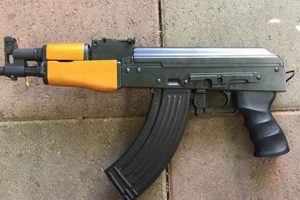
A gas blowback airsoft replica simulates the operation of a real firearm by utilizing compressed gas, typically propane or CO2, to cycle the slide or bolt and propel a projectile. These replicas offer enhanced realism compared to spring-powered or electric models due to their recoil action and operational similarities to their real steel counterparts. A common example is a sidearm that uses a magazine containing both the projectiles and the compressed gas reservoir.
The realism offered by these systems is a significant benefit, providing a more immersive training experience for law enforcement and military simulations, or a more engaging recreational experience for enthusiasts. Historically, these systems have evolved from simple, non-blowback gas-powered models to complex designs that closely mimic the weight, feel, and operation of real firearms. This evolution reflects a growing demand for realistic training tools and recreational equipment.
The following sections will delve into the specific components, maintenance procedures, and performance characteristics of these gas-operated airsoft mechanisms, providing a detailed understanding of their functionality and operation. Further discussion will also cover performance considerations, common issues, and safety protocols crucial for responsible usage.
Essential Usage Considerations
Optimizing the performance and longevity of a gas blowback airsoft replica requires adherence to specific maintenance and operational guidelines. Neglecting these aspects can lead to diminished performance, malfunctions, and potential damage.
Tip 1: Gas Selection: Utilize the appropriate gas type recommended by the manufacturer. Propane, often referred to as “green gas,” and CO2 are common choices, but each has specific pressure characteristics. Using the wrong gas can damage internal components or lead to inconsistent performance. Refer to the product manual for guidance.
Tip 2: Lubrication: Regularly lubricate moving parts with silicone-based oil. Metal-on-metal contact increases friction and wear. Apply a thin layer to the slide rails, hammer assembly, and magazine valves. Avoid petroleum-based lubricants as they can degrade rubber seals.
Tip 3: Magazine Maintenance: Keep magazines clean and free of debris. Regularly inspect magazine seals for leaks. A leaking magazine reduces gas efficiency and can cause inconsistent projectile velocity. Store magazines with a small amount of gas to maintain seal integrity.
Tip 4: Cleaning: Clean the barrel regularly using a cleaning rod and patches. Projectile residue can accumulate and reduce accuracy. Disassemble the barrel and hop-up unit periodically for a more thorough cleaning, ensuring all components are reassembled correctly.
Tip 5: Storage: Store the replica in a cool, dry place away from direct sunlight. Extreme temperatures can degrade plastic and rubber components. Deplete the gas from the magazine before long-term storage to prevent seal damage.
Tip 6: Component Inspection: Regularly inspect critical components such as the hop-up bucking, nozzle, and trigger assembly for wear or damage. Replace worn parts promptly to maintain optimal performance and prevent cascading failures.
Tip 7: Secure Handling: Always treat the replica as if it were a real firearm. Keep the muzzle pointed in a safe direction, and avoid dry-firing excessively, as this can damage internal components. Use only high-quality projectiles.
Implementing these maintenance and operational practices ensures consistent performance, extends the lifespan, and promotes safe operation of the system. Adherence to these guidelines is paramount for responsible ownership and effective utilization.
The subsequent sections will provide more in-depth information regarding specific performance metrics, customization options, and advanced troubleshooting techniques.
1. Realistic Recoil Simulation

Realistic recoil simulation is a defining characteristic of gas blowback airsoft pistols, differentiating them from spring-powered or electric airsoft replicas. The compressed gas, upon being released, propels the projectile and simultaneously drives the slide rearward, mimicking the recoil impulse of a real firearm. This action is achieved through a complex interaction of the gas valve, piston, and slide mechanism. The magnitude of the recoil force is directly influenced by gas pressure, slide weight, and the design of the blowback system. The more faithfully the replica replicates this recoil, the more realistic and immersive the shooting experience becomes. For example, a gbb pistol designed to closely replicate a 9mm handgun will have a slide weight and blowback system calibrated to deliver a recoil impulse similar to the real firearm, enhancing its training or recreational value.
The integration of realistic recoil simulation impacts various aspects of the airsoft experience. It enhances training scenarios for law enforcement and military personnel by providing a more authentic representation of weapon handling and recoil control. This, in turn, translates to improved accuracy and muscle memory development. Furthermore, recoil influences shot placement and trigger control, requiring more deliberate aiming and follow-through. Practical applications include force-on-force training exercises where participants benefit from realistic feedback, allowing them to adapt their techniques and strategies accordingly. The absence of realistic recoil, on the other hand, can lead to the development of incorrect shooting habits and a reduced sense of realism.
Realistic recoil simulation in gas blowback airsoft pistols is a crucial element that bridges the gap between simulated and real firearms. It offers tangible benefits for training, recreation, and immersive gameplay. While challenges remain in achieving perfect replication and managing gas efficiency, ongoing advancements in design and technology continue to refine and improve the realism of recoil feedback. Understanding the relationship between gas pressure, mechanical design, and recoil impulse is essential for selecting and maintaining a gbb airsoft pistol that meets specific training or recreational needs.
2. Gas Efficiency Management

Gas efficiency management is a crucial factor in the performance and user experience of gas blowback airsoft pistols. It directly affects the number of shots achievable per gas fill, influencing gameplay duration, operational costs, and overall practicality. Optimizing gas efficiency requires a comprehensive understanding of the various factors that contribute to gas consumption and wastage.
- Internal Seal Integrity
The integrity of internal seals is paramount to gas efficiency. Leaks within the gas system, particularly at magazine valves, nozzle seals, and cylinder components, result in wasted gas. Regular maintenance, including lubrication and seal replacement, is essential to prevent leaks and maintain optimal gas usage. Damage from wear and tear, improper lubrication, or incompatible gas types degrades seal performance, leading to significant gas losses. For example, a small leak at the magazine valve can reduce the number of shots per fill by 20-30%.
- Blowback System Design
The design of the blowback system directly impacts gas consumption. Systems with heavier slides or stronger recoil springs require more gas to cycle, reducing efficiency. The efficiency is often a tradeoff with recoil feel. Engineering modifications, such as lightweight slides or adjustable gas valves, can optimize the balance between recoil and gas usage. The efficiency can also be affected by the fit of the slide and components, more friction meaning more gas needed to operate.
- Temperature Sensitivity
Gas pressure is temperature-dependent; lower temperatures reduce gas pressure, leading to decreased velocity and potentially insufficient force to cycle the slide. Conversely, higher temperatures increase pressure, potentially damaging internal components. Users often employ different gas types based on ambient temperatures to mitigate these effects, with weaker gas used in higher temperatures and strongers gas used in colder temperatures. Effective gas efficiency management considers environmental conditions and adjusts gas type accordingly. Also, keeping magazines warm can help keep pressure within the magazines more stable.
- Hop-Up Unit Settings
The hop-up unit, which imparts backspin to the projectile, indirectly affects gas efficiency. Incorrect hop-up settings that require excessive gas pressure to achieve the desired range increase gas consumption. Fine-tuning the hop-up to achieve optimal projectile trajectory with minimal gas pressure is crucial. A badly adjusted hop-up might not let the bb pass properly through the barrel, requiring more gas usage.
These facets demonstrate that gas efficiency in gas blowback airsoft pistols is a complex interplay of design, maintenance, and environmental factors. Addressing each of these aspects is crucial to maximizing performance, minimizing operational costs, and achieving a consistently reliable airsoft experience. Moreover, a user’s commitment to regular maintenance routines ensures not only peak gas efficiency but also extended system longevity.
3. Slide Cycling Reliability

Slide cycling reliability is a critical performance metric for gas blowback airsoft pistols. It dictates the pistol’s ability to consistently load, fire, and eject projectiles in a semi-automatic or fully automatic mode. Reliable slide cycling is essential for both accurate shooting and realistic operation. Failure in this area can result in misfeeds, stovepipes, or a complete inability to fire, rendering the system ineffective. The factors that affect cycling include gas pressure, slide weight, magazine feed lip integrity, and the condition of internal components. For example, a weakened recoil spring might not provide sufficient force to return the slide to its forward position, causing a malfunction.
Several real-world factors influence slide cycling reliability. Low ambient temperatures reduce gas pressure, potentially hindering the slide’s ability to fully cycle. Conversely, excessively high gas pressure can damage internal components, also impairing cycling. Furthermore, substandard projectiles or magazines with damaged feed lips can cause misfeeds, disrupting the cycling process. Proper maintenance, including regular lubrication and cleaning, is imperative. Neglecting these procedures increases friction and the likelihood of malfunctions. High-stress environments, such as competitive airsoft matches, will place additional burden on cycling reliability where performance must be consistent and sustained over long periods.
In conclusion, slide cycling reliability is a pivotal element for the consistent performance of gas blowback airsoft pistols. Maintaining optimal gas pressure, ensuring proper maintenance, and utilizing high-quality components are vital for achieving dependable cycling. Challenges in maintaining consistent reliability include variations in temperature and the need for regular maintenance. Understanding the interplay between these factors is key to maximizing the effectiveness and lifespan of any gas blowback airsoft pistol.
4. Hop-Up Unit Performance
The hop-up unit in a gas blowback (GBB) airsoft pistol is a critical component that significantly influences projectile range and accuracy. This unit imparts backspin to the projectile as it exits the barrel, creating a Magnus force that counteracts gravity. The induced backspin extends the projectile’s flight path and stabilizes its trajectory, leading to increased effective range and improved precision. Without a properly functioning hop-up unit, GBB airsoft pistols would experience severely limited range and accuracy, making them less effective in gameplay scenarios. For example, a GBB pistol with an improperly adjusted or damaged hop-up unit may only achieve a range of 50 feet with erratic trajectory, compared to a properly adjusted unit capable of extending the range to 100 feet with a stable flight path.
The performance of the hop-up unit is contingent on several factors. These include the quality of the hop-up bucking (the rubber component that contacts the projectile), the consistency of the air seal, and the precision of the adjustment mechanism. A worn or damaged bucking can result in inconsistent backspin and decreased accuracy. Air leaks within the hop-up unit reduce the efficiency of the backspin effect. A poorly designed or calibrated adjustment mechanism can make it difficult to fine-tune the hop-up to achieve optimal performance for different projectile weights and target distances. In practical terms, a competitive airsoft player will meticulously adjust the hop-up unit before each game to match the specific projectile weight being used and the expected engagement distances. The ability to accurately adjust the hop-up is often the difference between consistently hitting targets and missing shots entirely.
In summary, hop-up unit performance is intrinsically linked to the overall effectiveness of a GBB airsoft pistol. The hop-up system contributes significantly to the airsoft pistol’s range and precision. The performance heavily relies on the precision of the settings to match bb weights used. Although hop-up units require careful settings and often require replacing of parts due to wear and tear.
5. Magazine Capacity Impact
Magazine capacity in gas blowback (GBB) airsoft pistols significantly influences gameplay dynamics, tactical considerations, and overall user experience. The number of projectiles a magazine can hold directly affects the frequency of reloads, altering engagement strategies and impacting the flow of gameplay.
- Reload Frequency and Tactical Implications
Higher capacity magazines reduce the need for frequent reloads, allowing players to maintain sustained fire and remain engaged in combat scenarios for longer periods. Conversely, lower capacity magazines necessitate more frequent interruptions for reloading, potentially exposing players to vulnerability and disrupting tactical momentum. For example, a player using a GBB pistol with a 15-round magazine may need to reload twice as often as a player with a 30-round magazine, impacting their ability to suppress opponents or advance across open ground. The tactical decision to utilize higher or lower capacity magazines often depends on the player’s role, play style, and the specific scenario being played.
- Realism and Authenticity Considerations
Magazine capacity also influences the realism and authenticity of the GBB airsoft experience. Replicas of real-world firearms often feature magazines with capacities that closely mirror their real steel counterparts. Adherence to these capacity limits enhances the realism of training scenarios and milsim (military simulation) events. Conversely, some players may opt for higher capacity magazines to gain a competitive advantage, sacrificing some degree of realism for increased firepower. The balance between realism and practicality is a key consideration for many GBB airsoft enthusiasts. For instance, a replica of a 1911 pistol with a 7-round magazine provides a more authentic experience but may be less practical in a fast-paced skirmish compared to a modified magazine holding 20 rounds.
- Gas Consumption and Performance Trade-offs
Magazine capacity can indirectly affect gas consumption and overall performance. Larger capacity magazines may require more gas to fully charge, potentially reducing the number of magazines that can be filled per gas canister. Furthermore, magazines with extended capacities may experience decreased gas efficiency due to the increased surface area for potential leaks. These trade-offs must be considered when selecting magazines for GBB airsoft pistols. A high-capacity magazine might offer increased firepower but at the expense of reduced gas efficiency and potentially lower projectile velocity. Therefore, users must weigh the benefits of higher capacity against the potential performance drawbacks.
- Magazine Weight and Handling Characteristics
Increased magazine capacity often translates to increased weight, particularly when the magazine is fully loaded with projectiles. This added weight can affect the handling characteristics of the GBB airsoft pistol, potentially impacting maneuverability and shooting stability. Players must adapt their techniques to compensate for the added weight, especially during rapid transitions or prolonged engagements. Lighter magazines, while offering reduced capacity, can improve handling speed and reduce fatigue during extended gameplay. The ideal magazine weight is a subjective preference that depends on the player’s physical capabilities and shooting style.
Magazine capacity represents a critical variable influencing the performance, tactical utility, and user experience of GBB airsoft pistols. Selecting the appropriate magazine capacity requires a careful evaluation of individual needs, gameplay preferences, and the desired balance between realism and practicality. By understanding the implications of magazine capacity, players can optimize their GBB airsoft setup to achieve maximum effectiveness in various scenarios. The interplay between magazine capacity, gas efficiency, and handling characteristics necessitates a holistic approach to GBB airsoft pistol configuration.
Frequently Asked Questions
The following section addresses common inquiries regarding the operation, maintenance, and performance of gas blowback airsoft pistols. These questions aim to provide clarity and guidance for both novice and experienced users.
Question 1: What types of gas are compatible with gas blowback airsoft pistols?
Gas blowback airsoft pistols typically utilize compressed gases such as propane (often marketed as “green gas”) and CO2. The specific type of gas recommended varies depending on the manufacturer and model. Consult the owner’s manual to determine the appropriate gas type. Using an incompatible gas can damage internal components and compromise performance.
Question 2: How frequently should gas blowback airsoft pistols be lubricated?
Lubrication frequency depends on usage intensity. For regular recreational use, lubrication of moving parts, such as the slide rails and magazine valves, is recommended after each use or after approximately 500 rounds fired. For more intensive use, lubrication may be required more frequently. Use only silicone-based lubricants designed for airsoft replicas.
Question 3: What are common causes of gas leaks in gas blowback airsoft pistols?
Gas leaks typically occur at magazine valves, cylinder seals, and nozzle components. Causes include wear and tear, improper lubrication, and exposure to extreme temperatures. Inspect these areas regularly and replace worn or damaged seals promptly.
Question 4: How does temperature affect the performance of gas blowback airsoft pistols?
Temperature significantly impacts gas pressure. Lower temperatures reduce gas pressure, resulting in decreased projectile velocity and potentially insufficient force to cycle the slide. Higher temperatures increase gas pressure, which can potentially damage internal components. Using different gas types based on temperature can mitigate these effects.
Question 5: What steps should be taken to maintain magazine feed reliability?
Magazine feed reliability is maintained by ensuring that magazines are clean and free of debris. Regularly inspect magazine feed lips for damage or deformation. Use only high-quality projectiles that are compatible with the magazine design. Periodically disassemble and clean magazines to remove accumulated residue.
Question 6: What safety precautions should be observed when using gas blowback airsoft pistols?
Treat the replica as if it were a real firearm. Always keep the muzzle pointed in a safe direction. Wear appropriate eye protection. Never aim at individuals who are not participating in the airsoft activity. Store the replica in a secure location when not in use. Ensure the area around any active airsoft range is safe and secured.
The provided answers address key operational and maintenance aspects of gas blowback airsoft pistols. Adherence to these guidelines will promote safe usage and prolonged system lifespan.
The subsequent sections will transition to a discussion of common upgrades and modifications available for these systems.
Conclusion
This exploration has detailed the functionality, maintenance, and critical performance aspects of gas blowback airsoft pistols. Key areas examined encompass gas efficiency, recoil simulation, slide cycling reliability, hop-up unit functionality, and magazine capacity. Each component contributes uniquely to the overall operational realism and effectiveness. A thorough understanding of these interconnected elements is essential for optimizing performance and ensuring responsible usage.
Continued advancement in design and materials promises further refinements in the realism and reliability of these systems. The responsible utilization and ongoing maintenance remain paramount, fostering a balance between recreational enjoyment and adherence to safety protocols. Further investigation into available upgrades, customization options, and advanced troubleshooting techniques will equip enthusiasts with the knowledge to enhance their experience and extend the lifespan of these sophisticated airsoft mechanisms.
![Top Picks: Best Spring Airsoft Pistol Guide [Year] | Ultimate Airsoft Guide for Beginners, Tactics & Gear Reviews](https://airsoftica.com/wp-content/uploads/2026/04/th-326-300x200.jpg "Top Picks: Best Spring Airsoft Pistol Guide [Year] Ultimate Airsoft Guide for Beginners, Tactics & Gear Reviews")