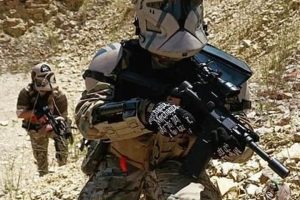
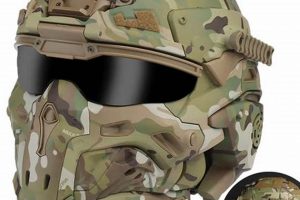
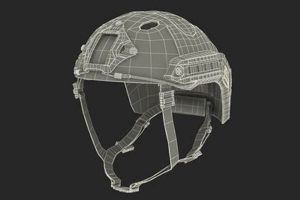
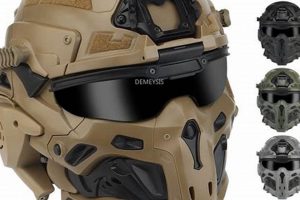
A balancing component attached to the rear of head protection used in airsoft, this item serves to offset the weight of accessories mounted on the front, such as night vision devices or cameras. These devices are typically pouches or specialized containers filled with weights, often lead or metal slugs, and are affixed securely to the helmet’s back. The principle is to create a more even distribution of mass across the head, enhancing stability and comfort for the wearer.
Employing these balancing systems is critical for mitigating neck strain and fatigue, particularly during extended periods of use. The weight distribution afforded by these systems not only improves comfort but also enhances the user’s ability to maintain situational awareness. Historically, improvised methods were often used to achieve balance, but purpose-built systems are now readily available, offering improved security and adjustability. The benefit of proper weight distribution cannot be overstated when users are performing activities requiring focused attention and quick reactions.
The following sections will delve further into the specifics of choosing the right weight, the different types available, installation techniques, and safety considerations when using these balancing items. Detailed examination of these areas will provide a comprehensive understanding of how to effectively utilize these essential pieces of airsoft gear. This will help players optimize their experience and performance during gameplay.
Essential Usage Guidance
Optimizing the utilization of a balancing system attached to headgear necessitates careful consideration of several factors. The following guidance aims to improve performance, increase comfort, and ensure safety.
Tip 1: Weight Calibration: Employ a graduated weight system to fine-tune balance. Adding or removing individual weights within the pouch allows for precise adjustment based on the specific accessories mounted on the front of the helmet. This minimizes excessive strain on the neck muscles.
Tip 2: Secure Attachment: Verify the secure and stable attachment to the helmet. A loose or improperly fastened balancing system can shift during dynamic movements, compromising balance and creating a potential hazard. Inspect the attachment points regularly.
Tip 3: Center of Gravity Considerations: Strive to position the weight to achieve an optimal center of gravity. An overly high or low placement can negatively impact stability. Experiment with different positions to determine the most comfortable and balanced configuration.
Tip 4: Profile Management: Select a low-profile design to minimize snag hazards. Bulky configurations can increase the risk of entanglement in vegetation or other obstacles. Streamlined designs enhance maneuverability in confined spaces.
Tip 5: Material Durability: Opt for pouches constructed from durable, abrasion-resistant materials. Rigorous activity can subject the counterweight system to significant wear and tear. High-quality materials ensure longevity and reliability.
Tip 6: Compatibility Verification: Confirm the compatibility of the balancing system with the specific helmet model. Not all systems are universally compatible. Ensure proper fit and secure attachment before use.
Tip 7: Regular Inspection: Conduct routine inspections of the entire system for signs of wear, damage, or loosening components. Promptly address any issues to maintain optimal performance and safety.
Adhering to these guidelines will maximize the benefits derived from using a balancing system, leading to enhanced comfort, stability, and overall performance during airsoft activities.
The subsequent sections will provide a detailed exploration of the various types available, offering insights into selecting the most appropriate system for individual needs and preferences.
1. Weight Distribution
Proper weight distribution is fundamental to the effective function of a headgear balancing system in airsoft. The addition of front-mounted accessories, such as night vision devices or tactical lights, creates an imbalance that can lead to neck strain, fatigue, and reduced stability. The primary purpose of a balancing system is to counteract this forward weight bias, thereby restoring equilibrium. The effects of inadequate distribution range from mild discomfort to significant impediments to performance, including impaired situational awareness and slower reaction times.
For example, consider a scenario where an airsoft participant utilizes a night vision device without a corresponding counterweight. The resulting forward weight shift forces the neck muscles to constantly compensate, leading to fatigue. Over time, this can develop into chronic neck pain. Conversely, a properly calibrated balancing system distributes the weight evenly across the head, reducing the strain on the neck and allowing for more comfortable and sustained operation. The weight and position of the counterweight must match the weight and location of front-mounted accessories.
In summary, weight distribution is not merely an ancillary consideration but rather a critical component of a headgear balancing system. Its proper implementation directly translates to improved comfort, enhanced stability, and optimized performance. Imbalances can lead to physical discomfort and reduce operational effectiveness. Therefore, understanding the principles of weight distribution and their application in balancing systems is essential for any airsoft participant who utilizes helmet-mounted accessories.
2. Secure Attachment
The method by which a balancing component is affixed to a piece of head protection is of paramount importance to its function and the wearer’s safety. The consequence of a failure in secure attachment can range from a minor annoyance to a significant hazard. An improperly secured system may shift during dynamic movements, altering the intended weight distribution and potentially causing imbalance or obstructing vision. Cause and effect are directly linked; a weak attachment mechanism leads to instability, which in turn compromises the user’s agility and reaction time.
Consider, for instance, an airsoft participant navigating a complex urban environment simulation. If the balancing system is not firmly secured, rapid head movements or impacts against obstacles could dislodge it. This not only disrupts the carefully calibrated weight balance but also presents a risk of the balancing component detaching entirely, potentially striking another participant or being lost. Furthermore, a loose attachment can create noise, compromising stealth in scenarios where auditory awareness is critical.
The need for secure attachment in a balancing system is non-negotiable. It directly impacts performance, safety, and mission success in the context of airsoft activities. Prioritizing robust and reliable attachment mechanisms is crucial when selecting and installing balancing components. Ignoring this aspect can negate the benefits of weight distribution and introduce avoidable risks. Therefore, a rigorous inspection and testing of the attachment system should be a standard procedure before and during use.
3. Adjustability Range
The adjustability range of an airsoft helmet counterweight dictates its adaptability to varying load configurations and individual user preferences. The ability to fine-tune the mass distribution is crucial due to the diverse array of accessories players attach to their helmets, each possessing unique weights. An inadequate adjustability range limits the system’s capacity to counteract the forward bias created by these accessories, undermining the core purpose of balancing the headgear. The lack of adjustability is a direct impediment to comfort and performance.
Consider a scenario where a player initially employs a lightweight camera, requiring a minimal balancing mass. As the player’s equipment evolves to include a heavier night vision device, the original system, lacking sufficient adjustability, becomes inadequate. The player then experiences increased neck strain and fatigue due to the persistent forward weight imbalance. Conversely, a system with a wide adjustability range accommodates this change effortlessly, allowing the player to add mass and restore optimal balance. This adaptability ensures consistent comfort and performance across various equipment configurations. Airsoft scenarios often demand adaptability, and a system that can be quickly adjusted is crucial.
In summary, the adjustability range represents a fundamental characteristic of the balancing component. Its presence ensures that the system can effectively counteract the weight of accessories. A limited range negates its benefits and may even exacerbate user discomfort. Players must carefully assess the adjustability range of such equipment to ensure that it meets the present and future needs. An appropriate adjustability range is not merely a convenience but rather a necessity for maintaining comfort, stability, and overall performance in the dynamic environment of airsoft.
4. Profile Dimensions

The profile dimensions of an airsoft helmet balancing component represent a critical design parameter influencing its practicality and usability. Profile dimensions are the physical size and shape of the component as it extends from the rear of the helmet. A high-profile configuration increases the likelihood of snagging on vegetation, building structures, or other obstacles during gameplay. This, in turn, compromises maneuverability, potentially exposing the user’s position and hindering swift movements. The inverse is also true; compact dimensions minimize interference, enhancing agility in constrained environments. A correlation, therefore, exists between diminished size and improved operational effectiveness.
Consider a scenario involving an airsoft participant navigating a dense woodland area. A balancing component with excessive depth or width is prone to entanglement with branches and foliage, impeding progress and creating noise. This noise can alert opposing players to the participant’s location, negating any tactical advantage gained through stealth. Conversely, a streamlined, low-profile balancing component reduces the chance of such interference, allowing for smoother and quieter movement through the same environment. In urban settings, larger dimensions increase the risk of impact and snagging on doorways or narrow passageways.
Therefore, an understanding of profile dimensions is essential when selecting a balancing system. Tradeoffs exist between weight capacity and physical size, demanding careful evaluation based on anticipated operating environments. A lower profile often necessitates a more compact and potentially heavier counterweight material to achieve the same balancing effect. The ultimate decision hinges on prioritizing maneuverability versus the necessity for counterbalancing a heavier load. Balancing profile dimensions with weight requirements is critical in real-world scenarios.
5. Material Durability
Material durability is a critical factor in the longevity and reliable operation of an airsoft helmet counterweight. The selection of appropriate materials directly influences the system’s ability to withstand the rigors of airsoft gameplay, which often involves exposure to impacts, abrasion, weather elements, and repetitive stress. Premature failure of a counterweight system due to inadequate material durability can lead to compromised balance, potential loss of equipment, and even safety hazards. The relationship between material selection and performance is a direct one; superior materials equate to extended service life and consistent functionality.
For instance, a counterweight pouch constructed from lightweight but fragile nylon is susceptible to tearing and abrasion, especially when exposed to rough terrain or contact with other gear. Over time, this degradation can lead to the loss of the counterweights themselves, rendering the system ineffective. Conversely, a pouch made from a high-denier, abrasion-resistant fabric, such as Cordura nylon, offers significantly greater protection against wear and tear. Similarly, the weights themselves benefit from durable materials. Lead weights, while dense, can deform under repeated impact; encased weights or the use of steel or tungsten slugs mitigate this issue. The choice of attachment method is another important durability aspect. Weak Velcro or plastic buckles are prone to failure under stress, jeopardizing the secure attachment of the entire system. Heavy-duty stitching, reinforced attachment points, and robust hardware such as metal buckles are essential for long-term reliability.
In summary, material durability is not a secondary consideration but rather a foundational element of a functional and reliable airsoft helmet counterweight. Selection of appropriate materials, with an emphasis on abrasion resistance, impact resistance, and robust attachment mechanisms, directly impacts the system’s service life, performance, and the user’s safety. Compromising on material quality represents a false economy, as the potential for premature failure and the associated risks outweigh any initial cost savings. Therefore, airsoft participants should prioritize systems constructed from durable, high-quality materials to ensure long-term performance and peace of mind.
6. Compatibility Verification

Compatibility verification constitutes a crucial step in the acquisition and deployment of balancing systems for airsoft head protection. This process ensures that the selected counterweight system is designed to interface correctly with the specific helmet model used. Failure to verify compatibility can result in improper fit, compromised functionality, and potential safety hazards.
- Attachment Interface
The attachment interface refers to the method by which the counterweight pouch or system physically connects to the helmet. This can include Velcro straps, MOLLE webbing, bolt-on adapters, or a combination thereof. Helmets equipped with ARC rails often require specific rail-mounted counterweight adapters. A mismatch between the helmet’s interface and the counterweight system’s attachment mechanism renders the system unusable. For example, attempting to attach a Velcro-backed pouch to a helmet lacking corresponding Velcro panels will result in a weak and unstable connection.
- Weight Capacity and Helmet Design
Helmet designs vary significantly in their ability to support added weight. Attaching an excessively heavy counterweight to a lightweight or structurally weak helmet can compromise the helmet’s integrity and potentially increase the risk of injury in the event of an impact. Verification should include an assessment of the helmet’s weight capacity and a determination of whether it is designed to accommodate the additional stress imposed by a counterweight and associated accessories. Overloading the helmet can strain the suspension system and lead to discomfort during extended use.
- Suspension System Interference
The internal suspension system of a helmet, which provides cushioning and impact absorption, can be negatively impacted by an improperly fitted counterweight. Some counterweight systems may interfere with the adjustment or proper function of the suspension system, reducing its effectiveness and potentially compromising safety. For instance, a counterweight that presses directly against the suspension straps can create pressure points and reduce the system’s ability to distribute impact forces evenly. Verification should include a thorough assessment of the counterweight’s interaction with the helmet’s suspension system.
- Accessory Mounting Considerations
Many airsoft helmets are designed with integrated accessory mounting points, such as NVG shrouds or side rails. The presence and location of these mounting points can influence the choice of counterweight system. Some counterweight systems are designed to integrate seamlessly with existing accessory mounts, while others may require modification or the removal of certain accessories. Verification should include an assessment of how the counterweight system interacts with other mounted accessories and whether it obstructs access to critical controls or functionalities.
These considerations illustrate the importance of thorough compatibility verification prior to deploying a balancing system. By carefully assessing the attachment interface, weight capacity, suspension system interference, and accessory mounting considerations, airsoft participants can ensure that the selected balancing system is safe, functional, and effectively contributes to improved comfort and performance. Neglecting compatibility verification can lead to suboptimal performance, equipment damage, and increased risk of injury.
7. User Comfort
The relationship between a balancing component used with airsoft head protection and user comfort is direct and significant. Prolonged use of headgear, particularly when augmented with accessories like night vision devices or cameras, introduces physical strain. Without a properly calibrated system, the cumulative effect of this imbalance precipitates discomfort, fatigue, and potential long-term musculoskeletal issues. Therefore, user comfort is not merely a desirable attribute but an essential functional requirement of any balancing system.
The application of these devices addresses the uneven weight distribution, alleviating pressure points and minimizing the compensatory strain exerted by neck and shoulder muscles. For example, an airsoft player using a front-mounted camera without a balancing device will experience a constant forward pull, necessitating continuous muscle contraction to maintain head stability. This prolonged contraction leads to fatigue and discomfort, potentially impacting reaction time and overall performance. A well-designed system, however, distributes the weight evenly, reducing the muscular effort required to maintain balance and promoting a more comfortable and sustainable experience. The degree of adjustability, the quality of materials used in the padding, and the overall profile of the balancing device contribute to its comfort rating. A system with a low profile minimizes snagging and reduces perceived weight, while high-quality padding prevents pressure points from forming.
In conclusion, user comfort is an intrinsic element of the functionality and effectiveness. Addressing weight imbalances through carefully designed and properly adjusted balancing systems significantly enhances the user experience, mitigating physical strain and promoting sustained operational capabilities. Neglecting the comfort aspect undermines the intended purpose of head protection and can lead to counterproductive outcomes. Therefore, when selecting and deploying a balancing device, prioritizing user comfort is paramount to maximizing performance and minimizing the risk of injury.
Frequently Asked Questions
This section addresses common inquiries and misconceptions regarding the utilization of a balancing component attached to protective headgear in the context of airsoft simulations.
Question 1: What is the primary function?
The primary function is to offset the weight of accessories mounted on the front of the headgear, such as night vision devices or cameras. This creates a more balanced distribution of weight, reducing neck strain and improving comfort.
Question 2: How much balancing mass is required?
The amount of mass required is contingent upon the weight of the front-mounted accessories. A graduated system, allowing for incremental adjustments, is recommended to achieve optimal balance. Over-correction can be as detrimental as under-correction.
Question 3: What types of materials are suitable for the housing?
Durable, abrasion-resistant materials, such as Cordura nylon or similar high-denier fabrics, are suitable for the housing. These materials withstand the rigors of airsoft activities and prevent premature wear and tear.
Question 4: Are balancing systems universally compatible with all headgear?
Compatibility varies. It is crucial to verify compatibility with the specific headgear model being used. Attachment interfaces, weight capacity, and suspension system compatibility must be considered.
Question 5: What are the potential safety considerations?
Potential safety considerations include ensuring secure attachment to prevent dislodgement during dynamic movements, avoiding excessive weight that could compromise the headgear’s protective capabilities, and selecting a low-profile design to minimize snag hazards.
Question 6: How often should the balancing system be inspected?
Regular inspections are essential. The attachment points, housing material, and internal mass should be inspected before and after each use to identify any signs of wear, damage, or loosening components.
In summation, these balancing components are a crucial addition to any loadout when users have accessories attached to their headgear. These devices help the efficiency and longevity of the user.
The subsequent section will delve into the best practices for maintaining and storing your balancing component to maximize its lifespan and effectiveness.
Airsoft Helmet Counterweight
This exploration has elucidated the critical role that the airsoft helmet counterweight plays in optimizing both comfort and performance. Proper utilization of these balancing systems, achieved through careful consideration of weight distribution, secure attachment, adjustability range, profile dimensions, material durability, and compatibility verification, translates directly into enhanced user experience and reduced risk of injury. These elements contribute in unison to operational effectiveness and are a core element of modern gameplay.
The responsible and informed implementation of airsoft helmet counterweights is, therefore, not merely a matter of preference but a strategic imperative. As technology advances and the complexity of airsoft loadouts increases, the need for effective weight management solutions will only become more pronounced. Continued research, development, and adherence to best practices are essential to ensure that these systems remain a valuable asset for airsoft participants, contributing to both their safety and their competitive edge. The end of the article will lead to the future for all airsoft gameplay and its participants.