The activity involves simulated combat using realistic replica firearms that fire spherical plastic projectiles. These projectiles, typically 6mm in diameter, are propelled by compressed gas or electric mechanisms. Participants engage in team-based scenarios, often mimicking military or law enforcement operations, with the objective of eliminating opposing players by hitting them with the plastic projectiles. A successful hit typically requires an honor system declaration from the struck player, acknowledging their elimination from the round.
This form of recreational shooting provides a structured and engaging environment for developing teamwork, strategic thinking, and communication skills. Its origins can be traced to the late 20th century, evolving from training exercises to a popular leisure pursuit. The appeal lies in the realism of the equipment and scenarios, providing a more immersive experience than some other similar activities. Furthermore, it fosters a sense of camaraderie and sportsmanship among participants, promoting physical activity and mental agility.
Having defined this activity, the following sections will delve into specific aspects such as equipment variations, gameplay styles, safety protocols, and a comparison with related recreational shooting sports. The exploration will also consider the legal and regulatory landscape surrounding this activity and examine its evolving role in popular culture and recreational activities.
Essential Guidance
The following recommendations aim to enhance engagement and safety when participating in this activity. Prioritizing proper preparation and responsible conduct contributes to a more rewarding and secure experience.
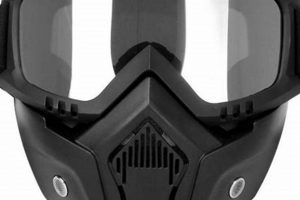
Tip 1: Prioritize Eye Protection: Approved, full-seal goggles or a facemask designed specifically for this activity are non-negotiable. Consistent use, even in designated safe zones, prevents potential eye injuries. For instance, ensure the protective gear meets or exceeds ANSI Z87.1 standards.
Tip 2: Understand Velocity Limits: Adherence to field-imposed velocity limits is crucial. Measurements, typically expressed in feet per second (FPS), determine the projectile’s maximum speed. Chronograph testing, conducted by field staff, ensures compliance and minimizes the risk of injury. A common limit is 400 FPS with a 0.20g BB.
Tip 3: Maintain Weapon Safety: Treat replica firearms as real firearms. Keep the weapon on “safe” mode unless actively engaged in gameplay. Muzzle awareness, directing the barrel in a safe direction, prevents accidental discharges and potential injuries.
Tip 4: Communicate Effectively: Clear and concise communication with teammates is vital for strategic planning and coordination. Employing hand signals or established communication protocols improves situational awareness and reduces friendly fire incidents.
Tip 5: Observe Minimum Engagement Distances: Establishing and adhering to minimum engagement distances, often based on weapon type and field rules, minimizes the potential for close-range injuries. These distances reduce the force of impact and allow players time to react.
Tip 6: Respect Field Boundaries: Staying within designated play areas prevents unintended encounters with non-participants and avoids trespassing on private property. Boundary markers should be clearly visible and understood by all participants.
Tip 7: Uphold the Honor System: This activity relies heavily on the honor system. Acknowledging hits honestly and fairly ensures the integrity of the game and promotes sportsmanship. Disputing legitimate hits undermines the experience for all participants.
Following these recommendations enhances the safety and enjoyment of the activity. Prioritizing responsible behavior ensures a positive experience for all participants, fostering a culture of respect and sportsmanship.
These guidelines serve as a foundation for responsible engagement. Further investigation into specific rules and regulations is essential for safe and compliant participation.
1. Replica Firearms

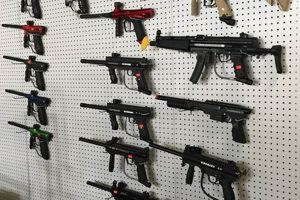
The use of replica firearms is a defining characteristic of the recreational shooting sport. These devices, designed to mimic the appearance and handling of real firearms, are integral to creating an immersive and realistic combat simulation. The inherent appeal lies in the aesthetic fidelity to actual firearms, ranging from modern assault rifles to historical weaponry. This realism, while contributing to the experience, necessitates responsible handling and a clear understanding of the associated safety protocols.
The importance of replica firearms stems from their contribution to strategic depth and tactical considerations within gameplay. Different replica models offer varying performance characteristics, such as effective range, rate of fire, and ammunition capacity. Players select their equipment based on their preferred role and the demands of the scenario, mirroring real-world military or law enforcement tactics. For example, a sniper might opt for a replica bolt-action rifle with enhanced range and accuracy, while a close-quarters combatant might favor a replica submachine gun with a high rate of fire. The correct utilization of these replica firearms is critical to success, impacting overall team dynamics and influencing tactical decisions.
Understanding the relationship between replica firearms and the broader activity necessitates recognition of associated challenges. The realistic appearance can create potential confusion for law enforcement in public spaces, requiring responsible transportation and storage. Furthermore, the potential for misuse or modification raises concerns about public safety and adherence to legal regulations. Therefore, informed participation involves a comprehensive awareness of local laws, responsible gun handling practices, and a commitment to maintaining the integrity of the sport, while preventing real-world misinterpretations or safety risks.
2. Plastic Projectiles

The nature of projectiles used is central to differentiating the recreational shooting sport from other similar activities. These spherical projectiles, typically made of biodegradable plastic, are the means by which players register hits on opponents. Their properties directly influence gameplay dynamics, safety considerations, and overall experience.
- Material Composition
The projectiles are commonly made from Polylactic Acid (PLA), a biodegradable thermoplastic derived from renewable resources. This composition contributes to environmental sustainability compared to non-biodegradable alternatives. However, variations in manufacturing processes can influence the PLA’s degradation rate and impact resistance. Proper disposal practices remain crucial to minimizing environmental impact, even with biodegradable plastics.
- Projectile Weight and Size
Standard projectile sizes are 6mm and 8mm in diameter, with varying weights ranging from 0.12g to 0.40g. Heavier projectiles tend to offer greater accuracy and resistance to wind drift, but also require higher energy output to achieve the same velocity. Field regulations often dictate maximum projectile weight and velocity limits to ensure player safety. The selection of appropriate projectile weight depends on the type of replica firearm used and the specific gameplay environment.
- Velocity and Impact
Projectiles are propelled from replica firearms using compressed gas (e.g., CO2 or green gas) or electric mechanisms, achieving velocities typically between 300 and 450 feet per second (FPS). While the plastic material is relatively soft, the impact force at close range can cause discomfort or minor welts. Mandatory eye protection is therefore essential. Fields commonly enforce minimum engagement distances to reduce the risk of injury from close-range impacts.
- Accuracy and Trajectory
The accuracy of projectiles is influenced by several factors, including projectile weight, quality, barrel type, and hop-up system (a backspin mechanism that extends the projectile’s range). Achieving consistent accuracy requires careful selection of projectiles and proper maintenance of replica firearms. External factors, such as wind and humidity, can also significantly affect projectile trajectory. Skilled players learn to compensate for these variables to maximize their effectiveness in gameplay.
These facets demonstrate the interconnectedness between projectile characteristics, equipment capabilities, and safety protocols. The selection and utilization of plastic projectiles is therefore a critical aspect that influences the overall dynamics and considerations of this activity.
3. Team-Based Scenarios

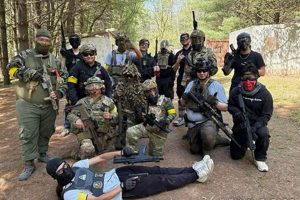
The structure of gameplay within this activity is heavily reliant on team-based scenarios. These simulated conflicts provide a framework for strategic interaction and coordinated action, forming a cornerstone of the overall experience.
- Objective-Oriented Missions
These scenarios frequently involve predefined objectives, such as capturing a designated point, defending a position, or retrieving an item. Success depends on the team’s ability to strategize, communicate effectively, and execute coordinated maneuvers. Examples include simulating a hostage rescue operation or securing a specific area to establish a forward operating base. The objective provides focus, encouraging teamwork and task delegation.
- Role Specialization and Coordination
Team-based scenarios often encourage or necessitate specialized roles within a team. Players may assume roles such as rifleman, sniper, medic, or grenadier, each requiring different equipment and tactical responsibilities. Coordination between these roles is crucial for achieving objectives. For instance, a sniper providing overwatch while a medic supports advancing riflemen exemplifies role-based coordination. The interdependence between roles fosters a sense of shared responsibility.
- Simulated Combat Environments
The scenarios frequently take place in simulated combat environments, such as wooded areas, abandoned buildings, or purpose-built fields. These environments introduce challenges that require adaptation and strategic thinking. Players must navigate obstacles, utilize cover effectively, and anticipate enemy movements. The simulated environment enhances immersion and demands tactical awareness.
- Communication Protocols
Effective communication is paramount in team-based scenarios. Teams often employ standardized communication protocols, including hand signals and radio communication, to relay information quickly and accurately. Clear and concise communication is vital for coordinating movements, calling out enemy positions, and adapting to changing circumstances. Reliable communication systems significantly enhance tactical effectiveness.
The integration of these facets underscores the significance of team-based scenarios in structuring gameplay. The dependence on strategic coordination, specialized roles, and effective communication mechanisms amplifies the communal dynamic and enhances the challenge for those engaged in the activity.
4. Objective-Driven Gameplay

Objective-driven gameplay is a fundamental component of this recreational shooting sport, providing a structured context for simulated combat engagements. The presence of defined objectives distinguishes the activity from simple target practice or unstructured skirmishes, introducing strategic depth and promoting teamwork. These objectives, which can range from capturing a designated point to rescuing a simulated hostage, serve as the impetus for player actions and tactical decision-making. The absence of clear objectives would reduce the activity to a less engaging and ultimately less rewarding exercise.
The significance of objective-driven gameplay extends to the development of real-world skills. Participants must learn to coordinate with teammates, develop strategies, and adapt to changing circumstances to achieve their objectives. For example, a scenario requiring the defense of a fortified position necessitates coordinated fire support, logistical planning, and effective communication to repel attacking forces. These practical applications of teamwork, strategic thinking, and problem-solving contribute to the activity’s appeal beyond mere recreational shooting. Successful objective completion often hinges on the ability to effectively delegate tasks, allocate resources, and anticipate opponent movements, mirroring many challenges encountered in professional settings.
In conclusion, objective-driven gameplay is an inextricable element of this activity, shaping its strategic dynamics and fostering the development of essential skills. While challenges may arise in designing balanced and engaging objectives, the presence of these goals remains essential for providing a focused and rewarding experience. Understanding the importance of objective-driven gameplay is critical for both participants and event organizers seeking to maximize the activity’s potential for strategic engagement and skill development.
5. Honor System

The honor system is a fundamental, albeit unconventional, governance mechanism that underpins the integrity and functionality of this recreational shooting sport. Its presence is vital, as the activity lacks the immediate, visual confirmation of a hit seen in similar sports. Therefore, the reliance on participant honesty dictates fair play and preserves the overall sporting experience.
- Self-Reporting of Hits
The cornerstone of the honor system is the expectation that players accurately and immediately self-report when struck by a projectile. Upon impact, individuals are expected to audibly declare themselves “hit” and remove themselves from active gameplay for a predetermined period or until the round concludes. This self-reporting is crucial, as referees cannot monitor every engagement on the field, and the plastic projectiles do not leave visible marks like paint. Without reliable self-reporting, disputes would be commonplace, and the activity’s flow would be disrupted.
- Addressing Disputed Hits
While the honor system promotes fair play, disputes can arise. In such instances, established field rules and designated game officials typically intervene. Evidence may be presented, such as witness testimony or video recordings, to resolve the disagreement. The resolution process often emphasizes mediation and sportsmanship, aiming to preserve the integrity of the game without escalating conflict. Repeated violations of the honor system can result in penalties, including temporary or permanent expulsion from the activity.
- Impact on Fair Play and Sportsmanship
The effective implementation of the honor system cultivates a culture of fair play and sportsmanship among participants. Recognizing that the activity depends on mutual trust, players are incentivized to adhere to the rules and uphold ethical conduct. This shared commitment to fairness fosters a positive environment and enhances the overall enjoyment for all involved. The honor system encourages self-regulation and discourages unsportsmanlike behavior, contributing to the unique social dynamic of the activity.
- Consequences of System Abuse
Deliberate disregard for the honor system, such as failing to acknowledge hits or intentionally misrepresenting events, undermines the integrity of the activity. Frequent or egregious violations can erode trust among players and lead to a decline in participation. Game organizers have a responsibility to enforce the honor system and address instances of abuse through established disciplinary measures. The long-term sustainability of the activity depends on the collective commitment to upholding ethical standards and ensuring fair play.
These interwoven facets demonstrate the central role of the honor system in defining this recreational shooting sport. From self-reporting protocols to dispute resolution mechanisms, the reliance on participant honesty shapes the dynamics, fosters sportsmanship, and preserves the integrity of the activity. Its effective enforcement is essential for maintaining a positive and engaging experience for all participants.
6. Strategic Communication
Strategic communication forms a critical component of effective gameplay within the recreational shooting sport. Its importance stems from the necessity for coordinated action and information dissemination across distributed teams operating in dynamic simulated combat environments.
- Pre-Mission Planning and Briefing
Prior to engaging in a scenario, teams typically conduct planning sessions to establish objectives, assign roles, and develop tactical strategies. These briefings involve clear communication of mission parameters, potential threats, and planned maneuvers. Effective pre-mission communication minimizes confusion and ensures that all team members are aligned on the overall strategy. For example, a team might discuss the approach to a fortified position, assigning specific roles for reconnaissance, flanking maneuvers, and direct assault. A breakdown in pre-mission communication can lead to disorganization and mission failure.
- Real-Time Information Relay
During active gameplay, the ability to relay information quickly and accurately is crucial for adapting to changing circumstances. Players utilize various communication methods, including hand signals, verbal cues, and radio communication, to report enemy positions, request support, and coordinate movements. Real-time information relay allows teams to respond effectively to unexpected events, such as an ambush or a change in enemy tactics. Failure to communicate critical information can result in casualties or missed opportunities. For instance, a scout spotting an enemy flanking maneuver must immediately communicate this information to the team to allow for a defensive response.
- Role-Specific Communication Protocols
Different roles within a team often require specialized communication protocols. Snipers, for example, may use a specific set of codes or signals to communicate target information to the team. Medics need to communicate their location and availability to wounded teammates. Establishing and adhering to these role-specific communication protocols ensures efficient and unambiguous information exchange. A medic might use a designated callsign and predetermined location coordinates to facilitate rapid response to injured players. Without role-specific protocols, communication can become garbled or misinterpreted, hindering team performance.
- Post-Mission Debriefing and Analysis
Following the completion of a scenario, teams often conduct debriefing sessions to analyze their performance and identify areas for improvement. These debriefings involve open and honest communication about successes, failures, and lessons learned. Effective post-mission communication allows teams to refine their strategies and improve their coordination in future engagements. For example, a team might discuss a failed assault, analyzing communication breakdowns, tactical errors, and equipment malfunctions. A thorough debriefing process can lead to significant improvements in team performance over time.
These intertwined facets highlight strategic communication’s paramount influence in the recreational shooting sport. Its necessity for coordinated pre-mission planning, accurate real-time information relay, role-specific protocols, and effective post-mission analysis amplifies the communal dynamic and enhances the challenge for those engaged in the activity.
7. Protective Gear
Adequate protective equipment is not merely recommended but is a compulsory element in participation within this recreational shooting sport. The velocity and impact of projectiles necessitates stringent safety measures to mitigate potential injuries. Consistent and proper utilization of specified protective gear is critical for ensuring participant safety during gameplay.
- Eye and Face Protection
Full-seal goggles or a dedicated facemask meeting or exceeding ANSI Z87.1 standards are universally mandated. These are designed to withstand the impact of projectiles at close range, preventing potential eye injuries or facial trauma. The seal is essential to prevent projectiles from entering around the edges. This requirement is consistently enforced at all organized events and fields to ensure participant well-being.
- Mouth and Tooth Protection
While full facemasks offer comprehensive protection, some players opt for lower-face masks or mouthguards in conjunction with goggles. These provide crucial protection against dental injuries, which can occur from direct projectile impacts. The selection of appropriate mouth and tooth protection often depends on individual preference and the level of protection afforded by the chosen facemask.
- Body Protection
Although not always mandatory, many participants choose to wear additional body protection, such as padded vests, jackets, or layers of clothing. These minimize the discomfort and potential bruising from projectile impacts, particularly in sensitive areas. The level of body protection selected often depends on the individual’s tolerance for discomfort and the intensity of the gameplay environment.
- Head Protection
Head protection, in the form of helmets or padded headwear, provides additional safety against head injuries. While direct impacts to the head are less common, helmets offer crucial protection against falls or collisions with obstacles on the playing field. The selection of appropriate head protection often depends on the terrain and the potential for physical hazards.
The adherence to these safety protocols, encompassing appropriate protective gear, is essential for responsible engagement in this activity. The continuous development and refinement of protective equipment contributes to injury prevention. Prioritizing safety ensures that participants can engage in the activity with minimized risks and a heightened sense of security.
Frequently Asked Questions
The following addresses common inquiries regarding this recreational shooting sport, providing factual information and clarifying prevalent misconceptions.
Question 1: What are the fundamental differences between this activity and paintball?
The primary distinctions reside in the type of projectiles used and the realism of the equipment. This activity employs spherical plastic projectiles, whereas paintball uses paint-filled gelatin capsules. Furthermore, equipment in this activity often replicates the appearance of real firearms, contributing to a more immersive simulation, unlike paintball markers.
Question 2: Is the activity safe?
Safety is paramount and relies heavily on adherence to strict protocols. Mandatory eye protection, velocity limits for projectiles, and responsible gun handling practices are essential for minimizing the risk of injury. Compliance with field rules and the utilization of appropriate protective gear significantly contribute to a secure environment.
Question 3: What age restrictions apply?
Age restrictions vary depending on the specific field or event organizer. Minors typically require parental consent or supervision. Many fields impose minimum age limits, often ranging from 12 to 18 years old, due to safety concerns and the responsible handling of replica firearms.
Question 4: What is the typical cost associated with participation?
Costs can vary considerably based on factors such as equipment rental, field fees, ammunition, and protective gear purchases. Entry-level participation with rental equipment may range from \$30 to \$50 per day. Owning personal equipment and participating in organized events can increase expenses significantly.
Question 5: What types of gameplay scenarios are common?
Common scenarios include capture-the-flag, team deathmatch, and objective-based missions simulating military or law enforcement operations. These scenarios often require strategic planning, teamwork, and effective communication to achieve victory.
Question 6: Where is this activity legally permitted?
The legality of this activity is subject to local laws and regulations. Certain jurisdictions may restrict the ownership, transportation, or use of replica firearms. It is imperative to research and comply with all applicable laws before participating in this activity.
These responses provide a foundational understanding of frequently encountered questions. Further inquiry into specific rules, regulations, and field guidelines is essential for informed participation.
The following section will explore ethical considerations pertinent to this recreational shooting sport.
Conclusion
This exploration of what is airsoft paintball has illuminated its multifaceted nature, revealing a recreational shooting sport defined by replica firearms, plastic projectiles, team-based scenarios, and a reliance on the honor system. The examination has underscored the importance of protective gear, strategic communication, and adherence to established safety protocols. Understanding these key attributes is crucial for both prospective participants and those seeking a comprehensive understanding of this activity.
As this simulated combat activity continues to evolve, maintaining a commitment to safety, ethical gameplay, and responsible equipment handling is essential. Further exploration into local regulations, advanced tactics, and the societal impact of this recreational pursuit is encouraged, ensuring informed and conscientious participation. The future trajectory of this activity depends on the collective dedication to responsible practices and the continuous refinement of safety standards.
![Paintball vs Airsoft: What's the Real Difference? [Guide] | Ultimate Airsoft Guide for Beginners, Tactics & Gear Reviews](https://airsoftica.com/wp-content/uploads/2026/02/th-423-300x200.jpg "Paintball vs Airsoft: What's the Real Difference? [Guide] Ultimate Airsoft Guide for Beginners, Tactics & Gear Reviews")