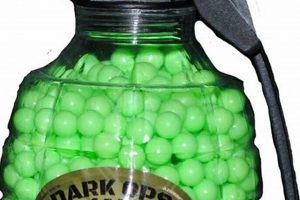
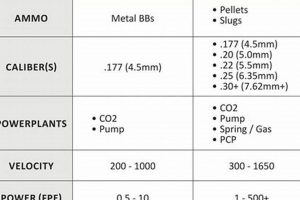
The differentiation between projectile diameters employed in airsoft replicas is crucial for optimal performance and safety. BBs, as they are commonly known, are manufactured in various dimensions, each designed to correspond with specific replica types and intended applications. A deviation from the recommended diameter can result in diminished accuracy, internal damage to the replica, or even potential injury. For example, using a 0.12g BB in a high-powered replica designed for 0.20g BBs can lead to inconsistent trajectory and increased risk of breakage within the gun’s mechanism.
The selection of an appropriate projectile dimension significantly impacts gameplay dynamics and equipment longevity. A properly matched BB promotes consistent velocity, enhances accuracy, and minimizes the risk of mechanical failure. Historically, the development of varying projectile dimensions has allowed for greater customization and optimization of airsoft replicas to suit diverse playing styles and environments. This specialization is essential for ensuring fair and safe competition, as well as prolonging the lifespan of expensive airsoft equipment. Choosing the right projectile size also aligns with responsible airsoft participation by minimizing potential risks.
Understanding the available range of BB diameters, weights, and their respective applications is therefore paramount. The following sections will delve into the specific dimensions commonly found in airsoft, the factors influencing projectile selection, and best practices for ensuring compatibility between projectiles and airsoft replicas. These aspects will contribute to a well-informed decision-making process when selecting appropriate projectiles.
The following recommendations provide crucial insight into projectile selection, ensuring compatibility, performance optimization, and the mitigation of potential risks associated with incorrect dimension usage.
Tip 1: Consult Replica Specifications: Always refer to the manufacturer’s specifications for the airsoft replica in question. These guidelines indicate the recommended BB diameter and weight range for optimal performance and to prevent internal damage.
Tip 2: Prioritize Consistent Diameter: Employ projectiles from reputable manufacturers known for their consistent diameter. Variations in diameter can lead to inconsistent shots and potential jamming issues within the airsoft replica.
Tip 3: Match Weight to Power: Select BB weight based on the airsoft replica’s power output (measured in FPS). Higher-powered replicas typically require heavier BBs for improved accuracy and reduced wind drift. Lighter BBs are more suited for lower-powered guns to achieve desired range.
Tip 4: Consider Environmental Factors: Account for environmental conditions such as wind. Heavier BBs are generally more resistant to wind interference, maintaining a straighter trajectory, particularly in outdoor scenarios.
Tip 5: Inspect BBs Before Use: Visually inspect BBs before loading them into magazines or the replica. Discard any BBs exhibiting imperfections, such as chips, cracks, or irregular shapes, as these can negatively impact performance and potentially damage internal components.
Tip 6: Store BBs Properly: Maintain BBs in a dry, cool environment to prevent moisture absorption. Moisture can affect the BB’s weight and shape, leading to inconsistencies in performance.
Tip 7: Use Quality BBs: Opt for high-quality BBs manufactured from precision-molded plastic. These projectiles are typically more consistent in size and weight, contributing to improved accuracy and reliability.
Adhering to these guidelines provides a foundation for making informed decisions, optimizing gameplay, and promoting longevity of airsoft equipment through the correct projectile selection.
With these considerations in mind, the final section will summarize the importance of informed choices regarding projectile specifications in airsoft and the impact these choices have on safety, performance, and equipment maintenance.
1. Diameter variance

Diameter variance, as a critical component of the phrase “airsoft bb size comparison,” represents the permissible range of deviation from a projectile’s stated diameter. Projectiles intended for use in airsoft replicas are manufactured to standardized dimensions, most commonly 6mm. However, manufacturing tolerances inevitably introduce slight differences in the actual diameter of individual projectiles. This variance, even if minimal, can significantly impact the performance and reliability of an airsoft replica. For example, a batch of 6mm projectiles with an actual average diameter of 5.95mm might exhibit reduced accuracy due to a looser fit within the replica’s barrel. Conversely, projectiles exceeding the 6mm specification could cause jamming or even damage to the internal mechanisms.
The impact of diameter variance is further amplified by the type of airsoft replica employed. High-precision replicas, such as those used by competitive airsoft players, demand projectiles with extremely tight tolerances to ensure consistent shot-to-shot performance. In these scenarios, even a variation of a few hundredths of a millimeter can be the difference between a successful hit and a miss. The significance of diameter variance extends to the selection of appropriate hop-up adjustments. Hop-up systems rely on imparting backspin to the projectile, and inconsistent diameters can disrupt this process, resulting in unpredictable trajectories. Consequently, careful evaluation of projectile diameter variance is essential for achieving optimal accuracy and consistency in airsoft gameplay.
In summary, diameter variance plays a crucial role in “airsoft bb size comparison” by impacting the compatibility and performance of projectiles in airsoft replicas. Understanding and mitigating diameter variance is essential for achieving consistent accuracy, preventing internal damage, and optimizing the overall airsoft experience. While achieving perfect uniformity is unattainable, prioritizing projectiles from reputable manufacturers with stringent quality control measures is a practical strategy for minimizing the adverse effects of diameter variance.
2. Weight correlation

Weight correlation, within the context of “airsoft bb size comparison,” denotes the relationship between a projectile’s mass and its dimensions, primarily diameter. While projectiles are often categorized by diameter (e.g., 6mm), the mass of the projectile exerts a substantial influence on its trajectory, velocity retention, and impact force. A higher-mass projectile, when propelled by the same force, exhibits greater inertia and is less susceptible to external factors such as wind. Consequently, projectile weight is a critical consideration in the application of airsoft replicas. Projectile mass also affects the range.
Real-world examples illustrate the practical significance of weight correlation. Lower-powered airsoft replicas, such as those used in indoor CQB (Close Quarters Battle) environments, typically employ lighter projectiles (e.g., 0.20g) to maintain velocity within safety limits. Conversely, higher-powered replicas, often used in outdoor fields, benefit from heavier projectiles (e.g., 0.28g, 0.30g, or even higher) to improve accuracy and range in spite of environmental influences. The practical implication of improper weight selection includes reduced accuracy (lighter projectiles in high-powered replicas) and limited effective range (heavier projectiles in low-powered replicas). Selection of the correct weight ensures optimal replica performance.
The link between projectile weight and diameter is fundamental to a comprehensive “airsoft bb size comparison.” Weight influences kinetic energy delivered upon impact. Understanding this relationship allows for informed decisions that enhance the airsoft experience, promoting both safety and efficacy. The weight selection needs to be considered depending the diameter. Disregarding the importance of projectile weight correlation can degrade performance and potentially increase the risk of injury.
3. Replica compatibility

The suitability of a specific projectile to a given airsoft replica constitutes a crucial factor in “airsoft bb size comparison.” Compatibility extends beyond simple dimensional fit, encompassing material compatibility, power output considerations, and performance optimization for specific replica types.
- Inner Barrel Diameter
The inner barrel diameter of an airsoft replica directly influences the optimal projectile size. While 6mm projectiles are standard, slight variations in inner barrel diameter necessitate precise projectile dimensions to ensure consistent air seal and efficient energy transfer. Incompatible projectiles may cause jamming, reduced velocity, or even damage the replica’s internal components. A loose fit can result in decreased accuracy, while an overly tight fit can lead to increased friction and inconsistent performance.
- Hop-Up System Integration
The hop-up system, designed to impart backspin for increased range, is intrinsically linked to projectile selection. Projectile weight and surface texture affect the effectiveness of the hop-up unit. Heavier projectiles generally require more hop-up force. Conversely, lighter projectiles may be over-hopped, leading to erratic trajectories. Mismatched projectile and hop-up settings reduce accuracy and range, negating the intended benefits of the hop-up system.
- Gas System Considerations
Gas-powered airsoft replicas, including gas blowback (GBB) pistols and rifles, require careful projectile selection to ensure proper cycling and gas efficiency. Projectile weight influences the energy required to propel the projectile and cycle the bolt. Overly heavy projectiles can strain the gas system, leading to reduced velocity, inconsistent cycling, or even damage. Lighter projectiles may result in excessive gas consumption and reduced power output. The gas system’s design will affect the replica compatibility.
- Magazine Compatibility
The physical dimensions of projectiles influence their compatibility with airsoft replica magazines. Inconsistent projectile diameters or shapes can cause feeding issues, such as jamming or misfeeds. These issues are particularly prevalent in high-capacity magazines (hicaps) or speedloaders, where multiple projectiles are loaded simultaneously. Ensure dimensions are optimal for consistent and reliable feeding.
Understanding these facets of replica compatibility underscores the importance of diligent “airsoft bb size comparison.” Suboptimal projectile selection can lead to decreased performance, increased risk of damage, and a diminished overall airsoft experience. Informed projectile selection, based on replica specifications and performance goals, is essential for maximizing the functionality and longevity of airsoft equipment.
4. Material composition
Material composition, within the context of “airsoft bb size comparison,” significantly influences projectile performance and the longevity of airsoft replicas. The constituent materials of an airsoft projectile directly affect its density, surface friction, and biodegradability, with each factor bearing implications for accuracy, range, and environmental impact. For instance, projectiles constructed from low-grade plastics are prone to inconsistencies in shape and density, leading to erratic trajectories and reduced accuracy. In contrast, high-precision projectiles composed of polished, high-density polymer materials offer greater consistency and improved performance.
The material composition also dictates the interaction between a projectile and the internal components of an airsoft replica. Projectiles with rough or abrasive surfaces can accelerate wear on barrels, hop-up buckings, and other critical parts, ultimately shortening the lifespan of the replica. Biodegradable projectiles, typically composed of polylactic acid (PLA) or similar compounds, offer an environmentally conscious alternative. However, their material composition can also impact performance characteristics. PLA projectiles may exhibit greater sensitivity to moisture and temperature fluctuations, potentially affecting their dimensional stability and trajectory. Furthermore, variations in the production process of PLA projectiles can result in inconsistent densities and surface finishes, influencing their overall accuracy. An example is using cheap plastic projectiles that can shatter inside of your inner barrel, causing internal damage.
In conclusion, material composition represents a crucial, yet often overlooked, aspect of “airsoft bb size comparison.” The selection of projectiles should consider not only diameter and weight but also the material properties of the projectiles. Understanding the interplay between material composition, projectile performance, and replica durability is essential for optimizing the airsoft experience while minimizing environmental impact. Careful consideration of material properties allows for a more holistic and informed approach to airsoft projectile selection.
5. Kinetic energy

Kinetic energy, as a function of mass and velocity, is a paramount consideration when evaluating “airsoft bb size comparison.” The projectile’s mass and the velocity imparted by the airsoft replica directly determine the energy transferred upon impact. Consequently, understanding the relationship between projectile dimensions, weight, and muzzle velocity is essential for ensuring safe and responsible gameplay. The energy must be regulated within established safety limits, typically measured in Joules, to mitigate the risk of injury. Selecting projectile sizes and weights that result in excessive kinetic energy output can lead to potential harm and is therefore a critical element of projectile selection.
For example, a heavier projectile propelled at the same velocity as a lighter projectile will possess greater kinetic energy. Conversely, a lighter projectile must achieve a higher velocity to attain the same energy level as a heavier one. Airsoft fields often impose restrictions on muzzle velocity and/or energy levels to maintain safety standards. These regulations necessitate careful consideration of projectile weight to remain compliant. A common scenario involves the use of heavier projectiles to mitigate wind drift, but this requires adjusting the replica’s power output to ensure the kinetic energy remains within acceptable limits. Chronographs are used to measure the muzzle velocity of airsoft replicas with the intended projectile. This data is then used to calculate kinetic energy. It is important to consult Joule creep, the effect of energy increased with heavier projectiles.
In summary, kinetic energy represents a critical safety parameter within the framework of “airsoft bb size comparison.” Understanding the relationship between projectile mass, velocity, and kinetic energy is vital for responsible gameplay. By selecting appropriate projectile sizes and weights and adhering to established energy limits, participants can minimize the risk of injury and promote a safe environment. Ignoring this aspect of projectile selection can lead to unsafe conditions and potential harm, underscoring the importance of informed decision-making.
6. Trajectory stability

Trajectory stability, referring to the projectile’s capacity to maintain a consistent and predictable path during flight, is inextricably linked to airsoft projectile dimensions and weight. Deviations from ideal dimensions, inconsistencies in weight distribution, or mismatched projectile weight relative to the airsoft replicas power output all contribute to instability. Such instability manifests as increased susceptibility to wind, inconsistent range, and reduced accuracy. A projectile with poor trajectory stability may veer unpredictably, rendering precise targeting impossible. Factors like the projectile’s center of gravity and rotational consistency exert significant influence. A non-uniform weight distribution or an imperfect spherical shape can induce wobble or erratic spin, severely compromising trajectory stability. Projectiles with these defects will not respond predictably to the hop-up system, further exacerbating instability.
The practical implications of trajectory instability are far-reaching. In a woodland skirmish, where wind conditions vary, stable projectiles are essential for maintaining accuracy over longer distances. Competitively, trajectory consistency is critical for achieving reliable shot placement. Real-world examples illustrate this point: a 0.12g projectile, commonly used in low-powered airsoft guns, is highly susceptible to wind drift. Conversely, a heavier 0.28g or 0.30g projectile fired from a tuned AEG exhibits greater stability and is less affected by external influences. The impact of projectile shape and surface finish on trajectory stability is also significant. Dimpled projectiles, similar to golf balls, are designed to reduce drag and improve flight characteristics, contributing to enhanced stability. This enhancement is achieved through precise manufacturing, where inconsistencies are minimized to ensure uniform flight patterns.
In summary, the relationship between projectile dimensions, weight, and trajectory stability is a key element in projectile selection. Understanding these interdependencies enables informed decisions that maximize accuracy, range, and consistency. While perfect stability is unattainable, prioritizing high-quality projectiles with consistent dimensions and weights remains crucial for achieving optimal performance. Addressing the inherent challenges of trajectory stability requires a holistic approach, considering both the projectile’s physical properties and the performance characteristics of the airsoft replica.
Frequently Asked Questions
The following section addresses common inquiries regarding airsoft projectile dimensions, providing clarity on critical aspects related to performance, safety, and compatibility.
Question 1: What is the standard projectile diameter used in airsoft replicas?
The standard projectile diameter for most airsoft replicas is 6mm. However, some specialized replicas may utilize 8mm projectiles. Referencing the manufacturer’s specifications for the specific replica is crucial to ensure the use of projectiles of the appropriate diameter.
Question 2: How does projectile weight impact the performance of an airsoft replica?
Projectile weight directly influences the trajectory, range, and impact force of the projectile. Lighter projectiles typically exhibit higher velocities but are more susceptible to wind drift. Heavier projectiles offer greater stability and range but may result in reduced velocity. Projectile weight should be selected based on the replica’s power output and the intended application.
Question 3: Can the use of incorrect projectile dimensions damage an airsoft replica?
Yes. Using projectiles that deviate significantly from the recommended dimensions can cause damage to the internal components of the airsoft replica. Projectiles that are too large can cause jamming or barrel obstruction, while projectiles that are too small can result in reduced accuracy and gas leakage. Always adhere to the manufacturer’s guidelines regarding projectile dimensions.
Question 4: Are biodegradable projectiles suitable for all airsoft replicas?
Biodegradable projectiles are generally compatible with most airsoft replicas. However, it’s important to consider the material composition and manufacturing quality of the biodegradable projectiles. Some biodegradable projectiles may exhibit greater sensitivity to moisture and temperature, potentially affecting their performance and longevity. Opt for reputable brands to ensure consistent quality.
Question 5: How should projectile weight be selected based on airsoft replica power output?
Lower-powered airsoft replicas, such as those used in CQB environments, typically perform optimally with lighter projectiles (e.g., 0.20g – 0.25g). Higher-powered replicas, such as sniper rifles, often benefit from heavier projectiles (e.g., 0.28g – 0.40g or higher) to improve range and accuracy. Experimentation with different projectile weights within the recommended range is advised to determine the optimal configuration.
Question 6: How does trajectory of projectile affects the “airsoft bb size comparison”?
The projectile weight and diameter will affect the overall trajectory. It needs to find a balance between the power output, weight, and diameter to produce a reliable trajectory of the projectile. The material composition must be considered to be accurate as well.
The correct projectile dimensions are crucial for safe and enjoyable participation in the sport. Therefore, adhering to the specifications is important for maximizing performance.
The subsequent section will provide a final summary encapsulating the information provided.
Airsoft Projectile Dimensions
The preceding analysis has comprehensively explored the multifaceted considerations inherent in “airsoft bb size comparison.” Diameter, weight, material composition, replica compatibility, kinetic energy, and trajectory stability emerge as critical factors influencing airsoft projectile selection. A thorough understanding of these elements is paramount for optimizing performance, ensuring safe operation, and preserving the longevity of airsoft equipment. Deviations from recommended specifications can compromise accuracy, increase the risk of injury, and potentially damage airsoft replicas. The interdependence of these factors necessitates a holistic approach to projectile selection, grounded in informed decision-making and adherence to established safety protocols.
The accurate assessment of “airsoft bb size comparison” is non-negotiable for responsible participation in the sport. Continued research and development in projectile technology are likely to yield further refinements in material composition, manufacturing precision, and performance characteristics. Participants are encouraged to remain abreast of these advancements and to consistently prioritize safety and performance in their projectile selection practices. Upholding these standards ensures a safe and enjoyable environment for all participants.

![BB vs. Airsoft: Are BB Guns and Airsoft the Same? [Explained] | Ultimate Airsoft Guide for Beginners, Tactics & Gear Reviews](https://airsoftica.com/wp-content/uploads/2025/12/th-29-300x200.jpg "BB vs. Airsoft: Are BB Guns and Airsoft the Same? [Explained] Ultimate Airsoft Guide for Beginners, Tactics & Gear Reviews")