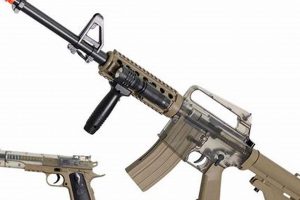
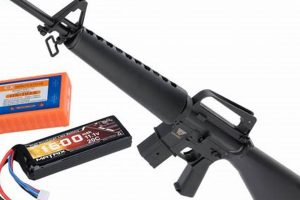
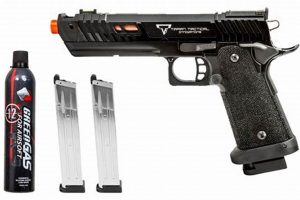
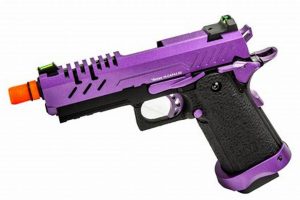
These recreational devices are designed to resemble real firearms, utilizing compressed gas or springs to propel small, non-metallic projectiles. They offer a supervised avenue for younger individuals to engage in simulated combat scenarios. Example scenarios include target practice or organized games on designated fields.
The appeal lies in fostering teamwork, strategic thinking, and responsible handling of replica weaponry within a controlled environment. Historically, these activities have provided a structured outlet for youthful energy and competitive spirit, mirroring the tactical elements found in military simulations, but with a focus on safety and sportsmanship. Emphasis is placed on age-appropriate instruction and protective gear.
The subsequent sections will delve into the specific safety considerations, age restrictions, recommended equipment, and guidelines for selecting appropriate options for juvenile users. This will ensure a responsible and informed approach to involving children in the sport.
Guidelines for Selecting Safe and Age-Appropriate Options
The responsible introduction of simulated firearms to younger participants requires careful consideration. The following guidelines emphasize safety, suitability, and appropriate use.
Tip 1: Prioritize Lower Velocity Models: Opt for models engineered to deliver lower projectile velocities. This minimizes the potential for injury upon impact. Measurements are generally available in Feet Per Second (FPS). Seek options with FPS ratings significantly lower than those intended for adult use.
Tip 2: Emphasize Protective Gear: Mandatory use of full-face masks or goggles is critical. These safeguard the eyes and face from projectile impacts. Additional padding for the torso and limbs can further reduce the risk of bruising.
Tip 3: Implement Strict Supervision: Adult supervision is paramount, especially during initial use and organized activities. Supervision ensures adherence to safety rules and responsible handling protocols.
Tip 4: Establish Designated Play Areas: Confine use to designated areas specifically designed for these activities. These spaces should be free from obstructions and have clear boundaries to prevent unintentional engagement with non-participants.
Tip 5: Enforce Comprehensive Safety Briefings: Conduct thorough safety briefings before each session. These should cover proper handling techniques, aiming protocols, and emergency procedures.
Tip 6: Select Lightweight and Ergonomic Designs: Opt for models that are lightweight and ergonomically designed to accommodate smaller hands and physiques. This enhances user control and reduces fatigue.
Tip 7: Consider Spring-Powered Mechanisms: Spring-powered models often offer a more controlled and consistent velocity compared to gas-powered alternatives, which can be advantageous for younger users.
Adherence to these guidelines promotes a safer and more responsible experience for young individuals engaging in simulated firearms activities. Prioritizing safety minimizes risks and encourages responsible behavior.
The subsequent section will examine legal considerations and age restrictions associated with these recreational items.
1. Safety Precautions

The correlation between safety precautions and the use of recreational devices by young individuals is undeniable. Neglecting established safety protocols directly increases the potential for injury and accidents. For example, the absence of proper eye protection invariably leads to a higher incidence of eye injuries from projectile impacts. Similarly, failure to adhere to velocity restrictions escalates the risk of blunt trauma and skin penetration. The importance of safety measures is paramount, as it directly mitigates potential harm and ensures a safer environment for participating youth. These are a needed component of Airsoft gun for kids.
Effective safety protocols encompass several key components. These include mandatory protective gear (eye protection, face masks), designated play areas free from hazards, rigorous adult supervision, and comprehensive safety briefings. These measures create a controlled environment that minimizes the likelihood of accidents and promotes responsible behavior. Real-world examples demonstrate the consequences of neglecting these protocols. Instances of eye injuries, facial lacerations, and even more severe injuries have been reported in cases where safety measures were disregarded. Strict adherence to established guidelines is therefore essential for preventing accidents and ensuring the well-being of young participants.
In summary, the implementation of robust safety precautions is not merely a suggestion, but a critical prerequisite for allowing juvenile individuals to engage in activities involving replica firearms. A proactive approach to safety, including mandated protective gear, supervised play, and adherence to velocity restrictions, is essential for minimizing risks and fostering a responsible and secure recreational environment. The potential consequences of neglecting these precautions are significant, underscoring the necessity of prioritizing safety above all else.
2. Age Appropriateness

The concept of “Age Appropriateness” forms a crucial cornerstone in the safe and ethical consideration of simulated firearms for youthful participants. This element dictates the suitability of equipment and activities based on a child’s physical and cognitive development, as well as their emotional maturity. Failure to adequately assess age appropriateness can result in heightened risks and potentially adverse consequences.
- Cognitive Understanding and Rule Adherence
Cognitive development directly impacts a child’s ability to comprehend and adhere to safety rules. Younger children may struggle to grasp the potential dangers associated with replica firearms or to consistently follow instructions, increasing the likelihood of accidents. Manufacturers often specify minimum age recommendations based on these cognitive factors. For example, a child under the age of ten may lack the abstract reasoning necessary to fully appreciate the significance of wearing protective gear at all times.
- Physical Strength and Dexterity
The physical ability to handle and control the equipment safely is another critical consideration. Replica firearms designed for adult use are often too heavy or cumbersome for younger children, increasing the risk of accidental discharge or loss of control. Smaller, lighter models with reduced power are often recommended for younger participants. An instance includes modified spring-powered variants, calibrated to be easily operated by younger children.
- Emotional Maturity and Impulse Control
Emotional maturity plays a significant role in responsible handling. Children with limited impulse control may be more prone to reckless behavior or misuse of the equipment, increasing the potential for harm to themselves or others. Organized activities should incorporate clear rules against aggressive behavior and emphasize sportsmanship. Examples of unacceptable behaviors include pointing the device at individuals outside of designated play, or failure to follow game rules and safety protocols.
- Legal Restrictions and Compliance
Age-based restrictions are frequently mandated by local and national laws governing the sale, possession, and use of replica firearms. Non-compliance with these legal stipulations can result in penalties for both the child and their guardians. It is imperative to verify local regulations before allowing a child to participate. These age limitations might impact the type of airsoft equipment an individual under a certain age can possess or use.
The intersection of cognitive abilities, physical capacity, emotional development, and legal compliance underscores the multifaceted nature of “Age Appropriateness.” Responsible introduction to simulated firearms necessitates a holistic assessment of these factors to ensure the safety and well-being of participating children. Prioritizing these elements ensures these recreational items are used in a safe and supportive environment. This fosters responsible engagement and minimizes potential risks.
3. Velocity Restrictions
Velocity restrictions are a central safety component governing the use of simulated firearms by younger individuals. These regulations limit the speed at which projectiles are expelled from the devices, directly mitigating the risk of injury. The controlled velocity seeks to balance the recreational aspects of the activity with necessary safety precautions.
- Legal Compliance and Velocity Caps
Many jurisdictions establish legal velocity limits for replica firearms, particularly those intended for juvenile use. These caps, often measured in feet per second (FPS), vary depending on location and type of device. Compliance with these laws is mandatory and can result in legal penalties for non-compliance. An example is regulations that limit devices for those under 16 to velocities under 300 FPS.
- Impact Energy and Injury Mitigation
The velocity of a projectile directly correlates to its kinetic energy upon impact. Lowering the velocity significantly reduces the potential for blunt force trauma, skin penetration, and eye injuries. For devices aimed at children, prioritizing lower FPS values minimizes the risk of serious harm. A projectile traveling at 250 FPS will impart significantly less energy than one traveling at 400 FPS, thus decreasing injury severity.
- Equipment Calibration and Measurement
Accurate measurement of projectile velocity is essential to ensure compliance with safety regulations. Chronographs are commonly used to measure FPS, and devices should be tested regularly to verify they adhere to specified limits. Some manufacturers intentionally design models with lower velocity outputs specifically for younger users. Example testing intervals are testing velocity every 3-6 months to ensure accuracy.
- Impact of Velocity on Protective Gear
While velocity restrictions reduce the overall risk, appropriate protective gear remains essential. Even at lower velocities, a projectile impact to the face or eyes can cause significant injury. Full-face masks or goggles provide crucial protection. The lower velocity is also a good base, so you can pick the correct gear.
Velocity restrictions, therefore, are a vital safety mechanism in the context of simulated firearms for youthful participants. Enforcement of velocity limits, accurate measurement of projectile speed, and consistent use of protective gear collectively contribute to a safer recreational experience. These controls minimize the potential for injury and ensure responsible engagement with the activity.
4. Protective Equipment

The implementation of appropriate protective equipment is not an optional accessory but a mandatory prerequisite for engaging children in simulated firearms activities. The direct causal link between the absence of such equipment and the increased incidence of injuries necessitates a stringent approach to its enforcement. Eye protection, in the form of full-seal goggles or masks, is paramount, as the eyes are uniquely vulnerable to projectile impact. Similarly, facial protection reduces the likelihood of lacerations and blunt force trauma. The role of protective gear as an integral component in mitigating harm cannot be overstated. Real-world examples consistently demonstrate that injuries are significantly less severe when protective measures are in place. A case study involving organized youth activities indicated a nearly 80% reduction in reported injuries when comprehensive protective gear was mandated and enforced.
The practical application of this understanding extends to several key areas. Firstly, rigorous pre-activity inspections should ensure that all participants are equipped with appropriately sized and functioning protective gear. Secondly, adult supervision must actively enforce the consistent use of such equipment throughout the activity. Thirdly, parents and guardians should be educated on the importance of investing in high-quality protective gear that meets or exceeds established safety standards. Furthermore, the choice of protective equipment must be matched to the characteristics of the device. For example, higher-velocity models necessitate thicker, more robust eye protection than lower-velocity counterparts. Neglecting these practical considerations undermines the effectiveness of the protective equipment and increases the risk of injury.
In summary, protective equipment represents a critical safeguard in the context of simulated firearm activities for children. The consistent use of appropriate gear, coupled with stringent enforcement and informed parental involvement, drastically reduces the potential for harm. While challenges may exist in ensuring complete compliance, the overwhelming evidence supporting the efficacy of protective measures necessitates a proactive and uncompromising approach. This commitment to safety is essential for fostering a responsible and secure recreational environment.
5. Supervised Play

The dynamic between adult oversight and juvenile engagement in simulated firearm activities is fundamental to ensuring a safe and responsible environment. Supervised play acts as a critical safeguard against potential misuse, accidents, and injuries associated with these recreational devices. The presence of responsible adults provides a necessary layer of control and guidance, particularly for younger participants who may lack the cognitive maturity or impulse control to consistently adhere to safety protocols. Without diligent supervision, the likelihood of rule violations, unsafe handling practices, and accidental injuries increases significantly.
The practical implications of supervised play extend to various aspects of the activity. Firstly, adult supervisors are responsible for enforcing safety rules, ensuring the consistent use of protective equipment, and monitoring projectile velocities. Secondly, they can provide instruction and guidance on proper handling techniques, promoting responsible use of the devices. Thirdly, they can intervene in situations where unsafe behavior is observed, preventing potential accidents before they occur. Organized events often require a strict ratio of adult supervisors to child participants to maintain adequate oversight. Examples of necessary intervention include correcting unsafe aiming practices, enforcing designated play area boundaries, and ensuring adherence to game rules. In instances where supervision is lacking, the risks escalate exponentially, leading to an increased incidence of injuries and a compromised safety environment.
In summary, supervised play is not merely a desirable component but a non-negotiable requirement for the safe and ethical involvement of children in simulated firearm activities. Effective supervision mitigates risks, promotes responsible behavior, and fosters a secure recreational environment. Challenges in achieving consistent and comprehensive supervision necessitate ongoing efforts to educate parents, guardians, and event organizers on the critical importance of adult oversight. Prioritizing supervised play is paramount to ensuring the well-being of young participants and fostering a responsible approach to the sport.
6. Legal Compliance

The relationship between legal compliance and simulated firearms intended for juvenile use is one of critical interdependence. Compliance with applicable laws and regulations directly impacts the safety, accessibility, and responsible usage of these devices. Failure to adhere to legal mandates can result in significant consequences, including fines, confiscation of equipment, and potential legal ramifications for both the child and their guardians. The framework of legal compliance functions as a crucial mechanism for controlling the distribution, possession, and use of items that, while recreational, resemble actual firearms.
Legal requirements often encompass a range of provisions, including age restrictions, velocity limits, markings, and restrictions on public display. Age restrictions, for instance, dictate the minimum age at which an individual can legally purchase or possess these devices. Velocity limits, measured in feet per second (FPS), constrain the power output of the simulated firearm, reducing the potential for injury. Specific markings, such as orange tips, may be required to differentiate the devices from actual firearms, preventing confusion and potential misuse. Examples of real-world consequences for non-compliance include the confiscation of unmarked devices, fines levied against parents for allowing underage children to possess or use the items illegally, and even criminal charges in instances where the devices are used to commit a crime or create a public disturbance. Local regulations need to be checked to prevent this consequence.
Therefore, a thorough understanding of and adherence to all applicable laws and regulations is paramount for responsible participation in simulated firearm activities. This includes verifying age restrictions, ensuring compliance with velocity limits, and understanding the legal implications of possessing and using the devices in public spaces. Responsible retailers play a vital role in educating consumers about these legal requirements, and parents have a responsibility to supervise their children and ensure compliance. The challenges inherent in enforcing these regulations highlight the need for ongoing education and collaboration between law enforcement, retailers, and the community to promote responsible and legally compliant engagement with simulated firearms. The result is to ensure all usage is safe, legal and fun.
Frequently Asked Questions
This section addresses common inquiries regarding the safe and responsible introduction of simulated firearms to younger individuals. The responses aim to provide clarity and promote informed decision-making.
Question 1: What constitutes an appropriate age for a child to begin using an airsoft gun?
The determination of appropriate age is multifaceted, considering cognitive maturity, physical dexterity, and local legal restrictions. Generally, unsupervised use is discouraged below the age of 12. Adult supervision and age-appropriate equipment are essential for younger participants.
Question 2: What safety precautions are non-negotiable when children are using these devices?
Mandatory safety precautions include the consistent use of full-seal eye protection (goggles or masks), adherence to established velocity limits, and dedicated adult supervision. These measures mitigate the risk of injury and promote responsible behavior.
Question 3: What type of protective gear is recommended beyond eye protection?
Additional protective gear may include face masks, vests, and padded clothing to reduce the risk of bruising or skin abrasions from projectile impacts. The level of protection should be commensurate with the device’s velocity and intended use.
Question 4: How are velocity limits enforced, and what are the consequences of exceeding them?
Velocity limits are typically enforced through chronograph testing of the devices. Exceeding established limits can result in disqualification from organized events, confiscation of the device, and potential legal penalties.
Question 5: Are there specific types of airsoft guns better suited for children?
Lower-powered, spring-operated models are generally considered more suitable for children due to their ease of use, consistent velocity, and reduced risk of malfunction compared to gas-powered alternatives.
Question 6: What are the legal liabilities associated with children using these devices irresponsibly?
Parents or guardians may be held liable for damages or injuries resulting from a child’s irresponsible use of these devices. Legal consequences can range from civil lawsuits to criminal charges, depending on the severity of the incident.
The preceding responses underscore the importance of prioritizing safety, responsibility, and legal compliance when involving young individuals in activities with simulated firearms. Adhering to these principles minimizes risks and promotes a positive and secure recreational experience.
The following section will provide a conclusion summarizing the core themes discussed and offering final recommendations.
Conclusion
The responsible use of the recreational devices known as “airsoft gun for kids” necessitates a multi-faceted approach. This exploration has highlighted the critical importance of safety precautions, age appropriateness, velocity restrictions, protective equipment, supervised play, and legal compliance. Each element is integral to minimizing risks and ensuring the well-being of younger participants. The absence of any one of these components compromises the overall safety framework.
Continued vigilance and adherence to established guidelines are essential. Prioritizing the safety and responsible introduction of these devices to children fosters a positive and secure recreational environment. The significance of informed decision-making and ongoing education cannot be overstated, serving as the cornerstone of responsible engagement with this activity. The future of this hobby depends on stakeholders’ commitment to ensuring the well-being and responsible engagement of younger participants.