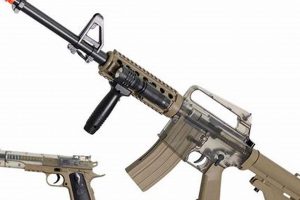
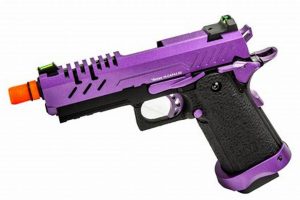
Applying a custom finish to an airsoft replica involves the careful selection of paints and techniques to achieve a desired aesthetic or camouflage effect. This process can range from simple, single-color applications to complex, multi-layered designs incorporating stencils and weathering effects. Achieving a professional result requires meticulous preparation, including disassembly, cleaning, and masking of critical components. For example, one might choose a desert camouflage scheme for play in arid environments, enhancing concealment during simulated combat scenarios.
A customized exterior offers advantages such as enhanced realism, personalization, and improved concealment during gameplay. Historically, modifications of this nature were primarily driven by the desire to replicate the appearance of real-world firearms used by military and law enforcement personnel. Today, the practice extends to artistic expression and individual identification within the airsoft community. The resulting visual transformation enhances the overall experience for enthusiasts and adds a layer of strategic advantage in the field.
The following sections will detail the necessary materials, step-by-step application processes, safety precautions, and best practices for achieving a durable and visually appealing customized exterior on an airsoft replica. Understanding these aspects is crucial for successful execution and long-lasting results.
Essential Considerations for Airsoft Replica Customization
Achieving a professional and durable finish on an airsoft replica requires careful attention to detail and adherence to best practices. The following tips offer guidance on various aspects of the customization process.
Tip 1: Disassemble Thoroughly: Complete disassembly of the airsoft replica is paramount. Remove all internal components, including the gearbox, inner barrel, and hop-up unit, to prevent damage from overspray and ensure access to all external surfaces.
Tip 2: Degrease and Clean: Thoroughly degrease all exterior surfaces with a suitable solvent, such as isopropyl alcohol or specialized degreaser. This removes oils and residues that impede paint adhesion.
Tip 3: Apply a Primer Coat: Utilize a primer specifically formulated for plastics and metals. Primer provides a uniform base for subsequent layers, enhancing adhesion and preventing discoloration.
Tip 4: Employ Multiple Thin Coats: Apply paint in several thin, even coats rather than one thick coat. This prevents runs, drips, and uneven coverage, resulting in a smoother, more durable finish.
Tip 5: Utilize Stencils Carefully: When employing stencils for camouflage patterns, ensure secure adhesion to prevent paint bleed. Use masking tape to reinforce stencil edges and achieve crisp, clean lines.
Tip 6: Allow Adequate Drying Time: Allow each coat of paint, including primer and clear coat, to dry completely before applying the next layer. Insufficient drying time can lead to cracking, peeling, and a compromised finish.
Tip 7: Apply a Clear Coat: Protect the painted surface with a durable clear coat. Matte clear coats are suitable for camouflage applications, while gloss clear coats provide a more reflective finish.
Maintaining these considerations optimizes the potential for a successful and aesthetically pleasing transformation of the airsoft replica. These steps ensure both visual appeal and long-term durability in field conditions.
The final section will address common pitfalls and troubleshooting strategies for achieving professional-grade results on an airsoft replica.
1. Disassembly

Disassembly constitutes a foundational stage in airsoft replica customization. The extent and precision of the disassembly process directly correlate with the quality and longevity of the subsequent finish. Failure to adequately disassemble the airsoft replica can result in compromised functionality, aesthetic imperfections, and potential damage to internal components.
- Component Accessibility
Complete disassembly facilitates access to all external surfaces of the airsoft replica. This ensures uniform application of primer, paint, and clear coat, preventing uneven coverage or missed areas. For instance, intricate details around the receiver, stock, or handguard require unobstructed access for precise application. Incomplete disassembly results in inconsistent finishes and potential aesthetic compromises.
- Protection of Internal Mechanisms
Internal components, such as the gearbox, hop-up unit, and inner barrel, are susceptible to damage from paint overspray. Disassembly removes these sensitive parts, safeguarding them from potential malfunction or performance degradation. Neglecting this precaution can lead to costly repairs or replacements. Preserving the operational integrity of the airsoft replica remains paramount.
- Masking and Separation
Disassembly allows for the separation of components that require masking or distinct finishes. For example, the pistol grip may necessitate a different texture or color than the receiver. Disassembly enables independent treatment of each component, resulting in a more refined and professional appearance. Precise masking techniques are facilitated by complete separation of parts.
- Thread Protection and Functional Integrity
Threads and moving parts must be protected from paint accumulation to maintain functionality. Disassembly allows for the application of masking tape or plugs to shield these critical areas. Failure to do so can result in binding, restricted movement, or impaired assembly. The mechanical integrity of the airsoft replica depends on protecting these elements during the refinishing process.
The facets of component accessibility, protection of internal mechanisms, masking and separation, and thread protection directly impact the final result. Meticulous disassembly is not merely a preliminary step, but an integral component of the painting procedure, influencing both the aesthetics and functionality of the airsoft replica. The success of the entire customization hinges on this initial phase.
2. Surface Preparation

Surface preparation constitutes a critical determinant in the success of painting an airsoft replica. Its effects are directly manifested in the adhesion, durability, and overall visual appeal of the applied finish. Inadequate preparation invites paint chipping, peeling, and a compromised aesthetic. For example, if grease or silicone lubricant residues are not removed before painting, the paint will not properly bond to the underlying material, leading to premature failure of the finish. The effectiveness of the painting process hinges on achieving a contaminant-free and properly abraded surface.
The process typically involves cleaning, degreasing, and abrasion. Cleaning removes surface dirt and debris. Degreasing, performed with solvents like isopropyl alcohol, eliminates oils and silicones. Abrasion, often achieved with fine-grit sandpaper or scouring pads, creates microscopic imperfections that enhance paint adhesion. Without these steps, the paint film relies solely on weak surface tension, predisposing it to damage. A well-prepared surface, conversely, provides a mechanical “key” for the paint to grip, ensuring a robust and long-lasting bond.
In summary, surface preparation is not merely a preliminary step but an integrated component of the overall painting procedure. Overlooking its importance will invariably lead to unsatisfactory results and premature degradation of the painted finish. Understanding and diligently executing the necessary preparatory steps are essential for any individual seeking to achieve a professional and durable customized exterior on an airsoft replica.
3. Primer Application

The application of primer represents a critical stage within the broader process of exterior refinishing. It serves as an intermediary layer between the substrate material of the airsoft replica and the subsequent color coats. Without primer, the adhesion of paint to plastic or metal surfaces is often compromised, leading to peeling, chipping, and an overall reduction in the longevity and aesthetic quality of the custom finish. For instance, on a polymer-bodied replica, primer creates a uniform surface texture, enabling paint to bond effectively rather than beading up or failing to adhere properly. This, in turn, improves the durability of the finish under the stresses of gameplay.
Primer also functions as a barrier against substrate imperfections and color variations. The base material of the replica, whether metal or plastic, can exhibit inherent color discrepancies or surface flaws that would otherwise bleed through the paint finish. Primer effectively neutralizes these inconsistencies, providing a uniform and neutral base coat for subsequent layers. A common application involves using a gray primer on an airsoft replica composed of disparate materials, such as metal upper receiver and a polymer lower receiver, effectively unifying the base color tone prior to the application of a camouflage pattern. This process contributes to a more professional and visually appealing outcome.
In summary, primer application is an essential pre-treatment that directly impacts the success of refinishing. It significantly enhances paint adhesion, conceals substrate imperfections, and promotes color uniformity. Neglecting to apply primer as part of the refinishing process undermines the overall durability and appearance. Understanding this integral relationship between primer application and the attainment of a high-quality, long-lasting custom exterior is essential for any individual undertaking exterior modifications.
4. Paint Technique

Paint technique constitutes a pivotal determinant in achieving a satisfactory outcome in the process of customizing an airsoft replica’s exterior. The chosen method directly influences the visual aesthetic, durability, and overall quality of the final product. Ineffective or improper paint application can result in runs, drips, uneven coverage, and premature wear, thereby compromising both the appearance and functional integrity of the airsoft gun. For example, applying paint too thickly in a single coat increases the likelihood of sagging and a textured, rather than smooth, finish. Mastering different application methods is therefore crucial for achieving a professional-grade result.
Various paint techniques are applicable, each tailored for specific effects and camouflage patterns. Stippling, involving the application of paint in a series of small dots, is effective for creating textured surfaces and breaking up solid colors. Layering, where multiple thin coats of different colors are applied, is conducive to generating complex camouflage patterns and realistic weathering effects. Masking, using tape or stencils, enables the creation of precise lines and intricate designs. Airbrushing, utilizing a compressed air source to atomize paint, facilitates the application of thin, even coats and gradients. The careful selection and execution of the appropriate paint technique, based on the desired aesthetic and skill level of the applicator, is paramount.
In conclusion, paint technique is not merely a cosmetic consideration but a fundamental element that directly impacts the success of customizing an airsoft replica. A thorough understanding and skillful application of various techniques are indispensable for achieving a durable, visually appealing, and professional-grade finish. The selection of the optimal technique is also inextricably tied to the chosen camouflage pattern.
5. Camouflage Patterns

The selection and execution of camouflage patterns constitute a central aspect of airsoft replica customization. The application of these patterns, achieved through various painting techniques, serves to enhance concealment and replicate the aesthetics of real-world firearms used in military and tactical operations. The efficacy of a given pattern is determined by its ability to disrupt the visual silhouette of the airsoft replica within a specific operational environment.
- Environmental Adaptation
Camouflage patterns are designed to blend with specific environments. Woodland patterns, characterized by green, brown, and black hues, are effective in forested areas. Desert patterns, featuring tan, beige, and light brown tones, are suitable for arid landscapes. Urban patterns, incorporating gray, black, and white, are designed for use in built-up environments. Applying the correct pattern enhances concealment and tactical advantage. The choice of pattern directly influences the operator’s ability to remain undetected.
- Pattern Complexity and Application
Camouflage patterns range from simple, single-color applications to complex, multi-layered designs incorporating stencils, masking techniques, and airbrushing. Simple patterns are relatively easy to apply but offer limited concealment effectiveness. Complex patterns, while more challenging to execute, provide superior disruption of the replica’s visual signature. The complexity of the chosen pattern must be balanced against the applicator’s skill level and available resources.
- Historical and Modern Patterns
Historical camouflage patterns, such as those used in World War II or the Vietnam War, are often replicated for authenticity and historical accuracy. Modern patterns, such as MultiCam, Kryptek, and MARPAT, are designed using advanced algorithms to maximize effectiveness across a broader range of environments. The choice between historical and modern patterns reflects individual preferences and operational requirements.
- Stencil Design and Creation
Stencils are frequently utilized to create precise camouflage patterns. Stencils can be commercially purchased or custom-made using various materials, including adhesive vinyl, cardboard, or specialized stencil films. Custom-designed stencils allow for the creation of unique and personalized camouflage patterns, enhancing individuality and aesthetic expression. The design and creation of stencils represent a critical skill in airsoft replica customization.
The successful integration of camouflage patterns hinges on understanding environmental factors, mastering application techniques, and selecting appropriate materials. The application of camouflage serves not only an aesthetic function but also enhances practical utility by improving concealment and tactical effectiveness within a simulated combat environment. The execution of any camouflage scheme must also consider the application of a clear coat to protect the finish of the base layer. These considerations are inseparable from “how to paint your airsoft gun.”
6. Protective Coating
In the context of airsoft replica customization, a protective coating represents a final, crucial layer applied to safeguard the underlying paint finish. Its purpose extends beyond mere aesthetics, providing essential resistance against abrasion, UV degradation, and chemical exposure encountered during gameplay and handling. The absence of a suitable protective coating can compromise the longevity and visual integrity of any paint scheme applied to the replica.
- Abrasion Resistance
The primary function of a protective coating involves shielding the paint finish from abrasion caused by contact with gear, terrain, and other surfaces. For instance, a matte clear coat applied to a camouflage pattern can significantly reduce wear and tear resulting from repeated handling and movement through dense vegetation. Without this protective layer, the paint is susceptible to scratches, chips, and eventual degradation, diminishing the aesthetic appeal of the customized replica. Applying a Cerakote clear coat will allow the airsoft gun to perform well in the field.
- UV Protection
Prolonged exposure to ultraviolet (UV) radiation can cause fading and discoloration of paint, particularly in brightly colored or chemically sensitive pigments. A UV-resistant clear coat acts as a barrier, mitigating the harmful effects of sunlight and preserving the vibrancy of the underlying paint. Consider the application of a UV-resistant coating to a replica used primarily in outdoor environments. Such UV application prevents premature color fading and maintains the desired aesthetic. It also requires consistent application to ensure full coverage.
- Chemical Resistance
Protective coatings offer resistance against chemicals, such as cleaning solvents, lubricants, and insect repellents, which can damage or dissolve the paint finish. A chemically resistant clear coat prevents these substances from compromising the adhesion and appearance of the underlying paint layers. If a solvent is used to clean the outer barrel, make sure the clear coat will be able to withstand such applications. It may lead to the need to reapplying the protective coating.
- Types of Protective Coatings
Various types of protective coatings are available, each offering distinct properties and levels of protection. Matte clear coats provide a non-reflective finish suitable for camouflage applications, while gloss clear coats offer a high-shine appearance. Two-part epoxy coatings offer superior durability and chemical resistance compared to single-component acrylic coatings. The selection of a protective coating should be based on the desired aesthetic, operational environment, and level of protection required. Some protective coating need to be cured in an oven.
The integration of a suitable protective coating represents a definitive step in the process of customizing an airsoft replica, directly influencing the long-term durability and visual appeal of the final result. Selecting the right type and ensuring proper application are essential for maximizing the protective benefits and preserving the integrity of the underlying paint finish. It also guarantees quality.
Frequently Asked Questions
This section addresses common inquiries related to customizing the exterior of airsoft replicas, providing detailed answers to ensure successful and informed application.
Question 1: What type of paint is most suitable for use on airsoft replicas?
Paints specifically formulated for plastics and metals are recommended. Acrylic lacquers and epoxy-based paints exhibit superior adhesion and durability compared to general-purpose paints. Adherence to manufacturer instructions regarding surface preparation and application techniques is crucial for optimal results.
Question 2: How can paint chipping and peeling be prevented?
Thorough surface preparation, including cleaning, degreasing, and abrasion, is paramount. Application of a primer coat designed for plastics or metals promotes adhesion. Applying multiple thin coats of paint, rather than a single thick coat, minimizes the risk of cracking and peeling. A protective clear coat further enhances durability.
Question 3: Is it necessary to disassemble the airsoft replica prior to painting?
Complete disassembly is strongly recommended to protect internal components from overspray and facilitate access to all external surfaces. Masking alone is insufficient to prevent paint from entering critical mechanisms, such as the gearbox or hop-up unit. Disassembly enables thorough and consistent application of paint to all exterior surfaces, ensuring a professional finish.
Question 4: How are camouflage patterns effectively applied to airsoft replicas?
Camouflage patterns can be applied using stencils, masking tape, or freehand techniques. Stencils provide precise lines and repeatable patterns. Masking tape allows for the creation of geometric shapes and sharp edges. Freehand techniques require skill and experience but offer greater flexibility. Layering different colors and textures enhances the effectiveness of the camouflage pattern.
Question 5: What safety precautions should be observed during the painting process?
Painting should be conducted in a well-ventilated area to minimize exposure to harmful fumes. Respiratory protection, such as a respirator or mask, is recommended. Eye protection, such as safety glasses or goggles, prevents accidental exposure to paint or solvents. Proper disposal of paint and solvent waste is essential to minimize environmental impact. Ensure the gun is clear prior to any disassembly to prevent an accidental discharge.
Question 6: How can a matte finish be achieved on a painted airsoft replica?
A matte finish can be achieved by applying a matte clear coat. Matte clear coats contain flattening agents that reduce the reflective properties of the paint surface. Alternatively, specific matte paints can be used for the base coat, eliminating the need for a separate clear coat. The even application of a matte finish is important to prevent streaking and ensure a uniform appearance.
The information presented here provides guidance on common challenges and best practices in customizing an airsoft replica exterior. Adherence to these recommendations contributes to a more successful and durable final product.
The subsequent section will summarize key considerations and offer final thoughts on the subject.
Conclusion
This exploration of how to paint your airsoft gun has detailed fundamental aspects of exterior customization. Key considerations include meticulous disassembly, thorough surface preparation, strategic primer application, appropriate paint technique selection, purposeful camouflage pattern design, and implementation of a durable protective coating. Adherence to these principles ensures a visually appealing and resilient finish.
The information presented provides a foundation for achieving professional-grade results in airsoft replica exterior modification. Continued research and diligent application of these techniques will facilitate ongoing improvement and enhanced customization capabilities. A commitment to safety and attention to detail remain paramount in every stage of the process.