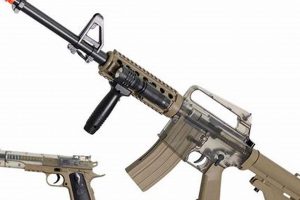
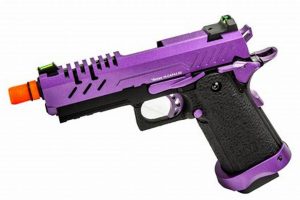
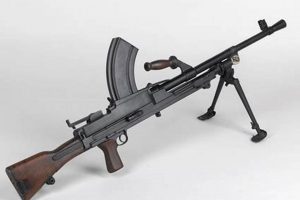
The monetary investment required to acquire these recreational projectile devices varies significantly based on several factors. A basic spring-powered model designed for casual backyard use may cost substantially less than a high-end electric-powered replica intended for competitive skirmishes. For example, an entry-level, single-shot airsoft gun might be priced under $50, while a realistic automatic electric gun (AEG) used in organized play can range from $200 to over $500.
Understanding the pricing spectrum is crucial for both newcomers and seasoned players. Affordability allows wider participation in the sport, while higher-priced models offer enhanced performance, durability, and realism. Historically, the initial accessibility of inexpensive models helped popularize airsoft. Now, a diverse market caters to different budgets and performance expectations.
The following sections will examine the primary variables influencing the price of airsoft guns, including type of power source, materials used in construction, brand reputation, and features offered. This analysis will provide a comprehensive overview to assist in making informed purchasing decisions.
Tips for Evaluating the Cost of Airsoft Guns
The following guidelines provide insights into assessing the value and expense associated with airsoft guns, enabling informed purchasing decisions.
Tip 1: Research Power Source Options: Electric-powered (AEG) models generally command a higher price point than spring-powered variants due to their automatic firing capabilities and complex internal mechanisms. Gas blowback models fall somewhere in between, offering realistic recoil but requiring regular gas refills or replacements.
Tip 2: Consider Material Composition: Airsoft guns constructed with metal components, such as aluminum or steel, typically cost more than those primarily made of plastic. Metal construction often contributes to enhanced durability and a more realistic weight and feel.
Tip 3: Evaluate Brand Reputation: Established brands with a proven track record of quality and performance often command higher prices. These brands frequently offer superior warranties and customer support compared to lesser-known manufacturers.
Tip 4: Assess Feature Sets: Adjustable hop-up systems, multiple firing modes (semi-automatic, full-automatic), and accessory rails can all contribute to increased prices. Determine which features are essential for the intended use and budget accordingly.
Tip 5: Factor in Accessories: The initial cost of an airsoft gun does not encompass all expenses. Magazines, batteries, chargers, tactical gear, and protective equipment represent additional investments that should be considered.
Tip 6: Explore Used Options: The secondary market can offer significant savings on airsoft guns. Thoroughly inspect used models for signs of wear and tear before committing to a purchase.
Tip 7: Understand Warranty Coverage: Review the manufacturer’s warranty policy prior to purchasing. A comprehensive warranty provides assurance against defects and potential repair costs.
By carefully evaluating power source, materials, brand, features, accessories, and warranty, a rational approach to assessing the expense of airsoft guns is possible. This approach enables the selection of a model that aligns with both budgetary constraints and performance requirements.
The subsequent section will delve into common misconceptions related to the pricing of airsoft guns, providing clarity for prospective buyers.
1. Entry-level Pricing

The cost of airsoft guns at the entry level directly influences accessibility to the sport. Lower initial prices broaden participation, attracting individuals who may be hesitant to invest heavily upfront. This affordability is primarily driven by simpler designs, typically spring-powered mechanisms, and the utilization of less expensive materials such as ABS plastic. For example, a basic spring-powered pistol can often be acquired for under $30, making it a financially feasible option for beginners.
The availability of inexpensive airsoft guns also serves an educational purpose. Newcomers can experiment with different roles and playing styles without significant financial risk. These affordable models introduce fundamental concepts such as aiming, loading, and basic maintenance. As individuals gain experience and develop preferences, they may then consider upgrading to higher-performance, and consequently more expensive, options. This progression allows players to gradually increase their investment as their commitment to the sport grows.
In summary, entry-level pricing plays a critical role in democratizing access to airsoft. It allows individuals to explore the sport without substantial financial barriers and fosters a foundation of knowledge upon which more advanced participation can be built. The price point of these entry-level models directly dictates how much an individual must initially invest, thereby determining the breadth of potential participants in the sport. Challenges remain in balancing affordability with durability, but the availability of lower-priced options remains crucial for growth and inclusivity.
2. AEG Expense

Automatic electric guns (AEGs) represent a significant tier in the airsoft gun market, contributing substantially to the overall expenses associated with the hobby. The cost of AEGs reflects their complex internal mechanisms and enhanced performance capabilities, impacting accessibility and purchasing decisions.
- Internal Components and Complexity
AEGs utilize a motor, gearbox, and battery to propel projectiles, leading to increased manufacturing costs compared to simpler spring-powered models. Gearboxes alone, which consist of multiple gears, pistons, and other components, can add significantly to the final price. For instance, a reinforced gearbox designed for higher rates of fire or heavier springs can double the cost of a standard gearbox.
- Performance and Upgradability
AEGs often boast higher rates of fire, greater accuracy, and increased range than spring-powered alternatives, justifying higher price points. Furthermore, AEGs are designed for upgradability, allowing users to replace internal components such as motors, barrels, and hop-up units to further enhance performance. These upgrade options represent additional costs that contribute to the overall investment in an AEG.
- Battery and Charger Requirements
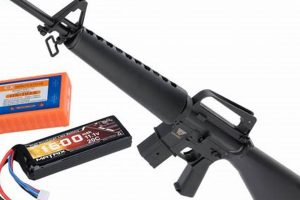
AEGs necessitate the purchase of batteries and chargers, adding to the initial and ongoing expenses. Batteries, which can range from NiMH to LiPo, vary in price depending on capacity and voltage. High-quality smart chargers that offer features such as overcharge protection are also recommended to prolong battery life, further increasing the total cost.
- Market Positioning and Competition
The AEG market is characterized by competition among various manufacturers, influencing pricing strategies. Well-established brands with a reputation for reliability and performance may command higher prices, while lesser-known brands may offer more affordable alternatives. The features, materials, and warranty offered by each manufacturer ultimately contribute to the variation in AEG prices within the market.
Therefore, understanding AEG expenses extends beyond the initial purchase price. Factors such as internal complexity, performance potential, battery requirements, and brand positioning all contribute to the overall cost. This deeper understanding enables prospective buyers to make informed decisions, balancing budgetary constraints with performance expectations.
3. Gas Blowbacks

Gas blowback (GBB) airsoft guns represent a distinct category that significantly influences the pricing landscape of airsoft weaponry. Their reliance on compressed gas for operation introduces unique cost factors compared to spring-powered and electric models.
- Gas Consumption and Refills
GBB models require a continuous supply of gas, typically either green gas, propane (with an adapter), or CO2. The cost of these gases, along with the frequency of refills, contributes to the ongoing operational expenses. For instance, a single magazine of a GBB pistol may require refilling after only a few uses, necessitating frequent gas purchases.
- Magazine Complexity and Cost
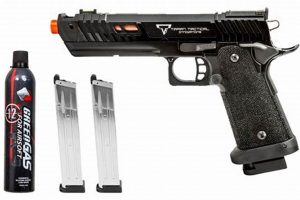
GBB magazines are more intricate than those for AEGs or spring guns. They must hold both BBs and a reservoir of compressed gas, leading to more complex designs and higher manufacturing costs. Replacement magazines for GBB pistols and rifles can range from $25 to $50 or more, depending on the model and capacity.
- Maintenance Requirements
GBB airsoft guns often demand more frequent maintenance than AEGs due to the wear and tear associated with gas seals and moving parts. Silicone oil is typically required to lubricate the seals and prevent leaks, adding to the overall cost. Furthermore, damaged seals or components may necessitate replacement, incurring additional expenses.
- Realism and Performance Trade-offs
GBB models are often favored for their realism, as the blowback action simulates the recoil of a real firearm. However, this realism often comes at a premium. GBBs may exhibit lower consistency in terms of velocity and range compared to AEGs, potentially requiring upgrades to achieve comparable performance. The cost of these upgrades should be factored into the overall investment.
The connection between GBB mechanisms and pricing is evident in both the initial purchase and long-term maintenance. While offering enhanced realism, GBB airsoft guns involve ongoing costs for gas, more expensive magazines, and potentially more frequent maintenance, influencing the purchasing decision based on budgetary considerations. Consequently, buyers must weigh the desired realism against the increased operational costs.
4. Materials Impact
The materials used in the construction of airsoft guns exert a direct influence on their price point. The selection of materials determines durability, weight, realism, and ultimately, manufacturing cost. For instance, a model primarily composed of high-impact ABS plastic will generally be less expensive than one crafted with aluminum alloy or steel. This difference is rooted in the costs associated with raw material procurement, manufacturing processes, and the labor involved in shaping and assembling these materials.
Examples illustrating this principle are prevalent across the airsoft market. Entry-level pistols, often marketed towards casual users, frequently feature ABS plastic bodies and internal components, reducing their production cost and making them accessible to a wider consumer base. Conversely, high-end replicas designed for serious skirmishers incorporate metal slides, frames, and gearbox components to withstand rigorous use and provide a more authentic feel. These metal components contribute significantly to the overall price, reflecting the increased material cost and precision machining required. Consider the difference between a $50 plastic pistol and a $300 full-metal replica; the primary differentiator is the material composition.
Understanding the materials’ impact is crucial for making informed purchasing decisions. While a lower price point may be attractive, particularly for beginners, it is essential to consider the long-term implications of less durable materials. A metal-constructed airsoft gun, though initially more expensive, may prove more cost-effective in the long run due to its enhanced longevity and resistance to wear and tear. Therefore, materials directly contribute to the “how much is airsoft guns” equation, representing a critical factor in determining value and suitability for the intended use.
5. Brand Premiums

The correlation between established airsoft brands and pricing constitutes a significant aspect of the “how much is airsoft guns” equation. Brand recognition, built upon years of performance, innovation, and customer service, often translates directly into higher price points. This premium reflects several factors, including research and development investment, quality control measures, and established distribution networks. For example, a well-known brand might invest substantially in designing a more accurate hop-up system, resulting in a superior product but also a higher manufacturing cost that is passed on to the consumer. Similarly, rigorous quality control processes minimize defects, but add to production expenses. This premium therefore reflects a manufacturer’s commitment to product excellence and customer satisfaction, indirectly increasing “how much is airsoft guns” for recognized brands.
Conversely, lesser-known or newer brands may offer lower prices to gain market share. While these alternatives can present cost-effective options, they often lack the established track record and comprehensive support systems of their more recognized counterparts. For instance, a lesser-known brand might offer a similar-looking airsoft gun for a significantly lower price. However, the gun may suffer from lower build quality, decreased accuracy, and limited availability of replacement parts. In practice, this can lead to a less satisfying experience and potentially higher long-term costs associated with repairs or replacements. Therefore, the “how much is airsoft guns” equation shifts from the initial purchase price to include factors such as long-term reliability and access to support.
Ultimately, brand premiums represent a complex interplay of perceived value, tangible benefits, and marketing strategy. While a higher price does not guarantee superior performance in every instance, established brands generally offer a greater degree of assurance regarding product quality, reliability, and after-sales support. Evaluating brand reputation, alongside other factors such as materials and features, allows for a more informed assessment of the overall value proposition and its influence on “how much is airsoft guns”. The choice between a premium brand and a more affordable alternative depends on individual priorities, budgetary constraints, and the level of risk tolerance regarding potential quality or support issues.
6. Accessory Costs
The overall financial investment associated with airsoft extends beyond the initial price of the guns themselves. Accessory costs represent a significant, and often overlooked, component in determining the total expenditure, profoundly affecting the perceived value and accessibility of the sport.
- Protective Gear Expenses
Eye protection, face masks, and appropriate clothing are essential for safety. Regulations often mandate specific standards for eye protection, necessitating the purchase of certified goggles or masks. These items range in price from basic models around $20 to high-end, full-face protection systems exceeding $100. The expense is non-negotiable, as safety is paramount; therefore, it must be factored into the initial cost considerations.
- Ammunition and Consumables
Airsoft guns require ammunition, typically 6mm plastic BBs. The cost of BBs varies based on quality, weight, and quantity. High-precision BBs, which enhance accuracy and reduce the risk of jams, often command a premium. Furthermore, gas-powered airsoft guns require a continuous supply of compressed gas, adding to the operational expenses. The cost of these consumables contributes incrementally to the long-term financial commitment associated with airsoft.
- Load-Bearing Equipment and Tactical Gear
Carrying extra magazines, gas canisters, and other essential items requires load-bearing equipment such as vests, belts, and pouches. Tactical gear, including slings, optics, and laser aiming devices, can further enhance gameplay but also significantly increase costs. While not always mandatory, such equipment offers a performance advantage and tactical flexibility, influencing many players’ purchasing decisions.
- Maintenance and Repair Components
Airsoft guns, like any mechanical device, require regular maintenance to ensure optimal performance and longevity. Lubricants, cleaning supplies, and replacement parts contribute to the ongoing costs. The complexity of internal mechanisms, particularly in automatic electric guns (AEGs), may necessitate professional servicing, resulting in additional labor expenses. Preventative maintenance and timely repairs are essential to avoid more costly damage in the long term.
These diverse accessory costs cumulatively impact the total financial outlay for airsoft participation. Understanding these expenses enables potential participants to develop realistic budgets, avoiding unexpected financial strain and allowing for a more sustainable engagement with the sport. Therefore, calculating “how much is airsoft guns” demands a holistic assessment including both the initial gun purchase and the associated accessories.
Frequently Asked Questions
The following questions address common inquiries regarding the financial aspects of acquiring airsoft guns, providing informative answers to assist prospective buyers.
Question 1: What is the minimum investment required to purchase a functional airsoft gun?
A functional, entry-level spring-powered airsoft pistol can be acquired for approximately $30 to $50. This price range typically represents a basic model with limited features and durability suitable for casual backyard use.
Question 2: How does the type of power source influence the overall price of airsoft guns?
Automatic electric guns (AEGs) generally command higher prices due to their complex internal mechanisms and automatic firing capabilities. Gas blowback (GBB) models fall in the mid-range, while spring-powered guns represent the most affordable option.
Question 3: Do metal components significantly increase the cost of airsoft guns?
Yes. Models constructed with metal components, such as aluminum or steel, are typically more expensive than those primarily made of plastic due to the increased material cost and manufacturing processes involved.
Question 4: Are there hidden costs associated with owning gas blowback (GBB) airsoft guns?
Yes. GBB models require a continuous supply of compressed gas, adding to the ongoing operational expenses. GBB magazines are also generally more expensive than AEG magazines.
Question 5: Does brand reputation affect the price of airsoft guns?
Established brands with a proven track record of quality and performance often command higher prices, reflecting investment in research, development, and customer support.
Question 6: What accessories are essential, and how much do they contribute to the overall cost?
Essential accessories include eye protection, ammunition, and batteries (for AEGs). These items can add a significant percentage to the initial cost, potentially ranging from $50 to $150 or more, depending on the quality and features.
In summary, the pricing of airsoft guns is influenced by numerous factors, including power source, materials, brand, and required accessories. A thorough understanding of these variables is crucial for making informed purchasing decisions that align with budgetary constraints and performance expectations.
The next section will provide guidance on finding affordable options without compromising on quality.
How Much Is Airsoft Guns
This exploration of “how much is airsoft guns” has illuminated the diverse factors influencing pricing within the airsoft market. From entry-level spring pistols to high-end automatic electric guns, the costs are demonstrably affected by power source, material composition, brand prestige, and necessary accessories. Prospective buyers must carefully weigh these elements against their budgetary limitations and performance requirements to make informed decisions.
Ultimately, understanding the financial landscape of airsoft weaponry is crucial for sustainable participation in the sport. Diligent research, mindful budgeting, and a realistic assessment of individual needs will enable informed acquisitions. The pursuit of airsoft should be guided by a clear understanding of the investments involved to ensure both enjoyment and long-term financial prudence.