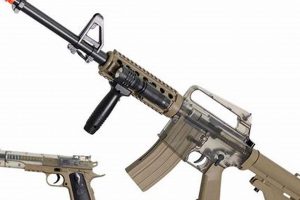
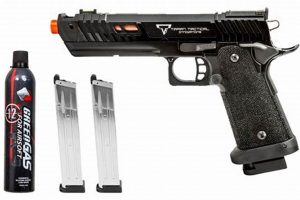
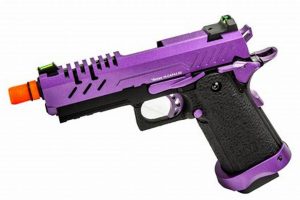
These specialized airsoft implements utilize high-pressure air as their propellant source. Instead of relying on spring mechanisms or gas magazines containing compressed gas, they connect to an external tank of compressed air via a hose. This external air source powers the projectile launch, offering a distinct operational characteristic compared to other types of airsoft markers.
The reliance on high-pressure air provides performance advantages, including consistent velocity and the potential for higher rates of fire. Historically, the adoption of this technology in airsoft allowed players to achieve a level of performance previously unobtainable with traditional gas or electric-powered platforms. This development significantly altered competitive airsoft, enabling greater tactical flexibility and dominance on the field.
The subsequent sections of this discussion will delve into the specific components, operational principles, performance characteristics, maintenance requirements, and the overall advantages and disadvantages of using high-pressure air systems in airsoft applications.
Airsoft HPA Systems
This section provides crucial guidelines for optimizing the performance and longevity of high-pressure air systems in airsoft applications. Adherence to these recommendations will ensure reliable operation and prevent costly malfunctions.
Tip 1: Prioritize Regulator Calibration: Inaccurate regulator settings can lead to inconsistent projectile velocities or system damage. Regularly check and adjust the regulator using a calibrated pressure gauge to maintain optimal operating pressure.
Tip 2: Implement Consistent Lubrication Practices: Proper lubrication minimizes friction within the system’s internal components. Use only manufacturer-recommended lubricants and apply them sparingly to O-rings, valves, and other moving parts to prevent degradation.
Tip 3: Ensure Adequate Air Tank Maintenance: High-pressure air tanks require periodic hydrostatic testing to ensure structural integrity. Adhere to the tank manufacturer’s recommended testing schedule and visually inspect the tank for any signs of damage before each use.
Tip 4: Employ High-Quality Air Filtration: Moisture and contaminants in compressed air can damage internal components. Install an inline filter/dryer system to remove impurities before they enter the system.
Tip 5: Monitor Hose Integrity: High-pressure air hoses are subject to wear and tear. Routinely inspect the hose for cracks, kinks, or abrasions, and replace it immediately if any damage is detected.
Tip 6: Adhere to Recommended Pressure Limits: Exceeding the maximum operating pressure specified by the manufacturer can cause catastrophic system failure. Always consult the product manual and stay within the established pressure limits.
These guidelines are critical for maximizing performance, ensuring safety, and extending the lifespan of airsoft systems that utilize high-pressure air. By implementing these recommendations, users can minimize downtime and enjoy a more consistent and reliable airsoft experience.
The following sections will offer more information, further solidifying your grasp of this technology.
1. Consistent Air Pressure

Maintaining consistent air pressure is fundamental to the reliable and predictable performance of airsoft implements utilizing high-pressure air. Deviations in pressure directly impact projectile velocity, accuracy, and overall system stability. Understanding the sources of pressure fluctuation and implementing strategies for mitigation is critical for effective operation.
- Regulator Functionality
The regulator serves as the primary control mechanism for ensuring consistent air pressure. Its function is to reduce the high pressure from the external tank to a stable, pre-set operating pressure. Malfunctions, wear, or improper calibration of the regulator can lead to pressure inconsistencies, resulting in variable shot velocities and reduced accuracy. A high-quality, well-maintained regulator is therefore essential.
- Tank Fill Level
As compressed air is discharged from the tank, the internal pressure decreases. While a regulator aims to compensate for this, significant pressure drops in the tank can exceed the regulator’s capacity to maintain a constant output. Monitoring tank fill levels and refilling before critical thresholds are reached mitigates this effect, ensuring the regulator operates within its optimal range.
- Ambient Temperature Effects
Temperature fluctuations influence the pressure of compressed air. Higher temperatures typically increase pressure, while lower temperatures decrease it. These changes can affect the regulator’s set point and, consequently, projectile velocity. Compensating for ambient temperature variations may necessitate minor pressure adjustments to maintain desired performance.
- Hose and Connection Integrity
Leaks in the air hose or at connection points compromise pressure stability. Even minor leaks reduce the available pressure, leading to decreased velocity and potentially causing the regulator to work harder to compensate. Regular inspection and maintenance of hoses and connections are crucial for preventing pressure loss and maintaining system efficiency.
The preceding considerations underscore the multifaceted nature of achieving consistent air pressure in airsoft systems. By addressing these potential sources of instability through proper equipment selection, maintenance protocols, and operational awareness, users can maximize performance and ensure a reliable and predictable airsoft experience.
2. External Air Source
The operational mechanism of airsoft systems employing high-pressure air fundamentally relies on an external air source. Unlike gas blowback or spring-powered variants, these systems do not contain a self-contained propellant reservoir. The external source, typically a compressed air tank, connects via a high-pressure hose to the airsoft gun, supplying the necessary pressure to propel projectiles. This reliance has a direct effect on performance characteristics, enabling consistent power output and eliminating the limitations associated with diminishing gas pressure in self-contained systems. For example, a player utilizing a standard gas-powered rifle may experience a decrease in velocity as the gas magazine empties, whereas a high-pressure air system maintains consistent velocity until the external tank nears depletion. The external air source, therefore, is not merely an accessory, but an integral component that defines the operational capacity and performance potential of these airsoft platforms.
The practical significance of understanding this reliance extends to considerations of logistics and gameplay. The user must account for the size and weight of the external tank, its fill level, and the length of the connecting hose, all of which influence maneuverability and tactical deployment. Furthermore, the ability to refill the external tank between games or during extended operations becomes a crucial factor. Consider a scenario in a milsim event: a player with this type of airsoft platform needs to consider the location of air fill stations. The success depends on effective planning and awareness of the relationship between the air source and the functionality of the airsoft system.
In summary, the external air source is not simply an addition, but an essential part of systems that use high-pressure air, influencing performance, logistics, and tactical considerations. The understanding of this dependency is essential for effective utilization and maximizing the benefits of these systems within the airsoft domain. Overcoming challenges related to tank management and hose deployment contributes to successful operation on the field.
3. Regulator Precision
Regulator precision is an indispensable element in systems reliant on high-pressure air. These systems, which utilize an external compressed air source to propel projectiles, necessitate precise control over the air pressure delivered to the firing mechanism. The regulators function is to step down the high pressure from the tank to a lower, consistent operating pressure suitable for the airsoft gun. Imprecise regulation directly translates to inconsistencies in projectile velocity, negatively impacting accuracy and potentially causing the system to violate field velocity limits. Consider a scenario where the regulator fluctuates by even a few PSI: This seemingly small variation can cause significant deviations in feet per second (FPS), resulting in shots that stray off-target or exceed safety regulations.
The consequences of inadequate regulator precision extend beyond accuracy. Over-pressurization can damage the internal components of the airsoft gun, leading to costly repairs or even system failure. Conversely, under-pressurization can result in reduced range and projectile impact, rendering the gun ineffective in gameplay scenarios. For example, a regulator with a wide margin of error may exhibit pressure spikes, increasing the risk of damage to delicate internal parts such as nozzles and valves. Furthermore, the consistency of the regulator dictates the stability of the firing rate, where a highly precise regulator permits rapid and controlled firing sequences without noticeable performance degradation.
In summary, regulator precision is not merely a desirable attribute but a critical necessity for systems operating on high-pressure air. It is a primary determinant of accuracy, reliability, and the overall safety of the system. Investing in a high-quality, precisely calibrated regulator is paramount for maximizing performance and preventing potential damage, thereby ensuring a competitive and reliable airsoft experience. The selection of a superior regulator constitutes a foundational step towards realizing the full potential of systems powered by high-pressure air.
4. Adjustable Velocity
The inherent capability to adjust projectile velocity is a significant characteristic of airsoft systems utilizing high-pressure air. This adjustability stems from the precise control afforded by the regulator, which governs the pressure delivered to the airsoft gun’s firing mechanism. Because projectile velocity is directly proportional to the regulated air pressure, modulating the regulator setting allows users to fine-tune the system’s power output. This contrasts sharply with other airsoft propulsion methods, such as spring-powered mechanisms, where velocity adjustments are typically less granular and require physical modifications. The availability of adjustable velocity in these systems presents distinct advantages related to compliance with field regulations, adaptability to diverse gameplay scenarios, and optimization of performance characteristics.
The primary practical application of adjustable velocity resides in adherence to site-specific velocity limits. Airsoft fields universally impose maximum velocity restrictions, measured in feet per second (FPS), to ensure player safety. Exceeding these limits results in non-compliance and potential exclusion from gameplay. Systems powered by high-pressure air, when coupled with a precise regulator, enable users to easily calibrate their velocity output to meet the stipulated FPS threshold. Consider a player transitioning between indoor and outdoor fields, each with differing velocity regulations. With a simple adjustment to the regulator, the system can be readily adapted to maintain legal compliance. Furthermore, adjustable velocity enables the fine-tuning of performance characteristics to suit particular roles or gameplay styles. For example, a sniper might opt for a higher velocity setting to maximize range and accuracy, while a CQB (Close Quarters Battle) player might reduce velocity to minimize potential for injury at close engagement distances.
In summary, the adjustable velocity characteristic is integral to the functionality and versatility of systems utilizing high-pressure air. It facilitates compliance with safety regulations, permits adaptation to diverse gameplay scenarios, and enables performance optimization based on individual player preferences. The ability to precisely control projectile velocity represents a significant advantage, contributing to a safer, more adaptable, and ultimately more enjoyable airsoft experience. The precise tuning allowed by regulators is key in achieving these advantages, showcasing its importance.
5. Hose Durability
Hose durability constitutes a critical performance parameter for systems powered by high-pressure air. These systems rely on a flexible, high-pressure hose to deliver compressed air from an external tank to the airsoft gun. A failure in the hose compromises the entire system, rendering it inoperable and potentially creating hazardous conditions. The hose is subjected to significant stress, including repeated pressurization cycles, physical abrasion, and exposure to environmental elements. The integrity of the hose directly impacts the system’s reliability and longevity.
Consider, for example, a scenario in which a player is actively engaged in a skirmish. A sudden hose rupture results in an immediate loss of air pressure, disabling the airsoft gun and exposing the player to potential disadvantage. Furthermore, the rapid release of compressed air can create a projectile hazard from the hose itself. The selection of high-quality, reinforced hoses designed specifically for high-pressure applications is therefore paramount. Materials such as braided stainless steel or reinforced polymers offer superior resistance to abrasion, kinking, and pressure-induced failures. Regular inspection of the hose for signs of wear, such as cracks, bulges, or abrasions, is also crucial for preventing catastrophic failures. Implementing preventative maintenance, including proper storage and avoiding sharp bends, can extend the hose’s service life. Neglecting hose maintenance can lead to a failure during critical moments of gameplay.
In summary, the durability of the high-pressure air hose is inextricably linked to the performance and safety of systems powered by high-pressure air. The hose serves as a vital link between the air source and the airsoft gun, and its integrity must be ensured through careful selection, regular inspection, and proactive maintenance. Compromising on hose durability introduces significant risks, potentially impacting gameplay effectiveness and jeopardizing player safety. A robust and well-maintained hose is, therefore, an essential investment for any user of these systems.
Frequently Asked Questions
This section addresses common inquiries regarding the utilization of high-pressure air (HPA) systems in airsoft applications. The information provided is intended to clarify misconceptions and offer guidance for informed decision-making.
Question 1: What is the typical operating pressure range for airsoft HPA systems?
The operating pressure range varies depending on the specific system and airsoft gun, but typically falls between 80 and 120 PSI. Exceeding the recommended pressure can damage internal components, while insufficient pressure impairs performance.
Question 2: Are specialized air tanks required for airsoft HPA systems?
Yes, dedicated high-pressure air tanks are necessary. These tanks are designed to withstand the pressures involved and are equipped with appropriate safety features. Standard paintball tanks are often compatible, but verification of pressure rating and regulator compatibility is essential.
Question 3: How frequently does the regulator on an HPA system require calibration?
The calibration frequency depends on usage and environmental factors. However, a best practice is to calibrate the regulator every 3-6 months, or more frequently if inconsistencies in projectile velocity are observed. Periodic calibration ensures optimal performance and prevents potential damage.
Question 4: What are the primary maintenance requirements for HPA air hoses?
Regular inspection for signs of wear, such as cracks or abrasions, is crucial. The hose should be replaced immediately if any damage is detected. Avoid sharp bends or kinks during storage to prolong its lifespan. Lubrication is generally not required for most air hoses used in airsoft.
Question 5: Does ambient temperature affect the performance of airsoft HPA systems?
Yes, temperature fluctuations can impact the pressure within the air tank and, consequently, the projectile velocity. Lower temperatures generally result in reduced pressure, while higher temperatures increase it. Compensation may be necessary to maintain consistent performance in varying climates.
Question 6: What are the safety considerations associated with airsoft HPA systems?
Safety is paramount. Always handle compressed air tanks with care and adhere to the manufacturer’s instructions. Never exceed the maximum fill pressure of the tank or the operating pressure of the airsoft gun. Regular inspection of all components is essential to prevent potential failures. Eye protection is mandatory at all times.
Proper understanding and adherence to these guidelines are critical for safe and effective use of high-pressure air systems in airsoft.
The following section will explore specific product recommendations and purchasing considerations for individuals interested in acquiring airsoft systems powered by high-pressure air.
Airsoft HPA Guns
This discussion has explored the operational principles, performance characteristics, and critical maintenance requirements associated with airsoft HPA guns. The advantages of consistent air pressure, adjustable velocity, and the necessity of durable components have been emphasized. Regulator precision and the responsible handling of external air sources have also been underscored as pivotal for safe and effective operation.
The informed selection and meticulous maintenance of airsoft HPA guns are crucial for maximizing performance and ensuring user safety. Continued adherence to best practices and diligent component inspection are essential for realizing the full potential of these advanced airsoft implements. The evolution of this technology promises further advancements in performance and reliability, necessitating ongoing education and responsible utilization within the airsoft community.