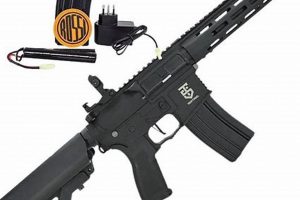
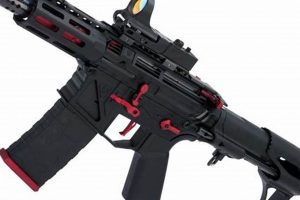
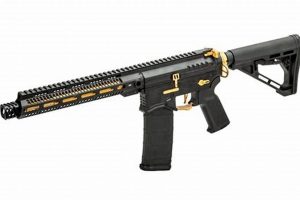
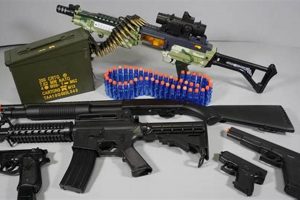
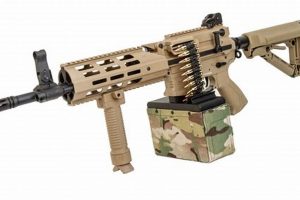
These are replica firearms that discharge spherical plastic projectiles, typically 6mm or 8mm in diameter. These devices are primarily utilized in recreational simulations of tactical scenarios and target shooting. The mechanism for propelling the projectiles varies, employing compressed gas (CO2 or green gas), electric motors (Automatic Electric Pistols or AEPs), or spring-powered systems. As an example, consider a model replicating a Beretta M9, used in mock military exercises.
Their significance lies in providing a safe and accessible means for individuals to engage in simulated combat and marksmanship training. The utilization of these devices offers an avenue for developing tactical skills, promoting teamwork, and enhancing physical fitness, all within a controlled environment. Historically, these items have evolved from simple spring-loaded toys to sophisticated, realistic replicas, mirroring the development of real firearms and tactical gear.
The following sections will delve into the various types, operation mechanisms, legal considerations, maintenance procedures, and safety protocols associated with these devices, offering a comprehensive understanding of their use and responsible ownership.
Essential Considerations for Airsoft Hand Guns
The responsible and effective use of these devices necessitates a thorough understanding of their operation, maintenance, and associated safety protocols. The following tips outline crucial aspects for maximizing performance and ensuring user safety.
Tip 1: Understand the Operating Mechanism. Familiarize yourself with the specific propulsion system of the device, whether it is gas-powered, electric, or spring-operated. This understanding is paramount for proper loading, maintenance, and troubleshooting. For instance, a gas-powered model requires awareness of optimal gas pressure and potential leakage points.
Tip 2: Prioritize Eye Protection. The consistent use of ANSI-rated Z87.1 eye protection is non-negotiable. Projectiles, even at low velocities, can cause serious eye injuries. Ensure the chosen eyewear provides a secure fit and full coverage. Examples include full-seal goggles or a combination of safety glasses and a lower face mask.
Tip 3: Adhere to Field Velocity Limits. Respect and abide by the designated velocity limits established by the airsoft field or organization. Exceeding these limits poses a significant safety risk to other participants. The velocity, measured in feet per second (FPS) with a standard weight BB, must be within acceptable parameters, typically determined by a chronograph.
Tip 4: Implement Proper Storage Procedures. When not in use, these should be stored unloaded, with the magazine removed, and in a secure location inaccessible to unauthorized individuals, particularly children. A locked case or gun safe is recommended for enhanced security.
Tip 5: Maintain Consistent Cleaning and Lubrication. Regular cleaning and lubrication are essential for optimal performance and longevity. Accumulated dirt and debris can impede the internal mechanisms. Use appropriate lubricants specifically designed for airsoft devices, avoiding petroleum-based products that can damage seals and other components.
Tip 6: Practice Responsible Handling. Treat these devices with the same respect and caution as real firearms. Never point them at anything one does not intend to shoot, and always keep the muzzle pointed in a safe direction. Developing safe handling habits minimizes the risk of accidental discharge and potential injury.
Tip 7: Respect Public Perception. Transport these devices in a manner that does not alarm or threaten the public. Use a carrying case or bag to conceal the device and avoid displaying it openly in public areas. Maintaining a low profile minimizes the potential for misunderstandings and unnecessary confrontations.
By adhering to these guidelines, users can enhance their enjoyment of the sport while mitigating risks and ensuring a safe and responsible experience for themselves and others.
The following sections will explore specific models and considerations for choosing the optimal airsoft hand gun for individual needs and playing styles.
1. Realism

The degree of realism in these devices significantly influences user experience, training applications, and overall appeal. The pursuit of accurate replication of real firearms drives design and manufacturing, impacting both aesthetic and functional aspects.
- External Appearance and Dimensions
The faithful reproduction of external features, including size, weight, and contours, is a primary factor contributing to realism. Dimensions closely mirroring those of real firearms allow for the utilization of compatible accessories, such as holsters and tactical attachments. Discrepancies in these areas can detract from the overall immersive experience.
- Operating Mechanisms and Controls
Realistic operation extends beyond appearance to encompass the functionality of controls, such as the trigger pull, magazine release, and slide operation. Some models feature blowback mechanisms that simulate the recoil action of a real firearm, enhancing the sense of authenticity. The presence of these features contributes to a more engaging and believable experience.
- Markings and Trademarks
The inclusion of accurate manufacturer markings, model designations, and warning labels enhances the realism of these replicas. Licensed models produced with authorization from real firearm manufacturers often feature identical markings, further blurring the lines between the replica and the original. The presence or absence of these details can significantly impact the perceived authenticity.
- Material Composition and Finish
The materials used in construction and their surface finishes contribute to the tactile and visual realism of these devices. Models constructed from metal alloys or high-density polymers can closely replicate the weight and feel of real firearms. Attention to detail in the finishing process, such as the application of realistic coatings and textures, further enhances the sense of authenticity.
The pursuit of realism in these devices extends beyond mere aesthetics, influencing the overall immersive experience and the utility of these items for training purposes. The extent to which a model accurately replicates the appearance, operation, and feel of a real firearm directly impacts its value for simulation, tactical training, and recreational use.
2. Propulsion Systems
The operational effectiveness of these devices is inextricably linked to their employed propulsion system. The chosen system directly dictates projectile velocity, rate of fire, operational costs, and maintenance requirements. The three primary propulsion methodsgas-powered, electric, and spring-poweredeach present distinct advantages and disadvantages, influencing suitability for different gameplay styles and environmental conditions. Gas-powered variants, utilizing compressed CO2 or green gas, often offer higher power and realistic blowback action, but require regular gas refills and are sensitive to temperature fluctuations. Electric models, employing battery-powered motors to drive a piston, provide consistent performance and higher rates of fire, but necessitate battery charging and can be heavier. Spring-powered types, relying on manual cocking before each shot, are the most affordable and require minimal maintenance, but offer lower power and limited firing rates. The selection of an appropriate system is paramount to maximizing performance and user satisfaction.
A practical illustration of the significance of propulsion systems can be observed in competitive scenarios. Players favoring rapid firing rates and consistent performance often opt for electric models, while those prioritizing realism and higher power output may choose gas-powered variants, acknowledging the trade-offs in maintenance and temperature sensitivity. Law enforcement and military entities also utilize realistic gas blowback models for training purposes. Conversely, spring-powered pistols, due to their simplicity and affordability, serve as entry-level options for beginners or as reliable backup devices. Understanding the cause-and-effect relationship between propulsion systems and performance attributes is crucial for informed purchasing decisions and effective utilization in diverse operational contexts.
In summary, the propulsion system represents a core component determining the functionality and overall utility of these replicas. Careful consideration of the specific attributes and limitations of each system is essential for aligning the choice of these devices with individual needs and operational requirements. Challenges remain in balancing realism, performance, and cost-effectiveness, but ongoing technological advancements continue to refine propulsion systems, enhancing the capabilities and versatility of these simulated firearms.
3. Ammunition Type

The selection of appropriate ammunition is a critical determinant of the performance, safety, and longevity of these devices. Utilizing incorrect or substandard projectiles can lead to malfunctions, damage to the device, and potential injury to users and bystanders.
- BB Material Composition
The vast majority of these use spherical plastic projectiles, commonly referred to as BBs. These are typically manufactured from ABS plastic or biodegradable PLA. The material composition affects the BB’s weight, density, and fragmentation properties upon impact. For example, using low-quality BBs with imperfections can damage the internal mechanisms, whereas biodegradable BBs are mandated in environmentally sensitive outdoor play areas.
- BB Weight and Caliber
BB weight, measured in grams, and caliber, typically 6mm or 8mm, directly influence the projectile’s trajectory, range, and impact force. Heavier BBs generally offer greater stability and resistance to wind, but may reduce muzzle velocity. A 6mm BB with a weight of 0.20g is a standard choice for general gameplay, while heavier weights like 0.25g or 0.28g are often preferred for enhanced accuracy at longer distances. Using the wrong caliber will result in the gun not functioning or being damaged.
- BB Quality and Tolerances
The quality of the BB, particularly its roundness and surface finish, is crucial for consistent performance. High-quality BBs are manufactured with tight tolerances to ensure uniform size and shape, minimizing friction within the barrel and maximizing accuracy. Lower-quality BBs often exhibit imperfections that can lead to jams, erratic trajectories, and potential damage to the internal components. For instance, polished BBs reduce friction inside the barrel.
- BB Color and Visibility
The color of the BB impacts its visibility in different lighting conditions and environments. White or light-colored BBs are generally easier to track in flight, while darker BBs offer greater concealment. Fluorescent or tracer BBs can be used with compatible tracer units to illuminate the projectiles, enhancing visibility in low-light or nighttime scenarios. For example, colored BBs allow a player to see where they were firing.
The interplay between these facets of ammunition type is fundamental to the safe and effective use of these devices. Choosing the correct BB weight, material, and quality ensures optimal performance, minimizes the risk of malfunctions, and promotes a positive and safe experience. This also helps avoid premature wear and tear on the internal components.
4. Safety Features

The integration of safety features within these devices is paramount, directly influencing the potential for injury and promoting responsible use. These features are engineered to mitigate risks associated with handling replica firearms, differentiating them from actual firearms in terms of lethality and intended application. The presence and functionality of these features serve as critical factors in ensuring user safety and compliance with legal regulations.
Examples of integrated safety features include trigger locks, designed to prevent unintentional discharge; blaze orange barrel tips, intended to clearly distinguish the device from a real firearm; and adjustable velocity controls, allowing users to regulate the projectile’s impact force. The cause and effect relationship is direct: the absence of a functional trigger lock increases the risk of accidental discharge, while a clearly visible orange tip reduces the likelihood of misidentification by law enforcement. These features are not merely cosmetic; they are essential components that minimize the potential for misuse and related harm. For instance, mandatory orange tips in many jurisdictions reduce the possibility of them being mistaken for real firearms.
The practical significance of understanding and utilizing these features extends beyond individual safety, impacting public perception and acceptance. Responsible handling, coupled with adherence to safety guidelines, fosters a positive image of the sport and reinforces the commitment to ethical and safe practices. Challenges persist in ensuring consistent implementation and enforcement of safety standards across all manufacturers and users. However, ongoing efforts to improve safety features and promote responsible use remain crucial for the long-term viability and acceptance of these recreational devices.
5. Legal compliance
Legal compliance represents a critical dimension in the ownership, use, and distribution of airsoft hand guns. Regulations governing these devices vary significantly across jurisdictions, encompassing factors such as marking requirements, permissible projectile velocity, age restrictions, and restrictions on public display. Non-adherence to these regulations can result in legal penalties, including fines, confiscation of the device, and potential criminal charges. The cause-and-effect relationship is clear: compliance fosters responsible ownership and reduces the risk of legal repercussions, while non-compliance carries tangible legal and social consequences. Compliance includes but is not limited to following age restrictions and marking requirements, such as orange tips to differentiate them from real firearms.
Practical applications of this understanding are evident in several areas. Retailers must ensure that their products meet all applicable legal standards before sale. Manufacturers must adhere to marking requirements and velocity limitations to avoid legal liability. Users must be aware of local ordinances regarding the transport and use of these devices in public spaces. For example, some municipalities prohibit the open carry of what might appear to be real firearms. The proper transfer of ownership, especially across state lines, often requires due diligence to ensure adherence to federal and state regulations. Ignoring these steps can lead to significant legal issues.
In summary, legal compliance is not merely an ancillary consideration but an intrinsic component of responsible airsoft hand gun ownership and use. Navigating the complex landscape of regulations requires diligent research and adherence to both the letter and spirit of the law. While challenges remain in harmonizing disparate legal standards across jurisdictions, the imperative for compliance underscores the commitment to safety, responsible conduct, and the avoidance of legal entanglements. The ongoing dialogue between manufacturers, users, and regulatory bodies is essential for fostering a clear and consistent framework for the legal and responsible use of airsoft devices.
6. Effective range

The effective range of these devices dictates their practical utility in simulated combat scenarios. This range, typically measured in feet, represents the distance at which a projectile can consistently and accurately strike a target with sufficient force to be registered in gameplay. Several factors influence this, including the propulsion system, projectile weight, barrel length, and hop-up system. A spring-powered model will inherently possess a shorter effective range compared to a gas-powered or electric variant due to differences in power output. For example, a typical spring-powered model might have an effective range of 50 feet, whereas a gas blowback pistol could reach 100 feet or more with proper tuning. The importance of this metric lies in its direct correlation with the ability to engage opponents effectively, influencing tactical decisions and gameplay strategies.
The practical application of understanding effective range extends to various aspects of airsoft. In close-quarters combat (CQB) environments, shorter effective ranges are often acceptable, prioritizing maneuverability and rate of fire. Conversely, in outdoor scenarios with larger playing fields, extended effective ranges become crucial for engaging opponents from a distance and maintaining a competitive advantage. Choosing a model with an appropriate effective range is, therefore, essential for optimizing performance in specific gameplay settings. Furthermore, factors such as wind and target size play significant roles. For instance, a slight breeze can significantly affect the trajectory of a BB at the edge of its effective range, reducing accuracy. Larger targets are, of course, easier to hit at a given range than smaller ones, thus requiring less precision.
In summary, the effective range is a primary consideration in selecting and utilizing these devices effectively. Understanding the factors that influence this metric, as well as its impact on gameplay, enables users to make informed decisions, optimize their equipment, and enhance their overall experience. Challenges remain in accurately assessing and comparing effective ranges across different models due to variations in testing methodologies and environmental conditions. However, recognizing its significance remains a cornerstone of responsible and effective participation in the sport. This can be an advantage to players who use it as a strategy to win.
Frequently Asked Questions
The following questions address common inquiries and misconceptions regarding these devices, their operation, and responsible use.
Question 1: What constitutes the primary difference between these devices and real firearms?
The fundamental distinction lies in their intended purpose and lethality. These devices are designed for recreational simulation and target shooting, utilizing low-energy projectiles that pose minimal risk of serious injury. Real firearms, conversely, are designed for lethal force and employ projectiles capable of causing significant harm or death. Visible markings such as blaze orange tips, are added as a visual identifier.
Question 2: What safety precautions are essential when handling these devices?
Critical safety precautions include always wearing ANSI-rated Z87.1 eye protection, treating the device as if it were a real firearm, never pointing the muzzle at anything one does not intend to shoot, keeping the finger off the trigger until ready to fire, and adhering to established field velocity limits. Safe handling minimizes the risk of accidental injury.
Question 3: What types of projectiles are appropriate for use in these devices?
The appropriate projectiles are spherical plastic BBs, typically 6mm or 8mm in diameter, manufactured from ABS plastic or biodegradable PLA. The weight of the BB should be selected based on the device’s specifications and the intended use, with 0.20g to 0.28g BBs being common choices. The use of metal BBs or other non-approved projectiles is strictly prohibited.
Question 4: What are the legal considerations surrounding the ownership and use of these devices?
Legal considerations vary significantly across jurisdictions. These may include age restrictions, marking requirements (e.g., orange tips), restrictions on public display, and regulations regarding permissible projectile velocity. Owners and users are responsible for understanding and complying with all applicable laws and regulations.
Question 5: How should these devices be properly stored when not in use?
Proper storage practices include unloading the device, removing the magazine, and storing it in a secure location inaccessible to unauthorized individuals, particularly children. A locked case or gun safe is recommended to prevent accidental use or theft.
Question 6: What maintenance procedures are necessary to ensure the optimal performance and longevity of these devices?
Regular maintenance procedures include cleaning the barrel and internal mechanisms, lubricating moving parts with appropriate airsoft-specific lubricants, and inspecting the device for any signs of wear or damage. Proper maintenance extends the lifespan of the device and ensures consistent performance.
These questions and answers serve as a foundation for responsible ownership and use. The information aims to promote safety and awareness within the airsoft community.
The following section will cover the customization and upgrade options for this replica.
Conclusion
This exploration of these devices has illuminated their functionality, applications, and the critical considerations surrounding their responsible use. From understanding propulsion systems and ammunition types to prioritizing safety features and legal compliance, the multifaceted nature of these items demands a comprehensive awareness on the part of users. The differentiation from real firearms, the necessity of stringent safety protocols, and the adherence to legal regulations remain paramount.
The continued evolution of airsoft technology and the growing popularity of the sport necessitate ongoing education and a commitment to ethical practices. A collective responsibility rests upon manufacturers, retailers, and users to ensure the safe and responsible enjoyment of these devices, fostering a culture of awareness and promoting the positive aspects of the sport within the broader community. The future of airsoft hinges on the sustained commitment to these principles.